Monthly Wrap-Up — September 2026
September rarely accepted the first answer.
A poem crossed into another language and changed on the way. Curiosity climbed, listened, questioned, and noticed exceptions. The body felt things before language could name them. Medicine reached for careful words instead of promises. Healing itself refused to move in a straight line.
Twenty-nine new pieces found their place on the Shelves.
And somewhere between the questions and the answers, September discovered that uncertainty is not always something language needs to eliminate.
Sometimes it is something language helps us navigate.
At the Edge of Certainty
September began with a poem crossing a border.
What survives when poetry changes language? What must be rebuilt? How closely should we read before interpretation becomes reduction? And after so much attention to expression, must everything within us be expressed at all?
Those questions opened a month unusually interested in the space between knowing and not knowing.
Curiosity followed.
Then illness.
Then recovery.
Again and again, certainty seemed to recede just far enough to make room for a better question.
The Month in Numbers
- 29 new published pieces
- 29 consecutive publishing days, from 2 to 30 September
- 4 Weekly Roundups
- 4 More Than Words journeys
- 2 Ravens’ Dispatches
- 8 new fables, fábulas, maxims, and short stories
- 1 Retrieved Field Log
- 2 new poetry readings
- A new recurring wandering format in More Than Words
- Major new paths and experiences across The Chronicle, Worth Noting!, Poetry Nook, Spanish Nook, Stories Nook, The Illustrated Calendar Gallery, and other corners of the Nook
September Highlights
⭐ Best On Language
Something can be felt long before the right word arrives.
A heaviness becomes tired. Unease becomes anxiety. Discomfort becomes pain, then perhaps symptom, condition, or diagnosis.
But the piece asks something more difficult: when language finally gives an experience a name, has it merely described what was already there—or has the name changed the experience itself?
⭐ Best Short Story
The Man Who Came Down from the Mountain
For twenty years, a former samurai has lived apart from the changing world with only his ageing Kiso horse for company.
Then a young traveller falls dangerously ill.
What begins as a descent in search of a doctor becomes something larger: an act of care, a return to human company, and an encounter between a man who withdrew from history and a world that did not stop moving without him.
⭐ Best Fable
A thrush injures his wing just before migration and is forced to remain behind.
At first, the ground feels like everything he has lost.
But winter teaches him another way to live: shelter, patience, attention, adaptation—and eventually the discovery that remaining is not always the opposite of moving forward.
⭐ Best More Than Words
More Than Words: The Shape of Healing
Recovery is easy to imagine as a return.
This piece questioned that shape.
Healing may mean restoring what was lost, but it can also mean adaptation, palliation, rehabilitation, patience, or learning how to continue when the old road is no longer available.
⭐ Best Reading
Illness changes more than the body.
Through Tolstoy, Woolf, Gilman, Mann, O. Henry, and others, the reading moved inside sickness itself—where rooms become worlds, time changes weight, dependence becomes visible, and small gestures can suddenly become enormous.
⭐ Surprise Pick
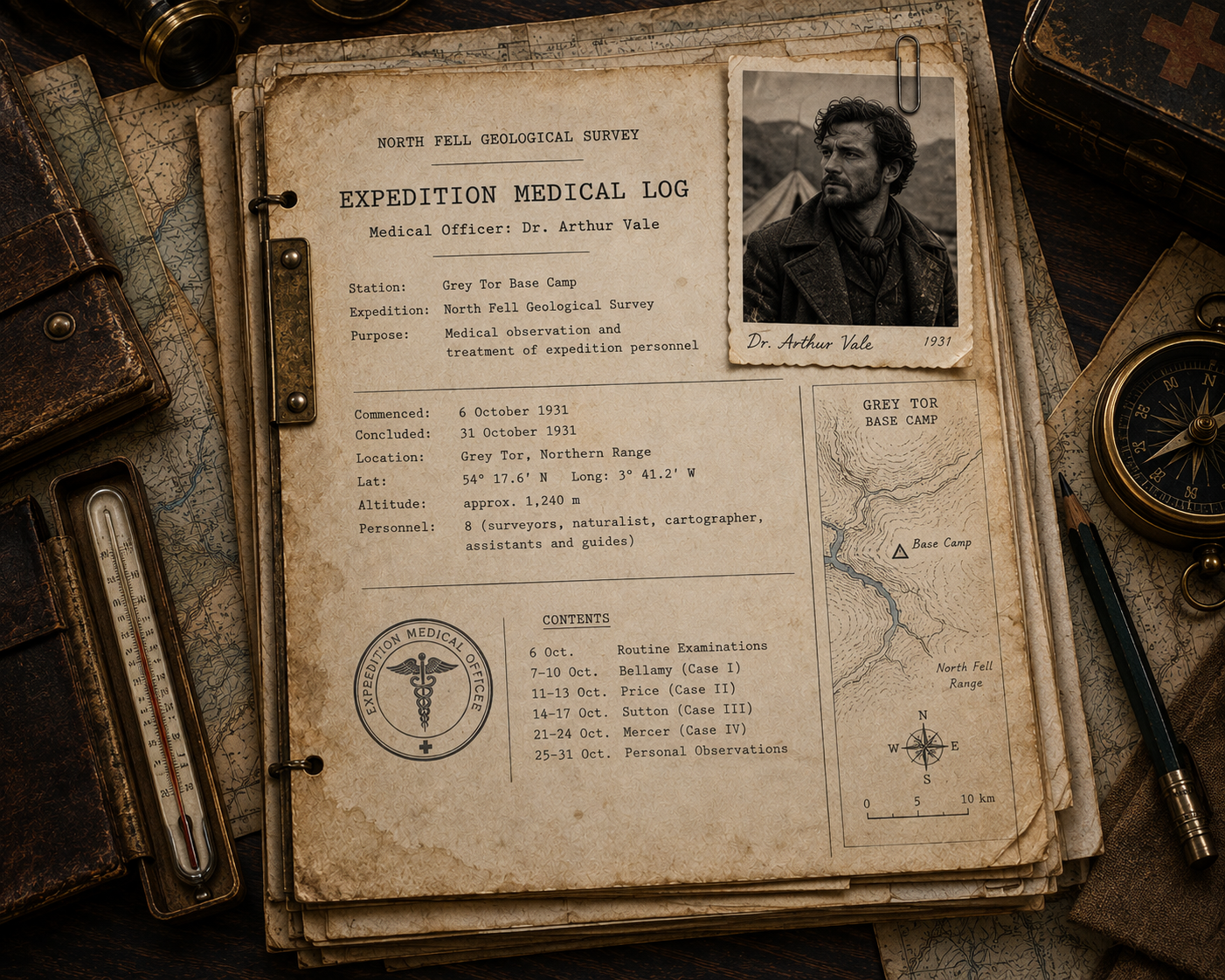
Another Field Log was found…
Care to find out what it holds?
What We Explored This Month
September opened with language refusing to stay still.
What Happens to a Poem When It Changes Language? followed poetry across translation, where meaning must travel alongside sound, rhythm, ambiguity, form, and cultural memory.
Then, for the first time, the Portal refused to stay where it was put.
More Than Words: The Portal Wanders introduced a new recurring kind of journey: one with no obligation to prove that every door belongs to the same corridor. Jewett led to O’Casey, Tolkien to the Grimms, Wheatley to Austen, Baudelaire to Radcliffe—and from History Nook the wandering continued into Word Nook.
Sometimes an archive needs a theme.
Sometimes it needs permission to wander.
How to Read a Poem Without Killing It then asked readers to notice before solving, and Must Everything Within Us Be Said? turned towards the other boundary of expression: the possibility that silence, privacy, and what remains unwritten may carry meaning too.
The next path began with a question.
Is Curiosity a Force or an Impulse? asked what actually keeps us looking once something has disturbed the familiar. In El zorro y los oyentes distraídos, hearing proved very different from listening. The Red Panda and the Height sent curiosity climbing after a destination that mattered considerably less than everything learned along the way.
More Than Words: What Curiosity Leaves Behind gathered those traces, before The Shepherd of Sleeping Keys offered an old ritual that worked long before anyone could explain why.
And then came The Pump at Bell Street.
Everyone had an explanation for the sickness.
Dr. Jon Snoew had a question.
By following the exceptions rather than the accepted answer, curiosity became observation—and health entered the month through investigation, evidence, and public health.
From there, September moved closer to the body itself, and to the language we use when something feels wrong.
Before It Has a Name began with sensation before definition. La ardilla y las siete medicinas surrounded a coughing squirrel with remedies before anyone stopped to ask what was actually wrong.
More Than Words: When Health Becomes Language followed the path from feelings and symptoms towards diagnosis, prognosis, urgency, and care, while When Anxiety Silences the Words You Know looked at a different kind of difficulty: knowing the language, yet temporarily being unable to reach it when pressure arrives.
Then the former samurai came down from his mountain because another person needed help.
By the following week, the question was no longer simply what illness is.
It was what happens afterwards.
Illness in Literature entered the altered world sickness creates. The Thrush and the Ground found adaptation where flight had temporarily failed. Why Doctors Say “Might” explored why may, might, could, likely, and possible can be marks of precision rather than weakness.
The Shape of Healing brought those paths together.
Then El perezoso y el castor reminded us that what restores one creature may not restore another, while Sanity followed sanus and sanitas back towards an older idea of health: something sound, whole, and as it ought to be.
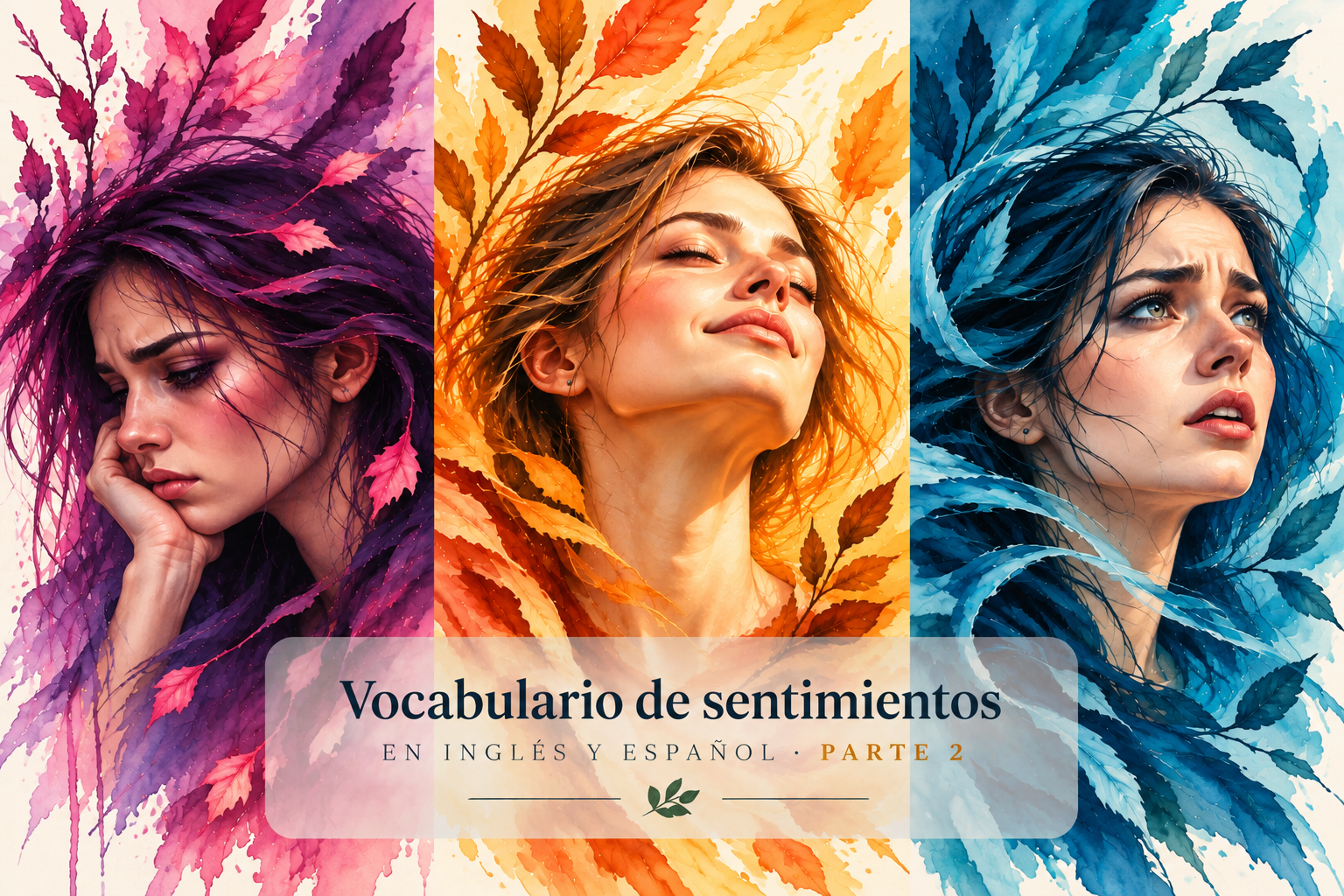
September ended by finding still more precise language for feeling in Vocabulario de sentimientos en inglés y español — Parte 2.
Then another Field Log surfaced.
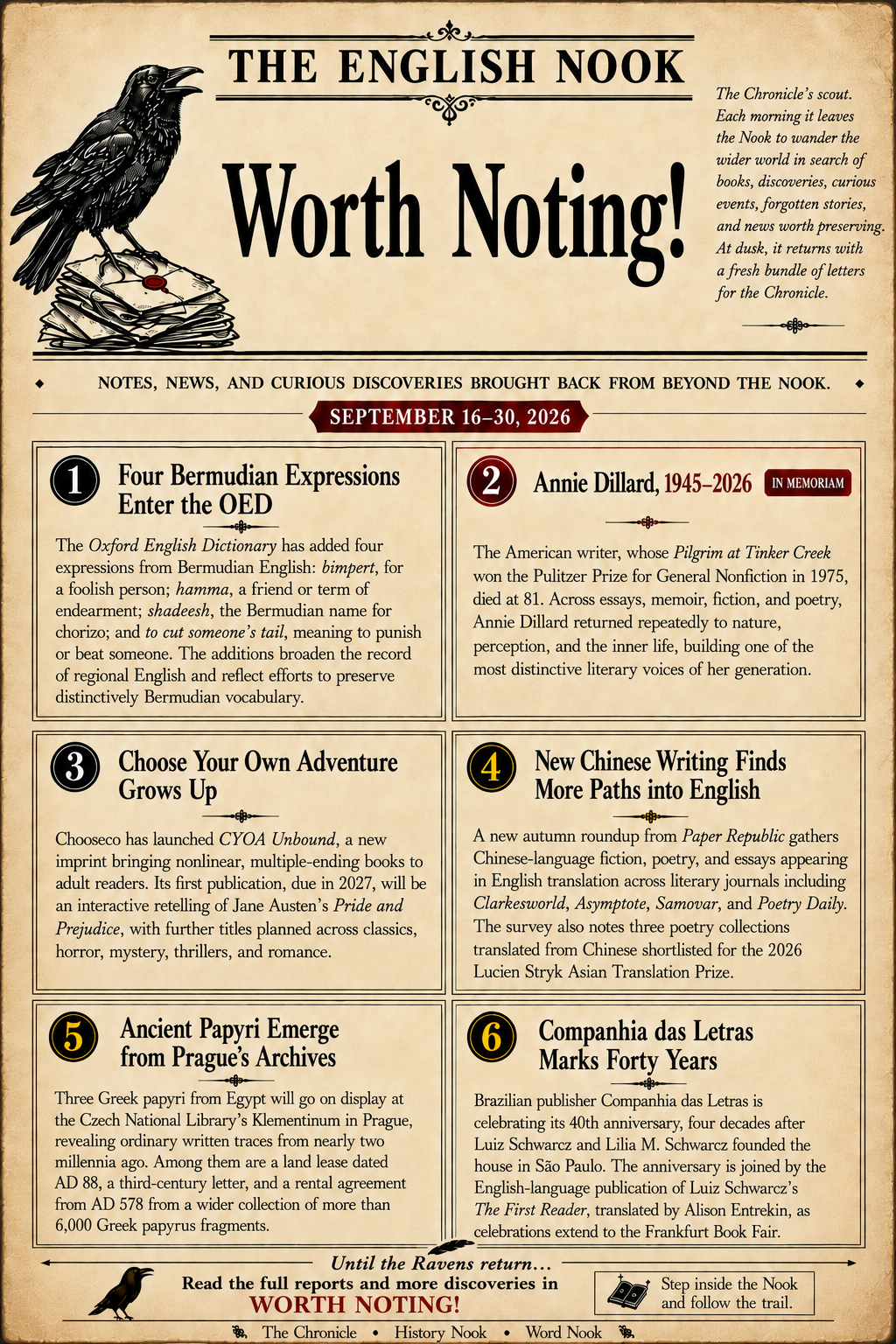
And on the final night of the month, the ravens returned with another bundle from beyond the Nook.
Explore the Nook
September changed more than the reading list.
Several parts of the Nook gained richer structures, clearer identities, and new ways for readers to wander through them.
- The Nook’s Chronicle underwent one of its largest transformations yet. Its visual identity grew stronger, its different forms became easier to discover, and Worth Noting! developed into a much richer news experience: English-Linked and International paths, a Quick Index spanning literature, translation, prizes, publishing, poetry, language, libraries and more, expandable stories, and a new way to step beyond the compact Chronicle card and read the full news. Fresh discoveries can also travel beyond the Chronicle through Latest News, arriving directly on readers’ screens elsewhere in the Nook. The work continued throughout September and has now reached its fullest reader-facing form as October opens.
- The Illustrated Calendar Gallery elevated the old Calendar Nook into something far more explorable. Calendars now gather into visual collections—Voices, Herbarium, Visions, Woodland Residents, and more—so choosing a calendar feels less like downloading a file and more like wandering through a small gallery.
- Poetry Nook received the home it had been growing towards. Its readings now gather by idea rather than simply by date: sound and form, voice and speaker, poetry and language, poetry becoming story, and other paths through the archive. Chronology still exists—but quietly, on its own shelf.
- Spanish Nook found a fuller structure and identity of its own, with clearer routes through Start Here, Everyday Spanish, Grammar & Structure, Speaking & Expression, Practical Spanish, Roots & Many Voices, and Stories & Fables.
- Stories Nook also began taking proper shape as a space of its own, bringing short stories, fables, maxims, and stranger narrative forms into a more deliberate reading experience without flattening the differences between them.
- English Language History began moving towards a Nook of its own, with paths forming around printing, the Great Vowel Shift, the King James Bible, inkhorn terms, and the changes that helped make Early Modern English what it became.
- The Quiet Shelf continued evolving as one of the Nook’s quieter entrances, with its reader-facing tab becoming a more deliberate doorway into stories and its reading controls and language paths continuing to grow.
- And a small Subscribe drawer appeared at the edge of the Nook, asking readers—with appropriate solemnity—whether they would like to join “most certainly” or “right away.”
Some changes opened whole rooms.
Others simply made an existing doorway more inviting.
Both matter.
From the Archives
- Why Must the Inner World Be Heard?
- The Apothecary’s Measure
- The Bear and the Puddle
- Before Poetry Was Read, It Was Heard
September’s questions did not appear from nowhere.
Older pieces had already been asking what happens when the inner world seeks language, what care chooses to protect first, what stillness reveals when disturbance stops, and how words once lived in breath before they lived on the page.
The archive rarely repeats itself exactly.
But it remembers where the paths began.
Closing Reflection
Perhaps certainty asks more of language than language was ever meant to give.
We want the right word to settle the feeling.
The right explanation to end the question.
The right diagnosis to make the body understandable.
The right treatment to promise a return.
But careful language often does something less dramatic—and more useful.
It gives uncertainty edges.
A name does not contain an entire experience, but it may give us somewhere to begin.
A question does not guarantee an answer, but it can change what we notice.
Might does not offer the comfort of certainty, but sometimes it tells the truth more precisely.
Healing does not always return us to an earlier version of ourselves, but it can still give us another way forward.
Perhaps understanding is not the moment every uncertainty disappears.
Perhaps it is the moment we can finally see where the uncertainty lies—and know how to continue beside it.
Good tidings found us this month.
Better ones await.
See you in a month.