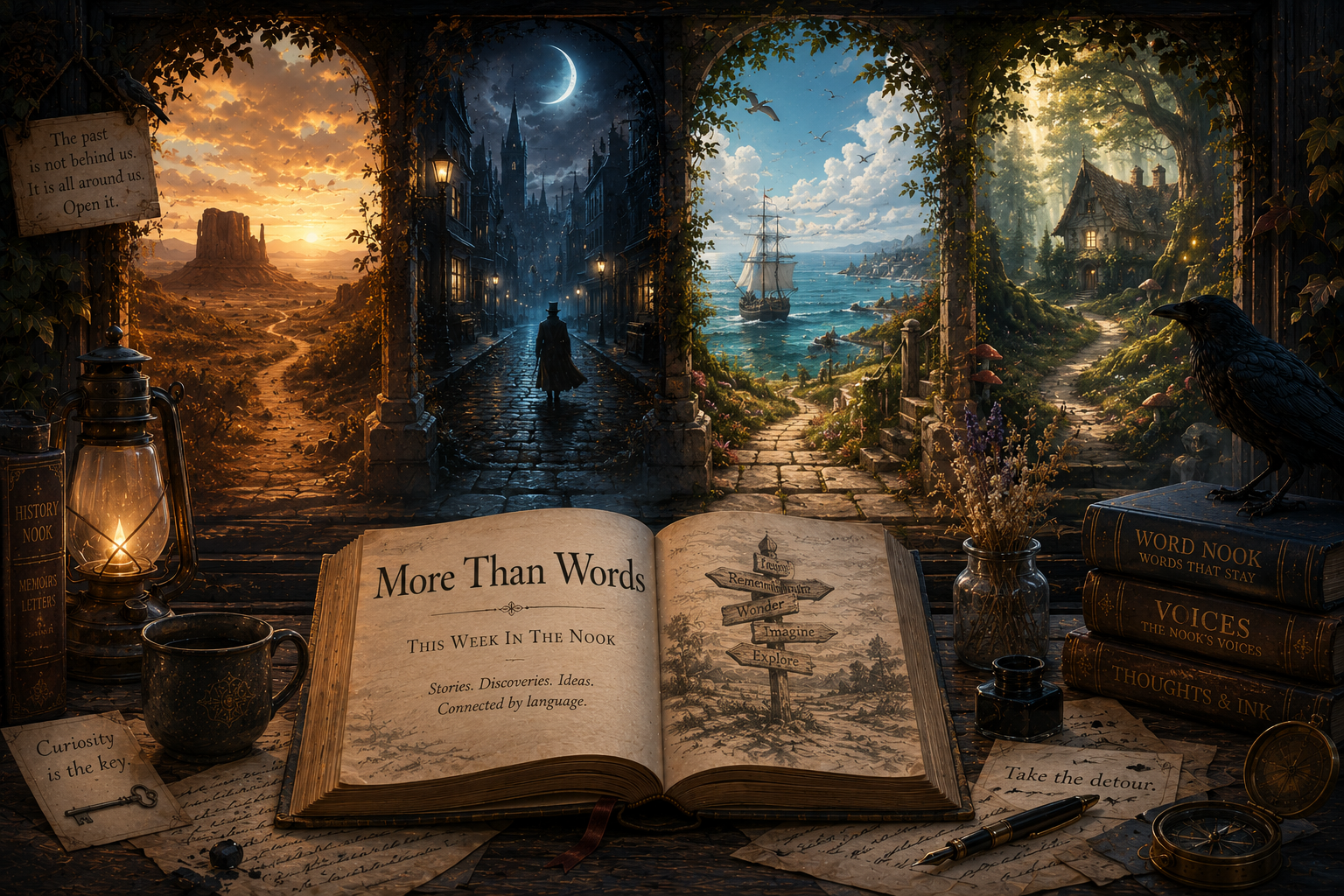

The Portal Wanders
Four doors. No map. A few old paths worth taking again.
Some weeks arrive already knowing what they are about.
This one did not.
History Nook moved from Charles Baudelaire and his dark modernity, to Phillis Wheatley forcing English letters to recognise her authorship, to J. R. R. Tolkien leaving behind languages and myths that continued growing after him—and today, to Sarah Orne Jewett, whose fiction listened closely to the particular places and voices of New England. Baudelaire made beauty uncomfortable; Wheatley made recognition unavoidable; Tolkien made imagined worlds feel inherited; Jewett made the local worth attending to.
Four consecutive days.
Four very different doors.
So perhaps, for once, we should resist making them behave.
🐦⬛ Fetched from the Archive
More Than Words usually gathers around an idea.
Today, the Portal gets to wander.
Each of this week’s doors points somewhere older—not necessarily toward the obvious companion, but toward another place in the archive where something begins to echo.
Follow whichever path catches your eye.
The Literature of Somewhere
Sarah Orne Jewett reminds us that literature does not need to escape the local in order to become large. A coast, a village, a particular cadence of speech: sometimes specificity is precisely what allows a place to become real enough for everyone else to enter.
▸ Seán O’Casey — The Playwright Who Brought Dublin Speech to the Stage
O’Casey found another kind of literary authority in another very particular place. Working-class Dublin speech did not need polishing into supposedly better English before it belonged onstage.
Two different worlds, joined by the same quiet conviction:
somewhere is already enough.
The Stories Beneath the Stories
Tolkien built forward by looking backward. Languages carried histories; names suggested older names beneath them; myths seemed to remember things the reader had never been told.
That instinct has ancestors.
▸ Publication of Grimms’ Fairy Tales — The Book That Gave English Its Mythic Grammar
The Grimms gathered stories that had travelled orally before becoming books, and those tales then travelled again—through translation, childhood, fantasy, adaptation, and writers who inherited their archetypes.
Tolkien built a mythology.
The Grimms remind us that no mythology begins entirely alone.
When a Voice Acquires a Name
Phillis Wheatley’s book had to arrive accompanied by proof that she had written it. Her authorship entered print under conditions no writer should have had to satisfy.
A very different story waits elsewhere in the archive.
▸ Jane Austen — The Day the Voice Outlived the Woman
Austen published anonymously. Only after her death did the public woman begin to emerge clearly from behind the novels.
The circumstances cannot be equated.
But placed beside one another, the two stories ask an unsettling literary question:
What has to happen before a woman’s voice is allowed to carry her own name?
The Uses of Darkness
Baudelaire made beauty share a room with decay, dread, desire, crowds, corruption, and modern unease. Darkness was not something poetry had to overcome. It became material.
▸ Ann Radcliffe — Pioneer of Gothic Fiction and Architect of English Literary Atmosphere
Radcliffe had already discovered another use for darkness: suggestion rather than spectacle, terror shaped through landscape, silence, uncertainty, and anticipation.
Different genres. Different centuries.
Yet both understood that darkness becomes most interesting when literature does more with it than simply turn out the light.
🌾 The Portal Wanders into Word Nook
The wandering does not end in History Nook.
Following the same eight encounters into Word Nook, the Portal finds that each figure leaves something else behind—not another article, but a pair of words that seems to have been waiting for them.
Sarah Orne Jewett leaves Curiosity and Hush on the table: the first for the extraordinary attention she gave to lives most literature might have walked past, the second for the quiet in which those lives become audible. Her Maine does not need to shout to become a world.
Seán O’Casey is louder. Theatre and Language come back with him, because Dublin does not merely provide his setting—it argues, jokes, curses, survives, and walks onto the stage speaking in its own voice.
This week commemorated Tolkien’s death, and two words hardly need choosing: Adventure and Fellowship. He gave the first roads worth disappearing down, but perhaps the second is the greater inheritance—the stubborn idea that even the smallest traveller may go farther because somebody chose to walk beside him.
The Brothers Grimm bring back Memory and Wit. Their tales survived because people remembered them, certainly—but survival in a fairy tale also tends to belong to the creature clever enough to notice the loophole, answer the riddle, or outthink whatever is waiting in the woods.
Phillis Wheatley leaves us Creation and Responsibility. One belongs to the astonishing fact of the poems themselves; the other to everyone forced to confront what those poems made impossible to deny. A voice entered print, and the world around it suddenly had something to answer for.
With Jane Austen, it could hardly be anything but Irony and Discernment. She understood how much can hide inside good manners—and how entertaining it becomes when one person in the room sees perfectly well what everybody else is pretending not to notice.
Baudelaire carries Shade and Undercurrent. The beautiful thing is never entirely clean; the modern street never entirely innocent. Something darker keeps moving beneath the surface, and instead of turning away from it, he asks poetry to look harder.
And somewhere down Radcliffe’s corridor we find Veil and Portent. She knew that the half-seen door, the distant sound, the landscape withholding its answer can trouble us far more effectively than the monster dragged fully into the light.
Sixteen words.
Eight encounters.
Not a taxonomy. Not a lesson.
Just what Word Nook happened to bring home after wandering through them.
Where the Portal Goes
An archive does not always need to prove that everything belongs together.
Sometimes its pleasure lies in discovering that one thing leads somewhere we did not expect.
A writer from Maine leads to a Dublin stage.
Tolkien leads backward into old tales.
Wheatley finds an unexpected conversation with Austen.
Baudelaire walks into a Gothic corridor and finds Radcliffe already there.
No map required.
This week, the Portal simply wandered.
And perhaps that is what archives are for—not only remembering where we have been, but giving curiosity somewhere unexpected to go next.
Until the next path opens,
take the interesting detour.