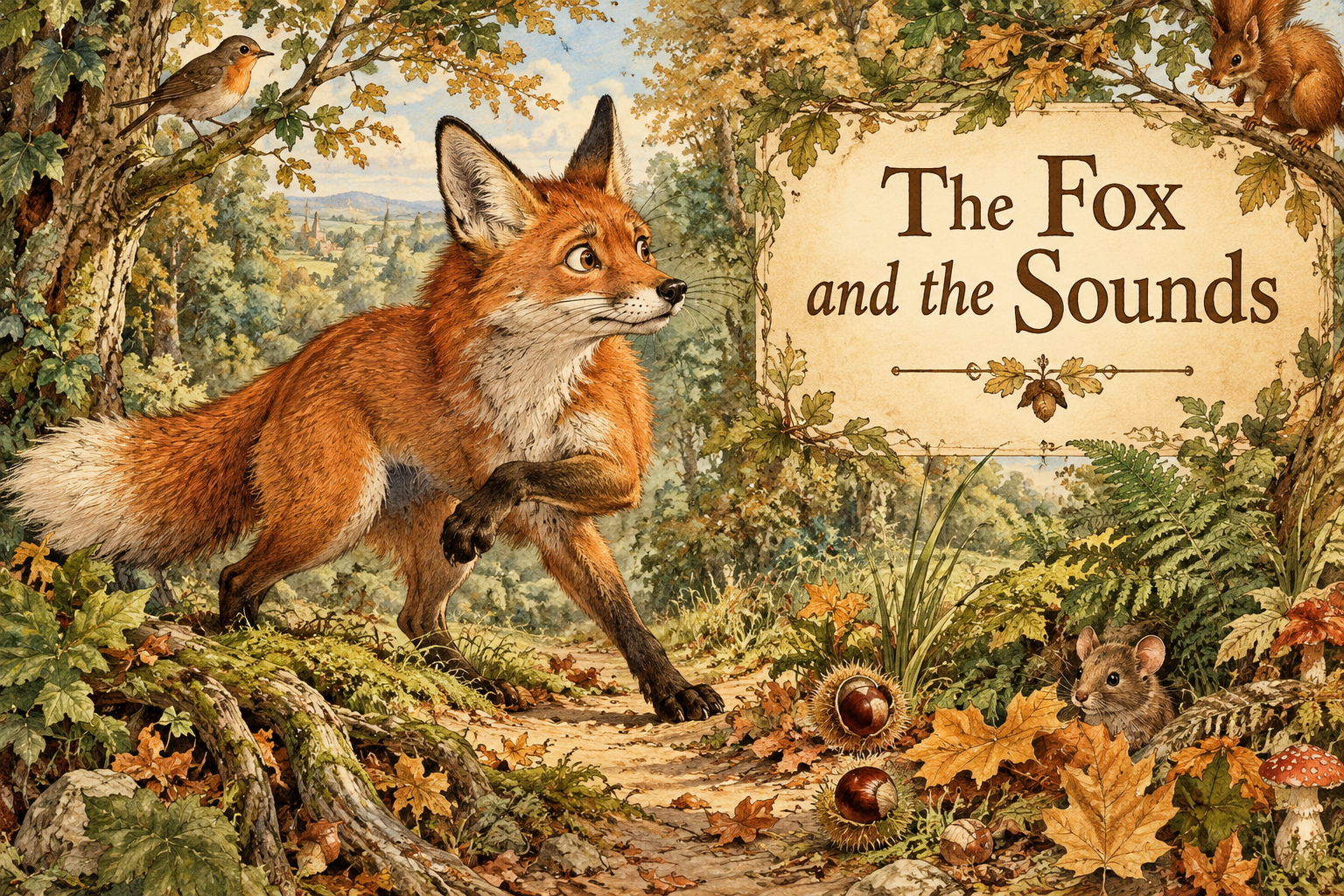
Why Do Fables Still Work?
On animals, brevity, and the strange power of being told the truth indirectly
Some stories give us enough room to disappear inside them. A fable does almost the opposite. There may be a fox beneath a tree, a snail on a path, a bear beside a puddle, or a bird trying desperately to be heard. The setting can be described in a sentence, the characters may have no past beyond what the story needs, and before we have properly settled into their world, someone has already wanted something, made a mistake, revealed a weakness, or discovered a truth.
Then the story ends, and somehow we are still thinking about it.
That is the peculiar achievement of the fable. It is one of the smallest forms of storytelling, yet it repeatedly manages to carry ideas much larger than itself. Part of its strength comes from the fact that it rarely confronts us directly. Instead, it allows an animal to do that first.
A Mirror That Does Not Look Like One
Imagine being told that you are vain, that you envy what other people possess, that you refuse to listen, or that you sometimes mistake stubbornness for strength. Even when the accusation is deserved, our first instinct may be resistance. Place the same weakness inside a fox, a crow, a tortoise, a mouse, or some entirely invented woodland creature, however, and something changes.
We watch the creature behave. We judge its choices. We understand perfectly well what it is doing wrong, and only afterwards does the uncomfortable possibility appear that perhaps we have done something similar ourselves.
The fable creates a small distance between the reader and the truth it wants to examine. That distance is not an escape from meaning; very often, it is what allows the meaning to reach us. A boastful fox is easier to observe than our own pride. A frightened mouse is easier to forgive than our own fear. A creature clinging desperately to something it cannot keep may become recognisable before we realise exactly what we have recognised.
The mirror is still there. It simply has fur, feathers, claws, or a shell.
Why Animals?
Animals in fables rarely behave like real animals. They argue, bargain, scheme, boast, worry about reputation, become jealous of one another, seek power, make promises, and break them. They are animals carrying very human burdens.
This also allows a fable to move with extraordinary speed. A fox enters the story and we are immediately alert to cunning. A lion suggests power. A snail suggests slowness. A bird may evoke freedom, song, restlessness, or vanity. The story does not need several pages of character development because the animal often arrives already carrying a set of associations.
Yet the best fables do not simply repeat those associations. They play with them. The slow creature may understand something the fast creature misses. The apparently weak animal may possess greater courage. The creature traditionally associated with cleverness may become trapped by its own cleverness. Familiarity gives the story a starting point, but what the fable does with that familiarity gives it life.
The Strength of Having Almost No Space
A fable cannot hide behind abundance. There is little room for long explanations, complicated histories, or unnecessary characters. Something has to happen, and it has to matter. That limitation creates pressure: one desire becomes important, one choice becomes decisive, and one image may carry the weight that several paragraphs would carry elsewhere.
A bell rings. An acorn is held too tightly. A puddle becomes still. A throne turns out not to be a throne at all.
The smaller the story becomes, the more carefully each part has to work. This is why brevity in a fable is not simply the absence of length. It is concentration. The story removes almost everything except the movement necessary to reveal its idea, and because there is so little surrounding it, the decisive moment becomes difficult to forget.
The Truth Arrives Sideways
Fables are often associated with morals, but the most memorable ones are rarely powerful merely because a sentence at the end tells us what to think. The story has usually done the real work already. We have watched the character choose, seen what followed, and by the time the lesson appears — whether explicitly stated or quietly implied — we have already experienced its shape.
That distinction matters. Advice can be ignored. An argument can be challenged. A lecture invites us to decide whether we agree with the person giving it. A story behaves differently because it asks us first to witness something.
Instead of saying that greed can leave us with less, a fable can show someone reaching for more and losing what was already in their hands. Instead of saying that patience allows us to see clearly, it can disturb the water until the reflection disappears. Instead of warning us abstractly about envy, it can let one small creature desire the burden carried by another.
The truth arrives sideways. Nothing has to point at the reader, and the path is left open enough for the reader to walk into the meaning alone.
And Then the Fable Stops
Longer stories can show what happens next. A fable often refuses. The animal learns something — or fails to learn it — and the curtain falls almost immediately. We may never discover whether the fox became wiser the following morning or whether the proud bird changed its behaviour a week later. The bear eventually walks away. The snail continues down the path.
That unfinished space belongs to us.
A fable gives us the situation, but the reader often supplies the continuation. Would I have done differently? Have I ever behaved like that? What would happen if the character repeated the mistake? What happens when I repeat it?
In that sense, the story can become larger after it ends because its final destination was never really the woodland, the farmyard, the forest, or the roadside. It was the person reading.
Small Enough to Remember
There is another reason fables remain so persistent: they are easy to carry. Not necessarily word for word, and not even character for character, but we remember their shapes. We remember the creature that wanted too much, the one that laughed too soon, the one that mistook admiration for affection, or the one that discovered the value of something only after losing it.
Years later, the details may blur while the pattern remains.
That is one of storytelling’s oldest strengths: an idea becomes easier to remember once it has been given a body. Pride grows feathers. Greed develops paws. Patience sits beside a puddle. Wisdom begins walking very slowly. An abstraction becomes something we can see, and what we can see, we can often carry.
The Animal Is Never Only the Animal
Perhaps this is why the fable has never really belonged only to children. Its surface may be simple, its characters playful, and its world small enough to fit inside a few paragraphs, but simplicity of form does not require simplicity of thought.
A child may read about a foolish animal and understand the consequence. An adult may return to the same kind of story and recognise self-deception, compromise, power, fear, envy, memory, or regret. The words have not necessarily become more complicated; the reader has.
And so the fable changes because we bring more of ourselves to it.
That may be its quiet secret. A fable does not need to know exactly who will read it. It creates a small enough space for many different readers to enter and leaves enough unsaid for each of them to recognise something different.
Why Do Fables Still Work?
They work because they rarely begin by telling us that we are wrong. They let someone else be wrong first. We watch a creature make a choice, smile at its foolishness, understand its desire, pity its mistake, or recognise the consequence long before the creature does. Somewhere in that small distance between the animal and ourselves, recognition becomes possible.
Perhaps the fable survives because it never asks us to admit that the animal is us. It simply tells the story. The fox walks away, the bird stops singing, the snail continues down the path, and if the fable has done its work, something human follows them out of the story.
Continue Exploring
→ Ars Brevis — Where Little Great Things Have Gathered
→ Fables in Spanish — Small Stories, Lasting Lessons
→ Prose’s Voice