Fables in Spanish
Small Stories, Lasting Lessons
Some stories require entire worlds. Others need only an animal, a choice, and a consequence.
A fox approaches a throne. A squirrel guards an acorn. A nightingale sings beside a bell. Within a few paragraphs, something recognisably human begins to unfold.
This is the peculiar strength of the fable.
Fables are among the oldest and most enduring forms of storytelling. They cross borders easily, survive translation, and return in new shapes from one generation to the next. Their characters may be animals, plants, objects, or forces of nature, but the questions they ask belong unmistakably to us.
What do we value?
What do we fear?
What happens when pride speaks louder than wisdom?
And what must we sometimes release before anything new can grow?
What Is a Fable?
A fable is a brief narrative, written in prose or verse, that uses a simple situation to reveal something about human behaviour.
Its characters are often animals given recognisable human qualities. The fox may be cunning, the lion proud, the ant industrious, or the owl observant. These qualities allow the reader to recognise familiar weaknesses and virtues without the story having to name a particular person.
The result is a kind of mirror held at a comfortable distance.
We may laugh at the boastful animal before realising that we have behaved in much the same way. We may judge a foolish decision, only to recognise the same temptation in ourselves.
Many fables end with an explicit moral: a short sentence explaining the lesson. Others leave the meaning unstated, allowing the reader to discover it through the character’s choices and their consequences.
The moral, however, is not the only thing that matters.
A good fable does not merely tell us what to think. It gives us a small situation worth thinking about.
Why Fables Endure
Fables survive because they are simple without necessarily being shallow.
Their worlds are usually small. There may be only two characters, one disagreement, and a single decisive moment. Yet within that limited space, a fable can examine pride, greed, generosity, patience, vanity, fear, power, or self-deception.
The animals make the stories memorable, but they also make them flexible.
A tale about a vain bird can belong to ancient Greece, eighteenth-century Spain, modern Latin America, or a woodland imagined today. The setting changes, but vanity remains recognisable. So do courage, envy, kindness, and the desire to be admired.
This is why fables travel so naturally between languages.
They do not depend entirely on one period or one place. Their central conflicts are carried by actions, symbols, and consequences that readers can understand across cultures.
The Fable in the Spanish-Speaking World
The Spanish-language fable belongs to a much wider tradition that includes ancient stories attributed to Aesop and later European writers such as Jean de La Fontaine.
Spanish authors did not simply preserve that tradition. They reshaped it.
Some adapted familiar tales into Castilian verse. Others used the fable to criticise literary vanity, teach younger readers, question social behaviour, or replace the reassuring moral with something sharper and more ironic.
Across Spain and Latin America, the form moved from the classroom into satire, children’s literature, poetry, and modern experimental prose.
The Voices Behind the Fables
Félix María de Samaniego
In eighteenth-century Spain, Félix María de Samaniego became one of the most recognisable voices associated with the fable.
His Fábulas en verso castellano brought older stories into clear and memorable Spanish verse. Written partly with education in mind, they drew upon earlier fabulists while giving the tales a distinct place within Spanish literature.
Among the works associated with Samaniego are El congreso de los ratones, La zorra y las uvas, and La gallina de los huevos de oro.
His fables helped generations of readers encounter moral questions through rhythm, humour, animals, and consequence.
Tomás de Iriarte
Tomás de Iriarte took the form in a more openly literary direction.
Published in 1782, his Fábulas literarias frequently examined writers, critics, artistic rules, and intellectual pretension. Rather than using animals only to teach broad lessons about honesty or effort, Iriarte used them to expose weaknesses within the literary world itself.
In El burro flautista, a donkey produces music accidentally and mistakes chance for talent. In Los dos conejos, an argument over an insignificant detail distracts the characters from a much more immediate danger.
The animals are amusing. The criticism behind them is considerably sharper.
Rafael Pombo
In nineteenth-century Colombia, Rafael Pombo became deeply associated with children’s verse and moral storytelling.
Works such as El renacuajo paseador have remained part of Colombian cultural memory for generations. Through rhythm, repetition, humour, and unforgettable characters, Pombo created stories that could entertain children while still carrying warnings about disobedience, pride, carelessness, and consequence.
His work stands near the border between fable, moral tale, and narrative poetry.
That border is important. Literary forms rarely remain neatly contained, especially once they enter popular memory.
Augusto Monterroso
In the twentieth century, Augusto Monterroso showed that the fable had not exhausted its possibilities.
His collection La oveja negra y demás fábulas brought the form into modern, ironic prose. The animals remained, but the lessons became less comforting. Authority, conformity, ambition, reputation, and hypocrisy appeared under examination.
In Monterroso’s hands, the reader cannot always stand safely outside the story and judge its characters.
Sometimes the moral appears to turn around and judge the reader.
Why Read Fables in Spanish?
For someone learning Spanish, a fable offers an unusual balance: the story is manageable, but its meaning is not necessarily simplistic.
The reader can follow concrete actions:
An animal arrives.
Another animal speaks.
Someone wants something.
A decision is made.
Something changes.
This clear movement makes the narrative easier to follow, even when every word is not immediately familiar.
Fables also introduce language through context. Words related to emotions, movement, nature, conflict, and character appear as parts of a story rather than as isolated items in a vocabulary list.
The reader is not merely memorising that orgulloso means “proud” or that engañar means “to deceive.” The reader sees pride or deception producing a consequence.
That connection makes language more memorable.
Fables also invite rereading. The first reading may be used to understand what happened. The second can focus on unfamiliar expressions. A later reading may reveal a meaning that was not obvious before.
The language becomes clearer while the story becomes deeper.
Spanish Fables in the Nook
The Spanish fables of The English Nook belong to this living tradition.
They are not translations of older works, nor are they attempts to reproduce the voice of one particular fabulist. Each begins with a small encounter and allows its meaning to emerge through action, image, and consequence.
El ruiseñor y la campana
A nightingale and a bell meet in a story about voice, recognition, and the difference between making a sound and truly being heard.
La ardilla y la bellota
A squirrel holds tightly to an acorn and discovers that some things can fulfil their purpose only after we allow them to leave our hands.
El zorro y el trono
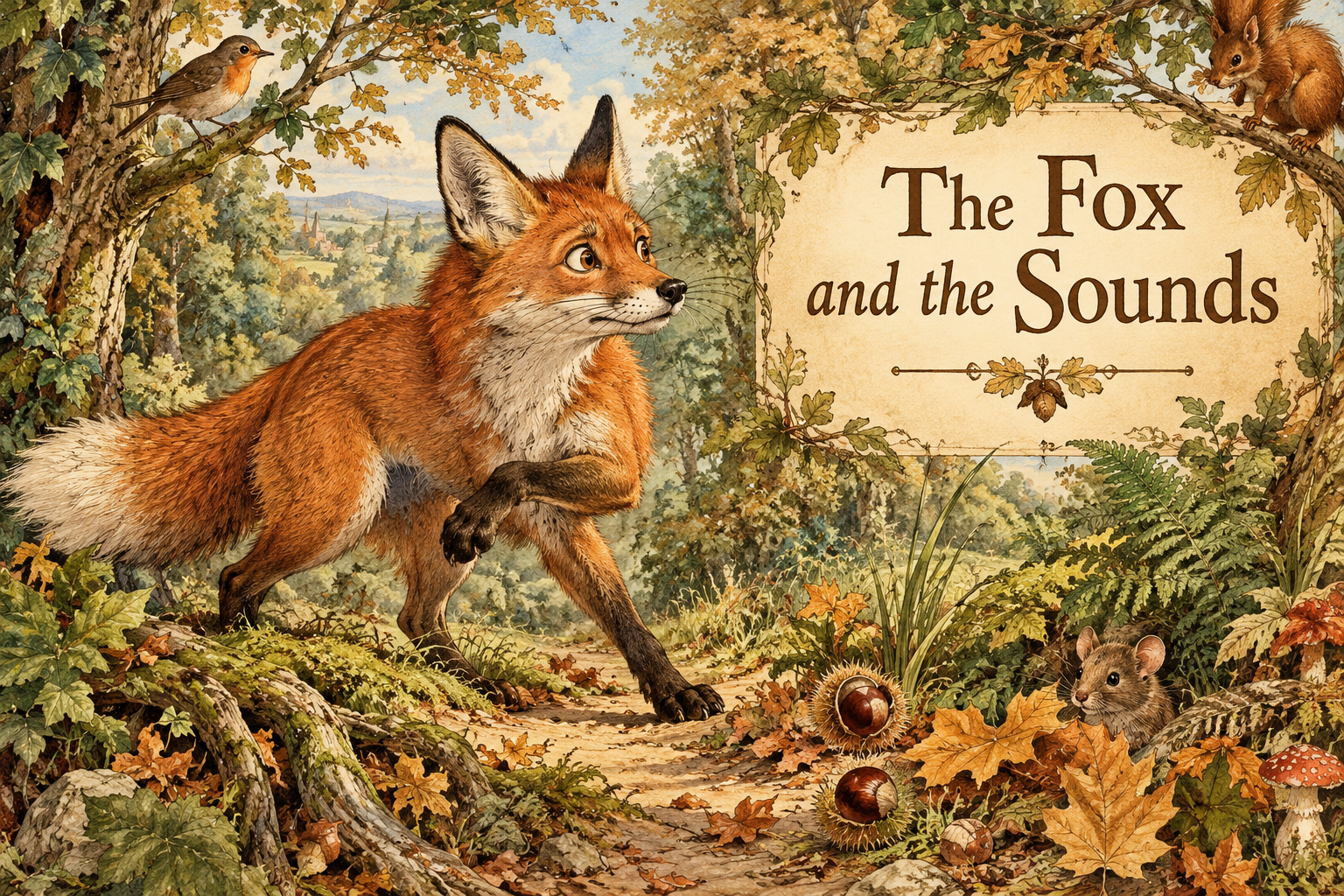
A fox repeatedly returns to an old tree stump, revealing how memory, familiarity, and belonging can make an ordinary place feel entirely one’s own.
Each story can be read simply for what happens.
Each can also be read as a question.
That is where the fable begins to remain with us.
A Small Story Is Still a Story
Because fables are short, they are sometimes treated as lesser forms: useful for children, convenient for lessons, but too simple to carry serious literary meaning.
Their long history suggests otherwise.
Brevity requires precision. A character must be established quickly. The conflict must be clear. Every action must contribute to the ending, and the ending must alter how we understand what came before it.
There is little room for waste.
A fable may occupy only a page, but the idea it carries can continue far beyond it.
The animal leaves the scene.
The reader remains.
And somewhere between them, the lesson is still moving.

The Spanish Fables of the Nook will continue to grow. Some will be gentle, some playful, and others less comfortable. Not every lesson will arrive as a moral written beneath the final line. Some things are better discovered quietly.
→ Read more interesting articles
→ Read a story
If this stayed with you, consider leaving a like, sharing it, commenting, or all three!