The Name in the Margin
Some truths survive only because someone refuses to let them disappear.
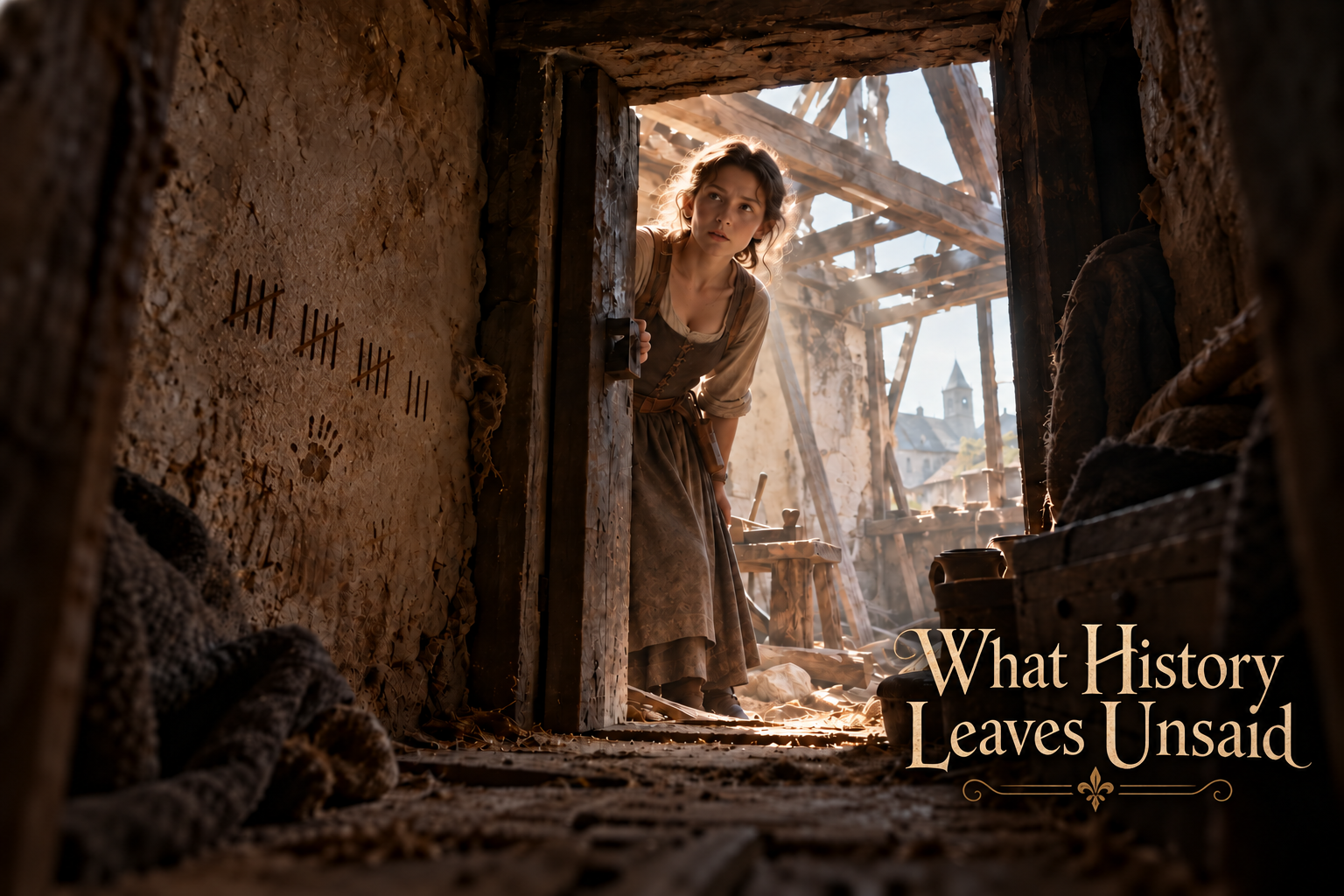
In the autumn of 1387, Brother Edmund discovered a name in the margin of an old chronicle.
It was written in a narrow hand, slightly inclined to the right, with the final letter drawn so closely against the edge of the parchment that it nearly disappeared beneath the binding.
Avice.
Edmund examined it briefly, then returned to his work.
There was nothing remarkable about a name in the margin of a manuscript. Readers frequently left annotations, corrections, references, and occasionally remarks that had little to do with the original text. Some were useful. Others were evidence of nothing more than boredom or a careless pen.
The chronicle itself was nearly two centuries old. Its leather covering had begun to split, and several gatherings of parchment had loosened from their stitching. Edmund had been instructed to repair the binding and correct a damaged passage describing the reign of Henry II.
He worked carefully, as he always did.
At forty-three, he had spent more than half his life among manuscripts. He knew the smell of old parchment, the changing colours of ink, and the particular difficulties of repairing a page that had been scraped too thin by an impatient scribe.
He also knew that old books contained mistakes.
Many mistakes.
A monk who believed every mark upon a manuscript carried divine significance would soon find himself unable to accomplish anything useful.
Brother Edmund believed firmly in God.
He did not believe that God required him to abandon common sense.
The name therefore passed from his thoughts.
Three days later, he encountered it again.
This time it appeared in a collection of historical accounts compiled during the reign of King John.
Avice.
The name had been placed beside a passage describing the disappearance of several men following a failed rebellion.
Edmund examined the lettering.
It was different from the first example.
The earlier name had been written with a narrow, restrained hand. This one was broader, with an unusually heavy stroke beneath the letter v.
Two scribes, certainly.
He found this mildly interesting.
Avice was not an impossible name. It appeared in English records, and there was no reason two unrelated readers could not have written it independently.
Nevertheless, he took a small piece of parchment and recorded the two occurrences.
Not because he suspected anything.
Because he liked his records complete.
The third occurrence came the following week.
And the fourth, two days afterward.
By the time November approached, Edmund had found the name in six manuscripts.
The books differed in age, subject, and condition. One concerned the lives of saints. Another recorded a series of local disputes over land. A third contained accounts of deaths during the pestilence of 1348 and 1349.
The handwriting varied.
Some annotations were neat. Others appeared hurried.
Yet the name remained the same.
Avice.
What troubled Edmund was not the repetition itself.
It was the location.
In every instance, the name appeared beside a passage concerning someone whose identity had been lost, omitted, disputed, or deliberately left unrecorded.
He knew enough about chance to distrust patterns that appeared only after one began looking for them.
But he knew enough about manuscripts to recognise an unusual habit.
And this was unusual.
One afternoon, he mentioned the matter to Brother Peter, the monastery’s elderly librarian.
Peter had served in the abbey for almost fifty years and possessed an extraordinary memory for books, though a less reliable one for people.
“Perhaps some earlier brother had a fondness for the name,” Peter suggested.
“In six different manuscripts?”
“There are brothers here who have written their own names in considerably more.”
“These were not written by the same man.”
“Then perhaps several brothers had the same fondness.”
Edmund smiled.
“You do not find that peculiar?”
“I find it peculiar that you have spent a fortnight counting names when the prior has been asking for the repairs to that chronicle.”
“The repairs are almost finished.”
“Then finish them.”
Peter returned to his reading.
Edmund might have followed the advice.
Indeed, he intended to.
But that evening, while reviewing his notes, he noticed something he had previously overlooked.
The manuscripts were old.
The annotations were not necessarily old at all.
A chronicle written in 1190 might have received a marginal note in 1350. Another copied in 1220 might have been annotated by someone living only thirty years before Edmund himself.
The age of the book did not establish the age of the writing.
He spread his notes across the table and began examining the letterforms he had copied.
Two of the annotations resembled writing from the middle of the previous century.
Three appeared considerably later.
The remaining example was difficult to classify.
The discovery resolved one mystery while creating another.
There was no need to imagine a name somehow travelling through centuries of manuscripts.
Someone had been writing it in old books.
Perhaps several people.
But why?
And why always beside accounts of the forgotten dead?
The answer began with a damaged register from 1349.
It was not a particularly interesting volume.
The monastery’s almoner had used it to record provisions distributed to travellers, labourers, the sick, and those who depended upon the abbey’s charity.
Most entries consisted of quantities.
Bread.
Ale.
Oats.
Linen.
Occasionally, a payment to a carpenter or a porter.
Edmund had requested the register because one of the manuscripts containing the name referred to a small lodging house beyond the western orchard.
He remembered seeing an account of that building among the monastery’s older records.
It had been called the west lodge.
The building no longer existed.
During the great pestilence, it had been used to accommodate people who could not safely enter the monastery itself.
Edmund knew the story.
The plague had reached the district when he was still a small child. He retained almost no personal memory of it, but older brothers occasionally spoke of those years.
Whole households had vanished.
Fields had been left untilled.
Some villages had lost so many inhabitants that the survivors could scarcely bury their dead.
The abbey itself had suffered greatly.
Several monks had died, including the former prior.
Nothing in the register initially attracted Edmund’s attention.
Then he reached the accounts for June 1349.
Bread for the west lodge: twenty-one persons.
The next day, another provision.
Then another.
For several days, the entries continued.
Afterward, the bread stopped.
Edmund turned the page.
No explanation appeared.
He examined the remaining accounts.
There were still payments for two men assigned to watch the building.
There was a payment for a carpenter.
Another for iron fittings.
And another for additional timber.
But no food.
For eight days, the men guarding the west lodge continued receiving wages.
No provisions were recorded for those inside.
Edmund frowned.
Perhaps the occupants had already died.
Perhaps the records were incomplete.
Both possibilities were reasonable.
Then he found the payment to the carpenter.
For securing the outer door and two shutters of the western lodging.
He read it again.
There was nothing remarkable about securing a building during an epidemic.
It might even have been necessary.
But a question had begun to form.
Why had the guards continued their duties after the provisions stopped?
He turned to the burial accounts.
There, near the end of the month, was an entry recording the removal of bodies from the west lodge.
Twenty-one persons.
All deceased.
The following line contained another familiar word.
Not in the main text.
In the margin.
Avice.
Edmund sat back.
For the first time, he wondered whether he had been examining a collection of unrelated curiosities or following a trail someone had deliberately left behind.
He returned to the earlier manuscripts.
This time, he ignored the names and read the passages beside them.
In one chronicle, the annotation appeared beside a description of a town abandoned during an epidemic.
In another, beside a dispute concerning lands inherited after the presumed death of their owners.
In the third, beside an account of people who had disappeared during a winter journey.
Different events.
Different circumstances.
Yet all involved a difficulty Edmund understood well.
The records described what people believed had happened.
They did not always establish what had happened.
A person might be recorded as dead because nobody had seen him return.
A household might be listed as abandoned because its inhabitants had fled.
A name might be omitted because the writer did not know it.
Or because someone had decided it should not be written.
That last possibility remained with Edmund longer than he expected.
The monastery maintained several chests of documents concerning its estates, buildings, and former possessions.
Some had not been opened for years.
With Brother Peter’s permission, Edmund began examining the records relating to the western orchard.
He found repairs to the lodge in 1338.
A grant of land.
An account of timber purchased for its roof.
And, among a collection of discarded papers, a narrow strip of parchment bearing an incomplete inventory.
The writing was difficult to read.
Much of the surface had been scraped, apparently so the parchment could be reused.
But several words remained.
The western lodging.
Those remaining.
To be entered among the deceased.
The remainder was illegible.
Edmund held the parchment closer to the window.
It was an ordinary administrative note.
The kind of scrap that might have been produced in the hundreds during a difficult year.
Yet there was something unusual about the final instruction.
To be entered among the deceased.
Not those who had died.
Those remaining.
He spent the next two days searching for the original inventory.
He found no trace of it.
He did, however, discover that the monastery’s register of deaths had been corrected during the years immediately following the pestilence.
Certain names had been scraped away.
Others had been inserted.
Entire lines had been rewritten.
Again, there was nothing inherently suspicious about this.
The epidemic had disrupted normal record-keeping. Mistakes would have been inevitable.
But one alteration caught his attention.
The entry concerning the west lodge had originally contained more writing than the final account preserved.
Under a strong light, Edmund could distinguish the faint impressions left by the erased letters.
There had been a separate line beneath the total of twenty-one.
Someone had removed it with considerable care.
He worked slowly, angling the parchment against the light.
Most of the letters remained unreadable.
Only three could be distinguished with confidence.
An A.
A v.
And the curved beginning of another letter.
Edmund put down the manuscript.
For several minutes, he did nothing.
Then he went to find Brother Peter.
Peter listened to the account without speaking.
When Edmund finished, the old librarian remained seated, his hands resting upon the closed book in front of him.
“Have you examined the burial register?” Peter asked.
“Yes.”
“And the almoner’s accounts?”
“Both.”
Peter looked toward the window.
“I was a young brother when the pestilence came.”
Edmund had known this.
“There were days,” Peter continued, “when we did not know which men would still be alive by evening. The infirmary was filled. The guesthouse was filled. We buried brothers whom we had spoken to the previous morning.”
He paused.
“Fear makes men careless.”
“Careless enough to erase a name?”
Peter did not answer immediately.
“Are you certain someone erased it?”
“Yes.”
“Then perhaps there was a reason.”
“That is what I am trying to discover.”
Peter rubbed his forehead.
“Brother Edmund, the men who made those records are almost all dead.”
“That does not make the records correct.”
“No.”
“Nor does it make the names unimportant.”
The librarian looked at him for a long moment.
Then he rose.
“Come with me.”
He led Edmund to a narrow chamber behind the library, where damaged manuscripts were stored until they could be repaired or reused.
From a wooden chest, Peter removed a small volume bound in dark leather.
Its covering was badly worn.
The clasp had broken long ago.
“This belonged to Brother Odo,” he said.
Edmund recognised the name.
Odo had served as a copyist and keeper of accounts for many years before dying in 1371.
“He was a careful man,” Peter continued. “Too careful, some thought.”
“Did he write the annotations?”
“I don’t know.”
“But you suspected something.”
Peter placed the book on the table.
“Odo asked me to keep this after he died. He said it contained papers that ought not to be destroyed.”
“Did you read them?”
“Some.”
“And?”
Peter looked suddenly older.
“I did not understand all of them.”
It was not the answer Edmund had expected.
Peter turned toward the door.
“You have wanted to know what happened. Perhaps you will understand better than I did.”
He left Edmund alone.
The little volume contained prayers, passages copied from sermons, and several pages of accounts written in Odo’s hand.
Nothing extraordinary.
But the back covering had begun to separate from the wooden board beneath it.
Between the layers, Edmund noticed a folded piece of parchment.
It had been placed there deliberately.
He loosened the damaged covering with the thin blade he used for repairing bindings and carefully removed the folded leaf.
The parchment was stiff.
Its edges had darkened.
Across the front, in Odo’s unmistakable handwriting, appeared four words.
Concerning the western lodging.
Edmund unfolded it.
The document was dated 1352.
Three years after the pestilence.
It began as a confession.
Odo described the arrival of the sick during the summer of 1349. He described the fear that had spread through the monastery and the decision to separate those suspected of infection from the remaining population.
The west lodge had been selected because it stood beyond the main buildings.
Twenty-one people had been sent there.
Some were ill.
Others had merely shared houses with the sick.
Several were children.
The former prior had ordered the doors secured.
No one was to leave until the danger had passed.
At first, food and water had been delivered regularly.
Then two of the men assigned to carry provisions developed fevers.
One died.
The other refused to return.
The prior ordered that no further brother should approach the building.
Edmund read the next paragraph twice.
There had been a woman employed by the abbey to wash linens and assist with the care of travellers.
Her name was Avice.
She had objected to the order.
When the prior refused to reconsider, she entered the lodge herself, carrying bread, water, and clean cloth.
She believed she would be allowed to leave after tending to those inside.
The door was secured behind her.
No further provisions were delivered.
The guards remained at their posts.
The document continued.
Odo had been instructed to prepare the accounts.
He had recorded the occupants as deceased.
Not after the building had been opened.
Not after anyone had examined the bodies.
Before.
He explained that the prior believed death inevitable and wished to prevent further contact with the lodge.
The monastery had already lost too many brothers.
The decision, Odo wrote, had been made in terror.
Then came the sentence that made Edmund lower the parchment.
For three nights after I entered their deaths, sounds were still heard from within the building.
Edmund remained motionless.
He read it again.
There was nothing mysterious about the sentence.
No apparition.
No miracle.
No uncertain omen.
Only an ordinary fact.
The record had declared twenty-one people dead while at least some of them remained alive.
He forced himself to continue.
The final section described the opening of the lodge.
All twenty-one occupants had died.
The bodies were buried hurriedly.
Avice was among them.
Odo had been ordered to remove her name from the account because she had entered against the prior’s instruction. Her death, it was argued, should not be counted among those for whom the monastery had formally assumed responsibility.
He had obeyed.
He had also removed the original dates.
And when the new record was complete, he had copied it into the monastery’s register.
The last paragraph was written more heavily than the rest.
I have entered what I was instructed to enter. I have not entered what I know.
Beneath it, Odo had written the names of the twenty-one people.
Edmund read them slowly.
Farmers.
Labourers.
Widows.
Children.
Some were identified only by a parent or a place of residence.
The final name was Avice.
No surname.
No age.
No account of her family.
Just the name.
The same name that appeared in the margins of the monastery’s books.
For several days, Edmund did not speak of the discovery.
He continued his work, attended the offices, and took his meals with the other brothers.
But his thoughts repeatedly returned to the west lodge.
He imagined the former prior receiving news that more men had fallen ill.
He imagined the guards standing beyond the building, afraid to approach.
He imagined Odo preparing his accounts, knowing that some of those listed as dead were still alive.
The more Edmund considered the events, the less he believed that one moment of cruelty could adequately explain them.
There had been fear.
Real fear.
The pestilence had killed men whose courage and devotion nobody had questioned.
Edmund did not doubt that the prior had believed he was protecting the monastery.
But fear had been followed by another decision.
And another.
The guards had continued receiving wages.
The doors had remained secured.
The accounts had been completed.
And when the occupants were finally found dead, their deaths had been entered under dates that concealed what had happened.
The men responsible had possessed opportunities to correct the record.
They had chosen not to.
The first decision might have been made in terror. The others had been made after there was time to think.
That distinction troubled Edmund more deeply than anything else.
He had never imagined that the men who preceded him were free from sin.
His faith taught him precisely the opposite.
But he had trusted the monastery’s records.
He had believed that whatever failures men committed, the act of preserving their history remained a separate duty.
Now he understood that the records themselves could become part of the wrongdoing.
One evening, he returned to the manuscripts containing the name.
He examined them again, comparing the annotations with Odo’s handwriting.
Two were unquestionably Odo’s.
A third appeared to be his work, though Edmund could not be certain.
The others belonged to different hands.
Someone had continued the practice.
Perhaps Odo had told another brother.
Perhaps someone had discovered his notes.
Perhaps the name had been copied without any knowledge of its significance.
Edmund could not determine which explanation was correct.
But he understood something he had not understood before.
The annotations were not necessarily attempts to communicate a secret.
They might simply have been acts of remembrance.
Odo had erased Avice from the official register.
Then, unable to forget what he had done, he had written her name elsewhere.
In the margins.
Beside accounts of the forgotten.
Beside deaths recorded without proper names.
Beside descriptions of people who had vanished from history.
A small act.
Almost nothing.
But enough to ensure that her name remained somewhere.
Edmund wondered whether Odo had expected anyone to discover the truth.
Or whether he had merely wanted to make the erasure incomplete.
Brother Peter visited him the following morning.
“You found something,” the old man said.
Edmund nodded.
He handed him Odo’s confession.
Peter read it slowly.
When he reached the passage concerning the sounds heard from inside the lodge, his hands began to tremble.
He finished the document.
Then he folded it carefully.
“I knew they had been shut in,” he said.
Edmund looked at him.
“I did not know this.”
“Did you know about Avice?”
“I remembered a woman. She worked near the infirmary. I could not have told you her name.”
“Why did you keep the book?”
“Odo asked me to.”
“And why did he not tell you what it contained?”
Peter considered this.
“Perhaps he was afraid.”
“Of what? The men responsible were dead.”
“Not all of them were dead when he wrote it.”
“He could have spoken later.”
“Yes.”
Peter’s answer was very quiet.
Edmund waited.
The old librarian looked down at the parchment.
“Perhaps I could have asked him.”
Neither spoke for some time.
At last, Peter said, “What will you do?”
Edmund had been considering that question since reading the confession.
“I will correct the register.”
Peter looked up sharply.
“That is not a small undertaking.”
“No.”
“The abbot must know.”
“Then I will tell him.”
“And if he forbids it?”
Edmund did not answer immediately.
He had taken vows of obedience.
Those vows mattered to him.
He did not regard them as a convenient arrangement to be set aside whenever his own judgment differed from that of his superiors.
But he had also devoted his life to copying words faithfully.
To preserving accounts.
To distinguishing a correction from an alteration.
He thought of the twenty-one people at the west lodge.
Then he thought of Odo, who had written their names only after helping erase them.
“I don’t know,” he said.
It was the first time he had admitted uncertainty without immediately trying to resolve it.
The abbot received Edmund two days later.
He listened without interruption.
He examined the accounts.
He read Odo’s confession.
Then he asked whether Edmund had shown the document to anyone else.
“Brother Peter.”
“Anyone beyond the monastery?”
“No.”
The abbot placed the confession upon his desk.
“The men who made these decisions are dead.”
“Yes, Father.”
“The monastery suffered terribly during those years.”
“I know.”
“And the record you have found was written by a man who acknowledges his own part in the matter.”
“That is why I believe it.”
The abbot looked at him.
“He may have written it to ease his conscience.”
“He could have done that without naming the dead.”
The abbot said nothing.
Edmund continued.
“The accounts support his account. The dates were changed. The provisions ceased. The guards remained. We can establish those things independently.”
“Can we establish that the former prior knew people were still alive?”
“Odo says he did.”
“Then we have the testimony of one dead man concerning another.”
“Yes.”
“And you would enter an accusation against the monastery on that basis?”
“I would enter what the documents establish.”
The abbot rose and walked toward the window.
Outside, the monastery’s orchard stood nearly bare.
A few leaves remained upon the branches, darkened by the autumn rain.
“Brother Edmund,” he said, “do you understand what such an account could do?”
Edmund waited.
“There are villages that depend upon this abbey. Families who receive bread from our stores. Men who work our fields. Children supported by gifts made to this house.”
“I understand.”
“Those gifts depend, in part, upon trust.”
Edmund looked at Odo’s confession.
“Then the trust should not depend upon a false account.”
The abbot turned.
For a moment, Edmund thought he might be ordered to leave.
Instead, the older man returned to his chair.
“You believe this is a matter of truth.”
“Yes, Father.”
“And obedience?”
“That too.”
“Then perhaps you should consider whether a man can be certain that his desire to correct another’s wrongdoing is not itself a form of pride.”
Edmund accepted the rebuke.
He had asked himself the same question.
“Perhaps,” he said.
The abbot seemed surprised by the answer.
Edmund continued.
“But whether I am proud does not change the dates in the register.”
The abbot looked down.
For several moments, only the rain against the window could be heard.
Finally, he said, “Leave the documents with me.”
Edmund hesitated.
“They must be preserved.”
“They will be.”
“May I retain my copies?”
The abbot regarded him carefully.
Then he nodded.
“You may.”
It was not permission to correct the register.
Nor was it a prohibition.
Edmund left uncertain whether he had accomplished anything.
That evening, he returned to the scriptorium.
He had already prepared a complete copy of Odo’s confession.
He had also transcribed the relevant entries from the almoner’s accounts, including the dates of the payments and the alterations in the burial register.
He began composing a separate account.
He wrote the year.
He described the pestilence.
He recorded the decision to secure the west lodge.
He distinguished what the surviving documents proved from what Odo alone had reported.
Where he could not establish a fact, he said so.
Where the evidence supported a conclusion, he did not weaken it merely because the conclusion was unpleasant.
And then he wrote the names.
Twenty-one of them.
For the first time in thirty-eight years, they stood together in a single record.
He left space beneath the account for any corrections that might later become necessary.
At the bottom, he wrote his own name.
Edmundus, monachus.
He did not know whether the abbot would permit the account to enter the monastery’s official register.
He did not know whether the documents would eventually reach the bishop’s officials.
He did not even know whether the story of the west lodge would survive another generation.
But there was now a second account.
One that did not depend upon the continued existence of Odo’s hidden confession.
One that could be copied.
And Edmund understood better than most men how difficult it could be to suppress something that had been copied often enough.
He dried the writing carefully.
Then he placed the new account among his papers.
Before leaving, he knelt and prayed.
Not for a sign.
Not for reassurance that he had acted correctly.
He prayed for those who had died.
And for those who had been afraid.
And for the men who had discovered reasons to remain silent.
Several days later, Edmund returned to the first chronicle.
The binding still required attention.
He had neglected the work longer than he wished, and the prior had begun asking when it would be finished.
The old manuscript lay upon his table, its damaged gatherings arranged in their proper order.
Edmund examined the stitching, replaced a loosened strip of leather, and secured the wooden board.
Then he opened the book to inspect the repaired pages.
There, beside the passage concerning the reign of Henry II, was the name that had begun everything.
Avice.
He looked at it with a different understanding.
He now knew why such a name might have been written.
He knew the story of the west lodge.
He knew what Odo had confessed.
And he understood why later copyists, if they had known even part of the truth, might have continued the practice.
There was nothing supernatural about any of it.
Only men.
Their decisions.
Their fear.
Their guilt.
And the fragile efforts of others to preserve what those men had concealed.
Edmund was almost relieved.
He turned the page toward the window and examined the annotation one last time.
Something about it had troubled him from the beginning.
The letters were unusually narrow.
The ink had faded differently from the other marginal notes.
And the name was positioned remarkably close to the edge of the original ruling.
He fetched a second manuscript for comparison.
Then a third.
He examined the shapes of the letters, particularly the long stroke of the final e.
He returned to the chronicle.
The writing did not resemble Odo’s hand.
Nor did it resemble the later annotations.
That, in itself, was unsurprising.
But there was another detail.
The name had been written before the parchment was trimmed for its present binding.
The final letter disappeared beneath an old cut that had removed a narrow portion of the original margin.
Edmund knew the book had been rebound before Odo was born.
He examined the ink again.
Then the ruling.
Then the letterforms.
He could not establish the precise date.
But he was increasingly certain that the annotation was considerably older than the others.
Possibly as old as the original manuscript.
Two centuries before the pestilence.
Long before Avice had entered the west lodge.
He sat for a while, considering the possibilities.
Avice was not an uncommon medieval name.
Perhaps another woman had borne it.
Perhaps a scribe had recorded a relative, a patron, or someone whose significance was now lost.
Perhaps the later annotations had been inspired by this very example.
All were reasonable explanations.
None required a miracle.
Edmund began to close the book.
Then he stopped.
He looked at the passage beside the name.
It described a dispute in which several people had been imprisoned following an accusation of disloyalty.
The chronicle recorded that the prisoners had died before they could be questioned.
There were no names.
No account of their confinement.
Only a brief statement that they had perished.
Edmund read the passage again.
Then he looked at the faded name beside it.
Avice.
He considered making another note.
There might be a connection worth investigating.
A forgotten custom among scribes.
An earlier event.
A coincidence that only appeared significant because of everything he had recently discovered.
He could not tell.
For several minutes, his pen remained suspended above the parchment.
Then he set it down.
He had learned enough to know that not every uncertainty could be resolved.
And enough to understand that uncertainty was not always the most frightening part of a record.
He closed the chronicle.
Outside, the abbey bell began to ring for evening prayer.
Edmund rose, put away his tools, and went to join the other brothers.
The manuscript remained on the table.
Its binding was repaired.
Its pages were in order.
And in the narrow margin of a passage written almost two hundred years before the deaths at the west lodge, a woman’s name remained.
No one had removed it.
No one had explained it.
It had survived where so many others had not.
Avice.

Thank you for reading “The Name in the Margin”! This is a story in a series created for avid readers and English learners who want to enjoy captivating tales while practicing their language skills. Stay tuned for more stories and language tips to enhance your journey!
Explore more short stories in English and Spanish by visiting the section:
Short Stories / Cuentos Cortos
When the world feels dull, your mind restless, or your heart heavy, let a story be your escape. Just one page, one sentence, one word—and suddenly, you’re somewhere new, where imagination breathes life into the ordinary and turns the simplest moments into magic.
Liked it? Drop an acorn! 🌰