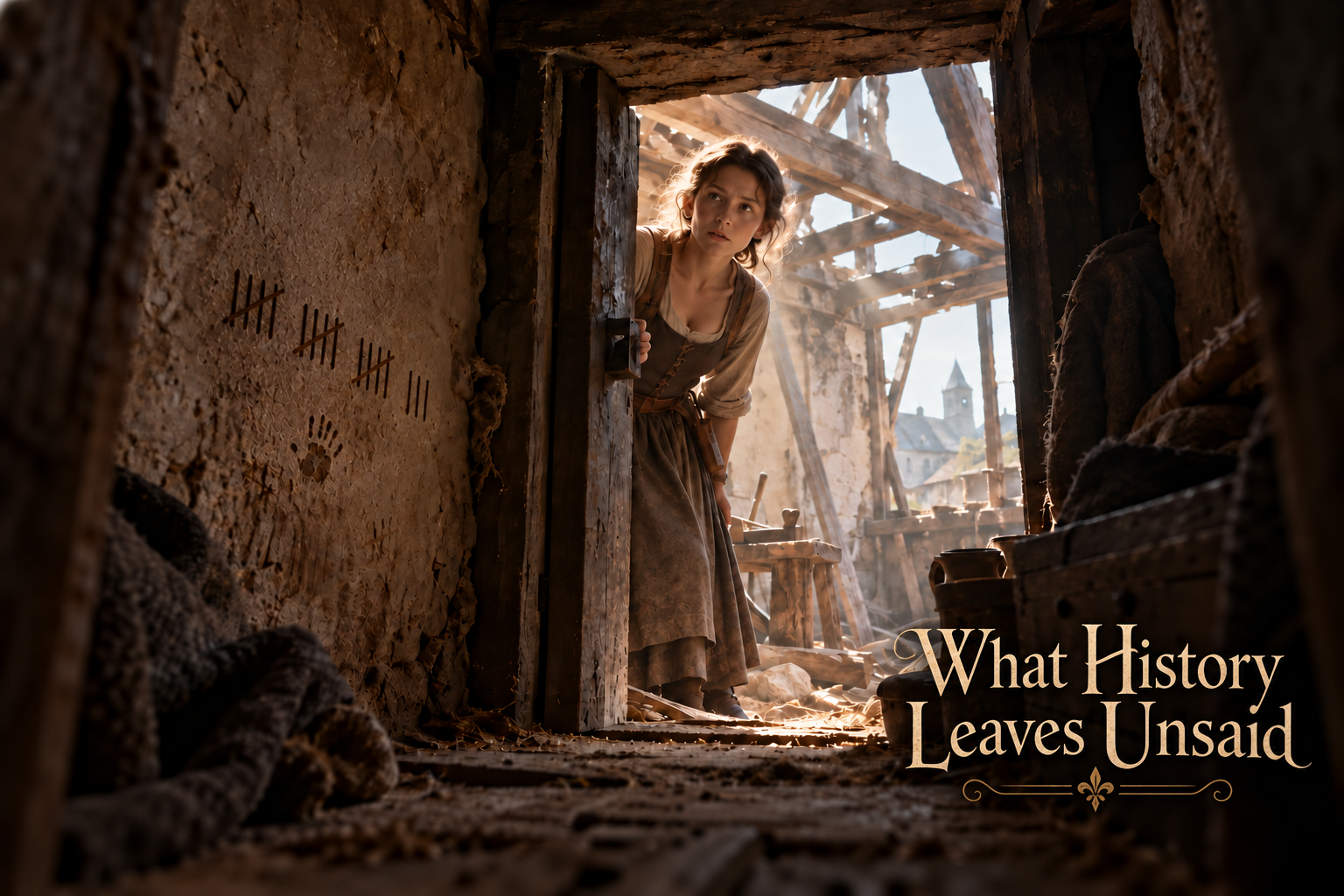
The Candle at the Window
Some warnings are remembered long after the danger has been forgotten.
Every evening, just before darkness settled over the village of Wychford, Thomas Vale placed a candle in the northern window of his house.
He had done so for twenty-six years.
Before him, his mother had kept the same custom, and before her, his grandmother. The candle was always placed upon a little iron plate, near the corner of the window where the glass had a faint greenish tint.
It was an ordinary candle, made from tallow, and nothing about it distinguished it from those burning in other houses.
Except that it was never used to light the room.
It belonged to the window.
Thomas’s wife, Joan, had questioned the habit when they first married.
“Why put a candle where nobody can read or work by it?”
“Because my mother did.”
“And why did she?”
“Her mother told her to.”
Joan had laughed.
“Then I suppose we must hope your grandmother knew what she was doing.”
That was the end of the discussion.
The candle became part of their household, as familiar as the worn bench beside the hearth or the crooked shelf above the cooking fire.
Their children grew up seeing it there. Their eldest son left to apprentice with a carpenter in Canterbury. Their daughter married a farmer from the neighbouring parish.
Still, every evening, Thomas lit the candle.
And every morning, he removed what remained.
In the autumn of 1426, a travelling merchant stopped at their house while seeking directions to the southern road.
He was a narrow-faced man with a cart full of woollen cloth and a horse that seemed determined to eat every plant within reach.
Thomas directed him toward the crossing.
The merchant thanked him, then noticed the candle already burning in the window.
“Someone coming home?” he asked.
“No.”
“Then why the light?”
“An old custom.”
The merchant examined it.
“My grandmother used to do something similar. She said a candle in the window told travellers there was shelter nearby.”
“Perhaps that’s why we do it.”
“Perhaps.”
The merchant smiled.
“Though I’ve known places where it meant precisely the opposite.”
Thomas looked at him.
“The opposite?”
“A warning to keep away. In times of sickness, some houses put a light where strangers could see it.”
“Did they?”
“So I’ve heard.”
The man gathered his reins.
“Funny thing, a light. Depends what you’re looking for.”
He departed before Thomas could ask anything further.
That evening, Thomas found himself watching the candle longer than usual.
It had always seemed reassuring.
Now he wondered whether it had originally been intended to reassure anyone at all.
Several days later, he asked his uncle Robert about the custom.
Robert was seventy-eight and lived beside the mill, where he spent much of his time complaining about the weather and the price of barley.
He remembered Thomas’s grandmother well.
“She was a stubborn woman,” he said. “If she decided a thing was necessary, you’d have had more luck arguing with the millstones.”
“But why the candle?”
Robert considered the question.
“Something to do with the old north track.”
“What old north track?”
“The road through the woods, before they cleared the southern crossing.”
Thomas knew the path. Few people used it anymore. It led between two wooded hills and eventually joined the road to the market town.
“Was it dangerous?”
“At night, certainly. The ground was uneven, and there were places where a traveller could easily lose his way.”
“So the candle guided people home?”
“Perhaps.”
“Did Grandmother ever say so?”
Robert frowned.
“No. Now that I think of it, she always told us to keep away from that window after dark.”
Thomas looked up.
“Why?”
“Because she didn’t want us disturbing the candle, I suppose.”
“Did she ever explain?”
“If she did, I don’t remember.”
The old man rubbed his knees.
“She did say one thing. Something about never letting the house appear empty.”
Thomas waited.
But Robert had already begun talking about the winter of 1397, when the mill wheel had frozen so firmly that three men were needed to free it.
That night, Thomas mentioned the conversation to Joan.
“Perhaps the light was meant to show that someone lived here,” he said.
“Someone does live here.”
“I know.”
“Then the candle is doing its work.”
He smiled.
“But who needed to know?”
Joan continued mending a sleeve.
“Perhaps someone who passed along the old road.”
“And why would it matter whether the house was occupied?”
She looked at him.
“Thomas, I don’t know.”
He sat quietly for a while.
Then he asked, “Have you ever noticed a light beyond the northern trees?”
Joan lowered her sewing.
“What sort of light?”
“Another candle. Or perhaps a lantern.”
“Where?”
“Near the old track.”
She thought for a moment.
“No.”
“Neither have I.”
“Then why ask?”
Thomas glanced toward the window.
“Because I’ve been looking.”
Joan put aside the sleeve.
“And what have you found?”
“Nothing.”
“Then perhaps you should stop looking.”
It was sensible advice.
He found it increasingly difficult to follow.
One evening, Thomas returned late from repairing a neighbour’s fence.
The sky had already darkened, and the first stars were visible between the clouds.
As he approached the house, he noticed the northern window.
It was dark.
Joan had gone to visit their daughter and would not return until the following morning. Thomas had been responsible for the candle.
He had forgotten.
He entered the house, put down his tools, and went to fetch a taper from the hearth.
Before lighting it, however, he looked outside.
The old north track disappeared into a patch of woodland, barely distinguishable from the surrounding fields.
He could see no movement.
No travellers.
No lanterns.
It occurred to him that nothing unpleasant had happened during the hour the candle had remained unlit.
Perhaps nothing ever would.
Thomas set the taper aside.
For the first time since his mother’s death, the window remained dark throughout the evening.
He awoke sometime after midnight.
At first, he thought someone had knocked.
He lay still, listening.
Nothing.
Then he noticed a faint glow upon the bedroom wall.
He sat up.
It came from downstairs.
Thomas rose, pulled on his woollen tunic, and descended the narrow stairs.
The northern window was illuminated.
He stopped halfway down.
For one bewildering moment, he thought the candle had been lit.
But the iron plate was empty.
The light came from outside.
Beyond the window, somewhere along the old track, a small yellow flame was visible between the trees.
Thomas approached slowly.
It seemed to hang at roughly the height of a person’s shoulder.
Perhaps someone was carrying a lantern.
He watched it for several minutes.
The light did not move.
Then, without flickering or diminishing, it disappeared.
Thomas remained at the window.
He told himself that a traveller had turned away, perhaps taking a path concealed by the trees.
There was nothing impossible about that.
He went back to bed.
But sleep did not return easily.
The following morning, he walked along the northern track.
The ground was damp, and fallen leaves covered most of the path.
Beyond the first bend, the trees grew close together, their branches forming a dark passage overhead.
Thomas continued until he reached a clearing.
There, among the roots of an old oak, stood the remains of a stone wall.
He remembered it from childhood.
Once, a little cottage had stood there. The roof had collapsed long before he was born, and most of the stones had been carried away for other buildings.
Now only part of one wall remained.
Thomas examined the clearing.
Someone might easily have stopped there with a lantern.
A shepherd, perhaps.
Or a traveller resting before continuing toward the village.
He found no ashes, no abandoned belongings, and no sign that anyone had recently slept among the ruins.
But beneath a patch of moss, he noticed a narrow stone ledge projecting from the wall.
It had once formed the base of a window.
The stone was stained dark near its centre.
Thomas rubbed it with his thumb.
The discoloration might have been soot.
Or simply damp.
He could not tell.
That afternoon, Joan returned.
Thomas told her what had happened.
She listened carefully.
“So you forgot the candle,” she said.
“Yes.”
“And you saw another light.”
“Near the ruined cottage.”
“Perhaps someone was travelling.”
“Perhaps.”
“Then what troubles you?”
Thomas considered his answer.
“It appeared when ours wasn’t burning.”
Joan folded her cloak.
“And?”
“Perhaps someone saw the dark window and came to investigate.”
“Then why didn’t they come to the door?”
“I don’t know.”
“Perhaps they weren’t looking for us.”
That possibility had occurred to him.
It had not made him feel any better.
Joan studied his face.
“Would you like me to light the candle tonight?”
Thomas looked toward the window.
“No,” he said. “I’ll do it.”
That evening, he returned to the familiar routine.
He set a fresh candle upon the iron plate and lit the wick.
Its flame trembled briefly before settling.
Outside, the northern track lay in darkness.
Thomas waited.
Nothing appeared among the trees.
After a while, he returned to the hearth, where Joan was preparing supper.
They ate, spoke about their daughter’s new calf, and discussed the repairs needed before winter.
The evening passed ordinarily.
Before going upstairs, Thomas looked at the window once more.
His candle had burned nearly halfway down.
Beyond it, in the direction of the ruined cottage, there was a small point of light.
He leaned closer.
The distant flame seemed almost stationary.
Then it moved slightly.
Or perhaps a branch had shifted in front of it.
Thomas opened the shutter.
Cold air entered the room.
He could see the light more clearly now, though it remained very small.
He watched it for some time.
Then he returned to the hearth and extinguished his own candle.
Almost immediately, the distant light disappeared.
Thomas stood motionless.
Had someone watched his window?
Had they put out their own light when his went dark?
Or had both flames vanished for reasons entirely unrelated?
He could not tell.
During the following week, Thomas repeated the experiment.
Not every evening.
Only when Joan had gone upstairs and the house was quiet.
Sometimes he left the candle burning until late.
Sometimes he extinguished it early.
Sometimes he waited before lighting it.
On three occasions, he saw the distant light.
Once it appeared before his own candle had been lit.
Twice it appeared afterward.
On another evening, he thought he saw it through the trees, but when he opened the shutter, there was nothing.
He began writing down what happened.
He was not accustomed to keeping records, and his notes were brief.
Tuesday: No light.
Wednesday: Light beyond the trees. Mine burning.
Friday: Light before I lit mine. Gone afterward.
Then came another entry.
Sunday: Two lights?
He could not remember why he had written the question mark.
He had seen something that evening.
He was certain of that.
What troubled him was that he could no longer say exactly what it had been.
Near the end of October, Thomas visited his uncle again.
Robert was sitting beside the mill, mending a leather strap.
Thomas described the ruined cottage and the distant flame.
The old man listened without interrupting.
When Thomas finished, Robert remained silent for a while.
Then he said, “There were two houses, you know.”
“Two?”
“Yours and the one in the woods.”
“I know.”
“No. I mean there were two houses that kept lights.”
Thomas leaned forward.
“Both of them?”
“I think so.”
“Why?”
Robert frowned.
“Your grandmother said something about it once. I was very young.”
“What did she say?”
The old man looked toward the waterwheel.
“That they could always tell whether someone was home.”
“Who could?”
“That’s what I can’t remember.”
“Did our family watch the other cottage?”
“Perhaps.”
“Or did they watch us?”
Robert slowly shook his head.
“I don’t know, Thomas.”
He looked almost apologetic.
“It’s a very old thing to remember.”
Thomas stayed a little longer, hoping another detail might return to his uncle.
None did.
That evening, Thomas sat beside the northern window.
Joan had gone to bed.
The candle burned steadily upon its iron plate.
Outside, a thin mist lay over the fields, and the trees appeared almost black against the remaining light in the sky.
He thought about the two houses.
Perhaps the inhabitants had once used candles to signal that they were safe.
Perhaps the light had warned travellers away from the old track.
Perhaps one household had kept watch over the other during a dangerous winter, and the custom had survived long after both families forgot its purpose.
All were reasonable explanations.
None could be proved.
Thomas watched the trees.
For a long time, nothing happened.
Then a light appeared near the ruined cottage.
Small.
Yellow.
Steady.
He looked at his own candle.
It was still burning.
He waited.
The distant light remained.
Thomas reached toward the iron plate.
He intended to lift the candle and move it away from the window, just long enough to see whether anything changed.
But before his fingers touched the plate, the distant light went out.
He stopped.
Outside, the woods were dark again.
Thomas remained beside the window for several minutes.
Then he picked up the candle and carried it to the hearth.
He had no wish to experiment further that night.
In the morning, Joan found his notes upon the table.
She read them with increasing curiosity.
“Why have you written that the other light disappeared before you moved yours?”
“Because it did.”
“And here?”
She pointed to an earlier entry.
Friday: Light before I lit mine. Gone afterward.
“That happened too.”
Joan looked at him.
“Thomas, are you certain which one of you is answering the other?”
He almost laughed.
“I don’t even know whether anyone is answering.”
She folded the paper.
“Then perhaps that’s enough.”
He considered this.
Perhaps it was.
There were fences to repair, wood to stack, and a roof that needed attention before the winter rains.
Thomas spent the day attending to them.
By evening, he was tired.
He washed his hands, ate with Joan, and went to light the candle.
As he approached the northern window, he noticed a distant flame already shining between the trees.
He stood for a moment.
Then he lit his own.
The other light disappeared.
Thomas watched the darkness beyond the glass.
He thought of the ruined cottage and the stone ledge beneath its vanished window.
He thought of his grandmother, whom he remembered only as an old woman sitting beside the hearth.
He could not recall whether she had ever told him to light the candle so that someone might find their house.
Or so that someone would know it was already occupied.
Or whether those were explanations he had invented himself.
He looked down at the candle burning in front of him.
He was certain that the other light had appeared first.
By the time Joan called him to supper, he was no longer entirely certain.
He left the candle where it was.
Outside, the old track disappeared among the trees.
And in the morning, as always, Thomas removed the remains of the candle and set a fresh one beside the window.