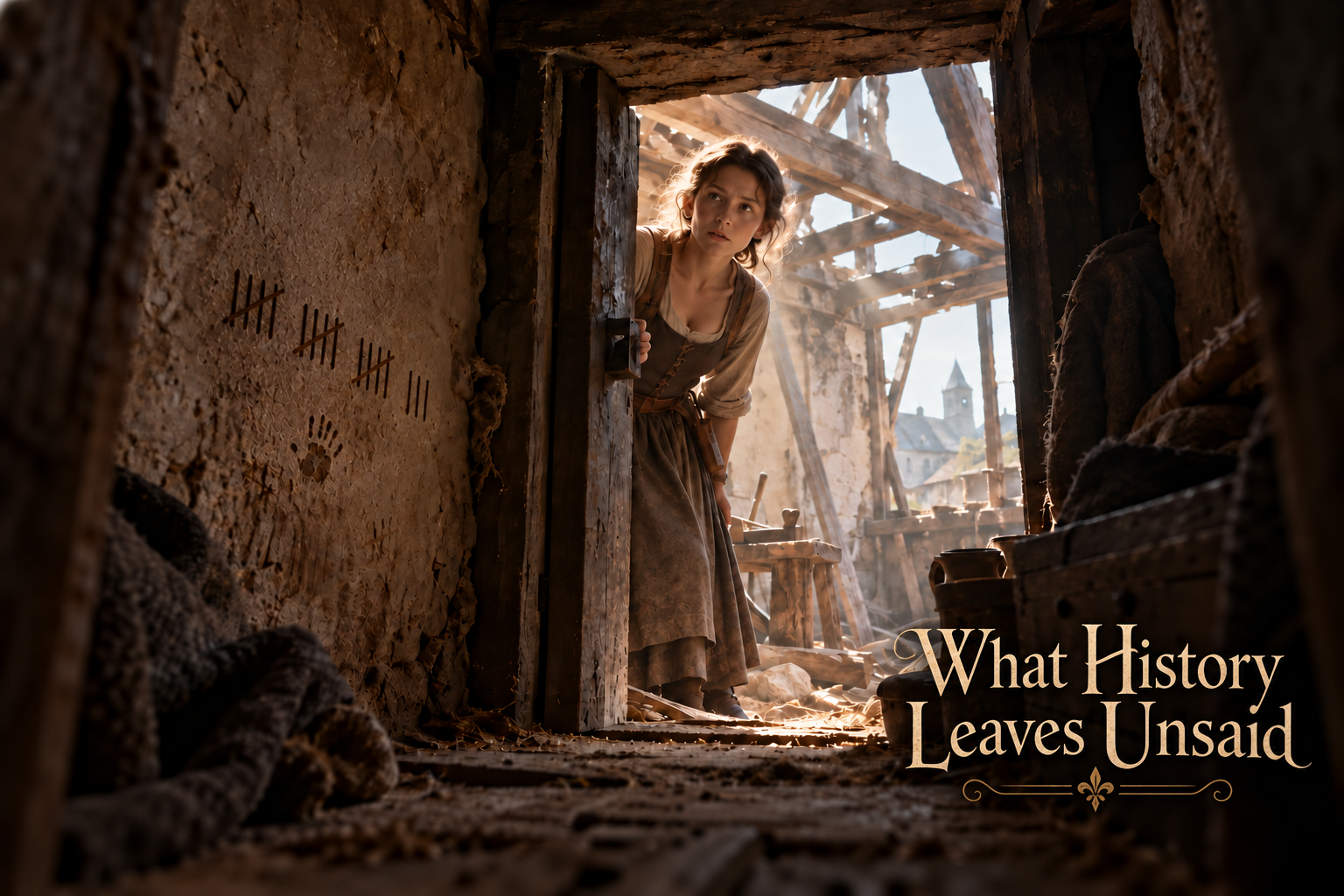

What History Leaves Unsaid
Some places are forgotten because nobody remembers them. Others because everyone remembers too much.
In the spring of 1355, the villagers of Ashcombe decided to pull down the last house on the western lane.
It had stood empty for six years.
Its roof sagged, its shutters had fallen from their hinges, and weeds grew through the stones beneath the doorway. During heavy rain, water entered through a gap in the thatch and collected in the kitchen.
Nobody had lived there since the sickness.
The decision was practical. The village needed timber for a new bakehouse, and the abandoned building contained enough sound oak to be worth recovering.
Margery, the carpenter’s daughter, was given the work.
At twenty-four, she had learned to cut joints, replace roof beams, and distinguish rotten wood from timber that merely looked old. Her father still supervised the larger jobs, but an injured knee kept him from climbing ladders.
He examined the house with her on a cold March morning.
“Take the roof first,” he said. “Then the upper walls. Don’t trust the western corner.”
Margery nodded.
“And the furniture?”
“Anything useful.”
“There may be things belonging to the family.”
Her father looked toward the empty windows.
“There’s no family left to claim them.”
He handed her the measuring cord.
“Bring what you can home before the rain.”
The house was smaller inside than it appeared from the lane.
A narrow kitchen opened into a room where the family had once slept. Beyond it stood a pantry with a stone floor and shelves that had collapsed beneath their own weight.
There were no beds, no pots, and nothing of value.
Someone had removed the household belongings long ago.
Margery began dismantling the roof.
For three days, she worked with another carpenter, stripping the thatch and lowering the sound rafters into the yard. By the fourth morning, they had exposed most of the upper walls.
That was when she noticed the discrepancy.
The pantry was shorter than it should have been.
From outside, the western wall measured almost twelve feet. Inside, the distance from the doorway to the far wall was barely nine.
Margery measured twice.
Then she examined the plaster.
It had been applied unevenly, and near the floor she found a narrow line running vertically through it.
She scraped away a little more.
Beneath the plaster was an old wooden frame.
“A blocked doorway,” she said.
Her companion looked over her shoulder.
“Perhaps another cupboard.”
“Three feet deep?”
“Then a large cupboard.”
He returned to the rafters.
Margery continued scraping.
By noon, she had uncovered the outline of a narrow door, built into the wall and covered with plaster.
An iron fastening remained fixed across its outer edge.
She touched it.
The metal had rusted, but the wood beneath it was surprisingly sound.
The fastening had been placed on the outside.
Her companion wanted to break the door open immediately.
Margery preferred to preserve the timber.
She worked the rusty nails loose, lifted the iron bar, and gradually eased the frame away from the surrounding plaster.
The door opened inward with considerable difficulty.
Behind it was a small room.
There was no window.
A little light entered through a narrow opening near the ceiling, and another, much smaller opening had been cut through the wall at floor level.
The room contained a stool, a wooden bowl, and the remains of a straw mattress.
Nothing else.
For several moments, neither carpenter spoke.
Then her companion laughed uneasily.
“Someone had a strange idea of a cupboard.”
Margery stepped inside.
The room smelled of damp earth and old timber.
The bowl lay beneath the high opening. Its surface was covered in dust, but its rim had been worn smooth by years of handling.
Beside the mattress stood a clay cup with a broken handle.
On the wall, near the door, someone had scratched a series of short lines into the plaster.
They were arranged in groups.
Five, five, five, and then three.
Eighteen marks.
Margery counted them again.
Beneath the last group, much lower down, was the faint outline of a hand.
A small hand.
She held her own against it.
The impression belonged to a child.
That evening, Margery asked her father about the house.
“Who lived there?”
He paused while sharpening a knife.
“The miller’s brother, I think. Before the sickness.”
“Was he married?”
“Yes.”
“Children?”
“At least one.”
“Did they all die?”
Her father stopped sharpening.
“I believe so.”
“Who closed the house?”
“I don’t remember.”
“Did you know there was another room?”
He looked up.
“What room?”
She described the concealed doorway, the iron fastening, and the marks upon the wall.
His expression changed.
Not dramatically. He merely put the knife aside and rested both hands upon the table.
“Leave that room alone,” he said.
“Why?”
“Because there’s nothing useful in it.”
“There’s good timber in the frame.”
“Then take the timber and leave the rest.”
Margery watched him.
“You knew about it.”
“I knew there were houses closed during the sickness.”
“With people inside?”
He did not answer.
Outside, rain began striking the shutters.
Margery waited.
Finally, her father said, “Ask Mistress Alice. She lived across the lane.”
Alice was nearly seventy and lived with her widowed daughter beside the churchyard.
She remembered the house.
“Robert Fenwick,” she said. “That was the miller’s brother. His wife was named Beatrice.”
“And their child?”
“Two children. A boy and a girl.”
Margery sat beside the hearth while Alice sorted dried herbs into little cloth bags.
“They were still living there when the sickness came?”
“Yes.”
“What happened?”
Alice continued sorting.
“The youngest fell ill first. Then the mother.”
“And the others?”
“They remained in the house.”
“Why?”
Alice looked at her.
“Where else were they to go?”
Margery described the hidden room.
The old woman’s hands became still.
For a while, she said nothing.
Then she placed the herbs aside.
“People were frightened,” she said.
“Of the sickness?”
“Of everything. A neighbour’s cough. A stranger at the well. A cart arriving from another village.”
She adjusted the shawl around her shoulders.
“Robert’s boy was sent to stay with his uncle. The others remained. When Beatrice grew worse, the men decided the family should be kept apart.”
“In that room?”
“At first, they were simply told to remain indoors.”
“But someone fastened the door.”
Alice nodded.
“Robert himself helped build the partition.”
Margery stared at her.
“He locked his family inside?”
“He believed it would keep the sickness from spreading through the house. And if he became ill, the neighbours could still bring them food without entering.”
“Did it work?”
Alice considered the question.
“The boy survived.”
“And the others?”
“I don’t know whether anything we did helped them.”
Alice explained that food had been passed through the opening near the floor.
At first, Robert received it himself.
Then his wife became too weak to stand, and he cared for her and their daughter.
The neighbours left bread, broth, and water.
Some mornings the bowls were empty when they returned.
Other mornings they were untouched.
“Did anyone ever open the door?” Margery asked.
“Robert did, in the beginning. He came out to fetch water from the kitchen. Then he became ill too.”
“And afterward?”
Alice stared into the hearth.
“We left things outside.”
“Did you speak to them?”
“When they answered.”
“And when they stopped?”
The old woman rubbed her hands together.
“Then we waited.”
Margery thought of the eighteen marks.
“How long?”
Alice shook her head.
“I cannot remember.”
“Was it eighteen days?”
“Perhaps.”
“Were the marks made by Robert?”
“I don’t know.”
“By the child?”
“I don’t know that either.”
The answers were becoming difficult to hear.
Finally, Margery asked what had happened when the sickness passed.
“The men opened the room,” Alice said.
“And?”
“By then, there were many houses to see to.”
She looked toward the window.
“Some things were done quickly.”
The following morning, Margery returned to the abandoned house alone.
She had brought a lantern, although daylight entered freely through the damaged roof.
The little room appeared less mysterious than it had the day before.
Its walls were rough, its corners uneven. The carpenter who had built it had worked hastily, using whatever timber was available.
Margery could see where the partition had been fixed to the older wall.
It was not a proper room at all.
It was a temporary enclosure that had somehow remained for six years.
She examined the small opening through which food had been passed.
The plaster beneath it was worn smooth.
Someone had repeatedly reached through.
Perhaps with a bowl.
Perhaps with a hand.
She crouched beside the marks on the wall.
Eighteen.
She tried to imagine the person making them.
A man counting the days of his family’s illness.
A child occupying herself while the adults slept.
Someone waiting for a door to open.
There was no way to know.
She touched the small handprint again.
It had been left in the plaster while the surface was still soft.
Perhaps the child had been curious.
Perhaps she had been helping her father build the wall.
Perhaps she had simply pressed her palm against something new, as children often did.
Margery found this last possibility the hardest to dismiss.
The print might have been made before anyone understood what the room would become.
By afternoon, the remaining roof timbers had been lowered.
Her father came to inspect the work.
Margery showed him the hidden room.
He stood in the doorway for some time.
“I remember Robert,” he said at last. “He was good with timber.”
“Did you help build this?”
“No.”
“Did you know what happened here?”
“Most people knew.”
“Then why did nobody speak of it?”
Her father looked around the little enclosure.
“Because there were other houses.”
Margery waited.
“And other families,” he continued. “People had to bury their dead, repair their roofs, and find enough hands to bring in the harvest.”
He ran his fingers over a crooked joint.
“Then another winter came. And another.”
It was not an explanation that satisfied her.
But she understood it.
The village had not forgotten because the room was unimportant.
The room had become unimportant because the village could not remain inside that winter forever.
They dismantled the house over the following week.
The sound timbers were taken to the new bakehouse. The damaged wood became firewood, and the stones were stacked for future repairs.
Margery removed the partition herself.
The narrow door yielded several useful boards. The iron fastening was too badly rusted to save.
When she reached the marked plaster, she stopped.
Her companion suggested breaking it away.
Instead, Margery carefully loosened the section from the wall.
Most of it crumbled.
But the small handprint remained on a piece of plaster no larger than a dinner plate.
She carried it to Alice.
The old woman examined it for a long time.
“Do you know which child made it?” Margery asked.
Alice shook her head.
“She was called Ellen.”
“The daughter?”
“Yes.”
“Do you remember her?”
“Of course.”
Alice smiled faintly.
“She was always asking to hold things she had been told not to touch.”
Margery looked at the little hand.
For the first time, it belonged to someone.
Alice accepted the plaster and placed it carefully upon the mantelpiece.
Neither woman said anything more about the room.
By early summer, the new bakehouse was finished.
It stood beside the village well, with a broad oven, a tiled roof, and enough space for several families to prepare their bread together.
Some of its beams had come from the house on the western lane.
Margery recognised every one.
On the first morning the oven was used, she arrived to make sure the chimney drew properly.
The room was already busy.
Women carried baskets of dough, children waited for scraps, and someone complained that the oven was too hot.
Margery adjusted the vent and watched the smoke rise.
Everything worked.
Outside, the western lane had been cleared. Grass was beginning to grow where the old house had stood.
There would be little reason for anyone to visit the place now.
Margery stayed until the first loaves were removed from the oven.
Then she collected her tools.
As she crossed the square, she passed Alice returning from the well with a bucket of water.
The old woman greeted her, asked whether the bakehouse was working well, and continued toward home.
They did not mention Ellen.
There was no need.
Margery had seen the little handprint upon Alice’s mantelpiece the previous evening, beside a bowl of dried herbs and a small wooden cup.
She wondered how many other things had been carried out of the abandoned houses, kept quietly by those who remembered.
Then someone called her name.
A shutter had come loose at the baker’s cottage, and there was work to be done.
Margery went to fetch her ladder.
Behind her, the first bread of the morning was being carried home.

Thank you for reading “What History Leaves Unsaid”! This is a story in a series created for avid readers and English learners who want to enjoy captivating tales while practicing their language skills. Stay tuned for more stories and language tips to enhance your journey!
Explore more short stories in English and Spanish by visiting the section:
Short Stories / Cuentos Cortos
When the world feels dull, your mind restless, or your heart heavy, let a story be your escape. Just one page, one sentence, one word—and suddenly, you’re somewhere new, where imagination breathes life into the ordinary and turns the simplest moments into magic.
Liked it? Drop an acorn! 🌰