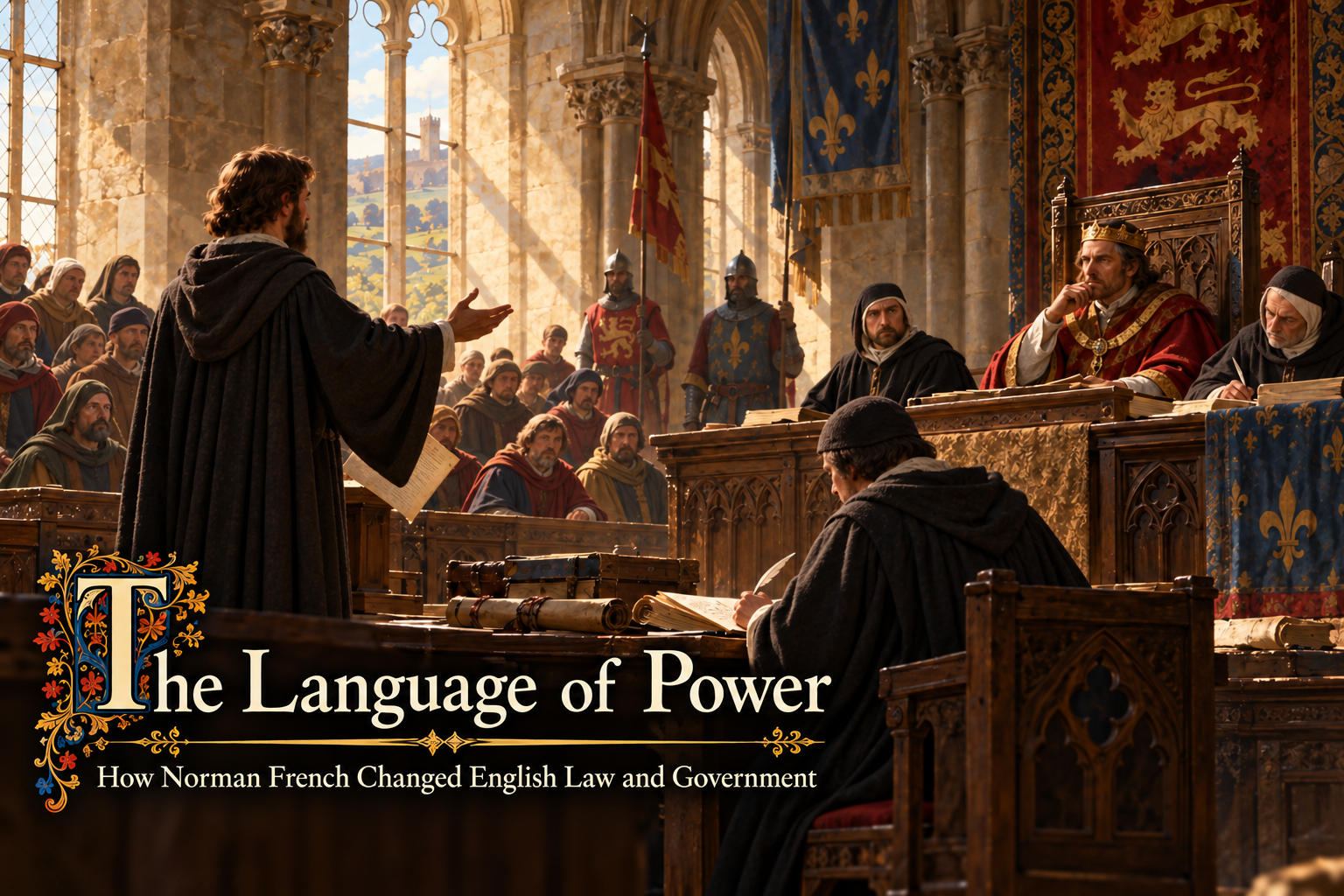

The Scribe and the King’s Silence
There are many ways to give an order. Not all of them require words.
The king appointed a new scribe on the first morning of winter.
He was a young man, careful with his letters and unusually patient with ink. His name was Ivo, and before entering royal service, he had spent three years copying land grants, tax records, and the occasional letter from a nobleman who could neither read nor write.
On his first day, the king summoned him to the council chamber.
“Your duty is simple,” he said. “You will record everything I say during council. Every command, every judgement, every promise. Nothing shall be forgotten.”
Ivo bowed.
“And if Your Majesty says nothing?”
The king smiled.
“Then your ink will last longer.”
The councillors laughed, and Ivo, uncertain whether he was expected to join them, lowered his eyes.
He would remember those words for a very long time.
For several weeks, his work was easy.
The king settled disputes between landowners, authorised repairs to the southern roads, approved the purchase of horses, and instructed the royal steward to collect a debt owed by a neighbouring lord.
Ivo recorded every decision.
He was proud of the precision of his pages. His letters were evenly spaced, his margins straight, and his abbreviations so consistent that even the oldest clerk in the chancery found nothing to criticise.
When the king spoke, Ivo wrote.
When the king stopped, so did his pen.
Then, one morning, three men arrived from the northern villages.
They wore rough woollen cloaks, and their boots were stained with mud. The eldest carried a small sack of grain, which he placed upon the council table.
He opened it.
Inside lay a handful of dark, shrivelled kernels.
“Our harvest has failed, Your Majesty,” he said. “The early rains destroyed much of the wheat, and what remained was spoiled before it could be stored. We have enough food for perhaps another month.”
The king examined the grain.
“What do you ask?”
“That the royal stores be opened until spring. We will repay what we take when the next harvest comes.”
The royal steward stepped forward.
“The northern garrisons depend upon those stores, Majesty. There have been reports of raiders beyond the frontier. If we release the grain now, we may have nothing for the soldiers should they be needed.”
The eldest villager bowed.
“Then perhaps only enough for the children.”
The king looked from the grain to the steward.
He rested one hand upon the arm of his chair.
For a moment, he seemed about to speak.
But he did not.
The steward waited.
The petitioners waited.
Ivo held his pen above the parchment.
At last, the king turned toward the next councillor.
“What news from the western road?”
The steward gathered the grain into its sack.
The three villagers were dismissed.
Ivo wrote:
The king requested news of the western road.
Then he continued with the day’s proceedings.
There was nothing else to record.
A fortnight later, the petitioners returned.
This time there were only two.
The younger man carried a letter bearing the mark of the village reeve. He explained that several families had already slaughtered the animals they intended to keep through winter.
“We ask again for grain, Majesty.”
The steward answered before the king could speak.
“The matter was brought before the council.”
“But no answer was given.”
“No authorisation was issued.”
“Then we ask for one now.”
The king sat very still.
Ivo watched his face.
There was no anger in it. No cruelty. Only the troubled expression of a man who had discovered that every choice before him carried a consequence he wished to avoid.
The steward repeated his warning about the northern garrisons.
The villagers repeated their request.
And the king said nothing.
At length, the steward dismissed them again.
Ivo looked at his parchment.
He had written the day’s decisions concerning a disputed pasture, the appointment of a new tax collector, and the repair of a mill belonging to the crown.
The petition from the northern villages occupied no space at all.
He hesitated.
Then, in the margin, beside the date, he made a short horizontal mark.
It was barely the length of his smallest finger.
No one noticed.
By midwinter, Ivo had begun to understand something about the council chamber.
The king was not a man who refused requests easily.
When a nobleman asked for a hunting privilege, the king often granted it. When a merchant requested protection for a caravan, he considered the matter and issued instructions. When two landowners quarrelled over a boundary, he listened carefully and delivered a judgement.
But when a decision might offend powerful men, exhaust the treasury, or make the king responsible for suffering he could not prevent, he sometimes became silent.
And the silence always seemed to favour whoever already held power.
When villagers complained of unlawful tolls, the toll collectors continued collecting.
When a widow petitioned for the return of land seized by a baron, the baron kept the land.
When the northern villages asked for grain, the granaries remained shut.
No order had been given.
Nothing had changed.
Ivo began placing a small mark beside each unanswered petition.
He never recorded a word the king had not spoken.
He added no accusation, no opinion, no explanation.
Only a line.
At first, the marks seemed insignificant.
Then they multiplied.
By the end of winter, one page contained seven.
One evening, the royal steward entered the chancery while Ivo was preparing the council records for binding.
He examined the pages, nodding at the careful lettering.
Then he noticed the marks.
“What are these?”
“Places where no answer was given.”
The steward frowned.
“You were ordered to record the king’s words.”
“I have.”
“Then why have you marked what he did not say?”
Ivo considered the question.
“Because the requests were made.”
“Requests are not royal commands.”
“No, my lord.”
“And silence is not a judgement.”
Ivo looked down at the parchment.
“Then why do the granaries remain closed?”
The steward’s face hardened.
“Because the king has not ordered them opened.”
Ivo said nothing.
The steward stared at him for several moments before turning away.
“Remove those marks,” he said. “They do not belong in an official record.”
That night, Ivo sat alone beneath a candle.
He took a small knife and carefully scraped the first mark from the parchment.
The surface became rough beneath the blade.
He removed another.
Then another.
By the fourth, he stopped.
The page looked strange.
The king’s commands remained, written in dark and confident strokes. His decisions occupied their proper places. But where the marks had been, pale abrasions interrupted the smooth surface of the parchment.
The words were preserved.
The absences had become more visible.
Ivo put down the knife.
He made no further alterations.
The following morning, the king summoned him.
The steward stood beside the throne, holding one of the council records.
“I am told,” said the king, “that you have begun recording my silences.”
Ivo bowed.
“Not in words, Your Majesty.”
“Yet you mark them.”
“Yes.”
“Why?”
“Because people act upon them.”
The king leaned forward.
“Do you believe my silence is an order?”
Ivo hesitated.
He knew the sensible answer. A scribe was not a councillor, and the young men who forgot this distinction seldom remained in royal service for long.
But the king had asked him a question.
“I do not know, Majesty.”
“Then why do you mark it?”
“Because your steward knows.”
The chamber became very quiet.
The king glanced toward the steward.
“What does he mean?”
The steward cleared his throat.
“Only that where no command is issued, the existing arrangements must continue.”
“And is that unreasonable?”
“No, Majesty.”
The king turned back to Ivo.
“You see? Nothing was decided.”
Ivo looked at the parchment in the steward’s hands.
“Yet something happened.”
“What happened?”
“The petitioners went home without grain.”
“That was not my command.”
“No, Majesty.”
“Then I am not responsible for it.”
Ivo did not answer immediately.
Outside, somewhere beyond the chamber walls, a cart rattled across the courtyard stones.
Finally, he said, “I cannot tell Your Majesty who is responsible. I was only instructed to record what you said.”
The king studied him.
“And what have you written?”
“Everything.”
“Nothing more?”
“Nothing more.”
“Then remove the marks.”
Ivo bowed again.
“As Your Majesty commands.”
The steward looked satisfied.
But the king continued to watch the young scribe.
There was something in his obedience that had become difficult to bear.
Spring came late that year.
The roads remained wet, and the thaw filled the rivers until the water rose almost to the wooden bridges.
One morning, a messenger arrived from the north.
He carried no sack of grain and no petition.
Only a short letter.
The steward broke its seal and read it aloud.
Three villages had been abandoned. Several families had travelled south in search of food. Others had survived by boiling roots and grinding the bark of trees.
The letter did not give a number for the dead.
The king listened without moving.
When the steward finished, he asked whether the northern garrisons had been threatened.
“No, Majesty.”
“Any reports of raiders?”
“None.”
The king lowered his gaze.
After a long silence, he said, “Open the royal stores. Send what remains to the northern villages.”
Ivo wrote the order immediately.
It was a good order.
A necessary one.
And it had finally been spoken.
The council moved on to other matters, but the king seemed distracted.
Before dismissing them, he called Ivo forward.
“Bring me the record of the first petition.”
The scribe obeyed.
The king examined the page.
There was the date, followed by the business of the western road.
Nothing concerning the northern villages.
He turned the parchment toward the light.
In the margin, he noticed a pale, roughened patch where the knife had scraped away the ink.
“What was written here?”
“A mark, Majesty.”
“For my silence?”
“Yes.”
The king ran a finger over the damaged surface.
“Can the parchment be made smooth again?”
“No, Majesty.”
“Can the mark be hidden?”
“With more ink, perhaps.”
“And would that restore the page?”
Ivo thought carefully before answering.
“It would cover the damage.”
The king placed the record upon the table.
For some time, neither spoke.
Then the king dismissed him.
Years passed.
The steward died, another took his place, and Ivo grew old among the royal records.
The northern villages recovered. New houses were built, new fields planted, and children were born who knew nothing of the winter when the granaries had remained closed.
The king, too, grew old.
His reign was remembered for many things: a successful treaty, the rebuilding of a great bridge, several years of peace, and a final campaign that secured the northern frontier.
The chroniclers wrote generously of his wisdom.
They had plenty of words to preserve.
But among the records of his reign remained a curious set of pages.
Most were filled with the king’s commands, written in the elegant hand of his first scribe.
Here and there, however, the parchment bore small, roughened spaces.
Later copyists sometimes mistook them for damage caused by careless scraping. Others assumed that a word had been written incorrectly and removed.
One young clerk, examining the pages many years afterward, asked Ivo about them.
“Master, what was erased from these places?”
The old scribe looked at the record.
He remembered the northern villagers, the sack of spoiled grain, and the king waiting upon his throne.
“Nothing,” he said.
“Then why are the marks there?”
Ivo touched the parchment.
“Because nothing was said.”
The young clerk frowned.
“But if nothing was said, why should anything have been written?”
Ivo smiled faintly.
“That is what the king believed.”
The clerk waited for an explanation.
None came.
After a while, he returned to his copying.
Ivo remained beside the window, looking at the old pages.
He had spent his life preserving the words of powerful men.
Yet the only part of his work that anyone had thought to question was the space where their words were missing.
And there, after so many years, the silence remained.

Thank you for reading “The Scribe and the King’s Silence”! This is a story in a series created for avid readers and English learners who want to enjoy captivating tales while practicing their language skills. Stay tuned for more stories and language tips to enhance your journey!
Explore more short stories in English and Spanish by visiting the section:
Short Stories / Cuentos Cortos
When the world feels dull, your mind restless, or your heart heavy, let a story be your escape. Just one page, one sentence, one word—and suddenly, you’re somewhere new, where imagination breathes life into the ordinary and turns the simplest moments into magic.
Liked it? Drop an acorn! 🌰