
The Pump at Bell Street
By the third week of August, everyone in Bell Street had an explanation.
The heat.
The drains.
The rotting vegetables behind the market.
The slaughterhouse two streets east.
The black water that collected beneath the gutters after rain.
Most of all, the smell.
It was impossible to ignore.
The whole quarter seemed to breathe through something damp and spoiled.
People closed their windows when the wind turned. Mothers pressed handkerchiefs against their children’s faces. Shopkeepers burned herbs near their doors. Vinegar was splashed across floors. Bowls of camphor appeared on windowsills.
The newspapers had a name for the danger.
Miasma.
Bad air.
And Bell Street had plenty of it.
Dr. Jon Snoew was less certain.
He had spent enough years among the sick to distrust explanations that arrived too quickly.
Disease rarely behaved politely.
This one certainly did not.
The first deaths had come from the houses nearest the market. Then three from Cooper Lane. Five from Bell Street itself. A family in Ash Court lost two children in the same night.
The illness moved brutally.
Vomiting.
Cramps.
A terrible draining of the body until strength seemed to disappear faster than anyone could replace it.
Yet some houses remained untouched.
That troubled Snoew.
If the poison travelled through the air, why should it enter one doorway and pass another?
Why should four people become ill in one building while six people next door remained perfectly well?
He asked the question at a meeting of local physicians.
One of them laughed.
“Because bodies differ.”
That was true.
Which made it a very useful answer.
Useful answers, Snoew had noticed, could sometimes prevent people from asking better questions.
So he began walking.
He carried a notebook.
Nothing more.
At every house where illness had appeared, he asked the same things.
Who had become ill?
When?
What had they eaten?
Where had they worked?
Where had they gone?
Where did they obtain their water?
At first, people answered impatiently.
Some were grieving.
Some were frightened.
Some had been questioned too many times already by men who arrived with theories and left with none of the dead.
Snoew learned not to ask everything at once.
He listened.
Then he returned later.
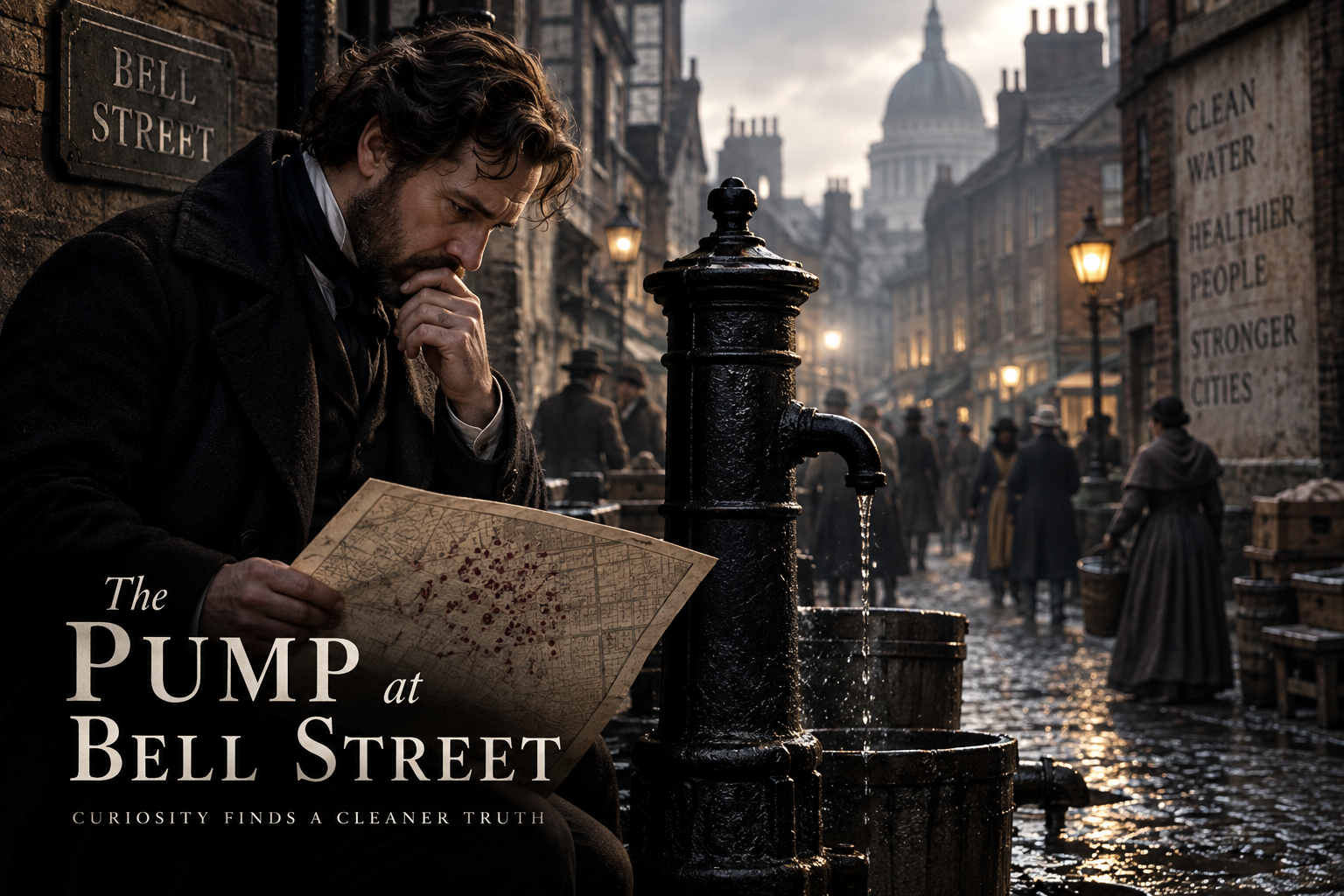
After four days, he spread a street map across his table and began making marks.
One mark for every death.
By midnight, Bell Street had become almost black with them.
But not evenly.
They crowded around one place.
The public pump at the corner of Bell and Mercer.
Snoew stared at it.
Then he became suspicious of himself.
Patterns were dangerous things.
Once a man wanted to see one, he could often persuade himself that it was there.
So the next morning, he stopped looking for evidence that supported the pump.
He looked for evidence that did not.
That was when he noticed the bakery.
It stood barely fifty paces from the pump.
Twenty-three people worked there.
None had died.
Snoew went inside.
The baker was flouring a table.
“You use the pump on Bell Street?”
The man looked offended.
“For drinking? No.”
“Why not?”
“Tastes of iron.”
“What do you drink?”
“Water from our well.”
The baker nodded toward the yard.
“And tea. Mostly tea.”
Snoew wrote it down.
The brewery came next.
Same foul air.
Same quarter.
Same streets.
Almost no illness.
Their workers drank from a private well.
And beer.
Snoew returned to his map.
Two empty places had become more interesting than fifty crowded ones.
The following day brought a problem.
A woman named Mrs. Vale had died nearly two miles away.
Her daughter had died the day after.
Neither lived anywhere near Bell Street.
Both had the same illness.
A clerk placed the report in front of Snoew.
“There,” he said. “Your pump walks.”
Snoew almost smiled.
Almost.
Instead, he read the report twice.
Then he went to Mrs. Vale’s house.
Her son answered the door.
Snoew explained why he had come.
The man listened, tiredly.
“No,” he said. “Mother never went to Bell Street.”
“Never?”
“Not in years.”
“Did she know anyone there?”
“She used to live nearby.”
Snoew stopped writing.
“Near the pump?”
The son shrugged.
“I suppose.”
“Did she ever speak of the water?”
That earned him a strange look.
“The water?”
“Yes.”
The man thought.
Then his face changed slightly.
“She liked it.”
Snoew lowered the notebook.
“What?”
“She said the water from that pump tasted better than ours.”
He pointed toward the kitchen.
“We used to have bottles brought to her.”
Snoew said nothing.
“When was the last one brought?”
The man looked toward the floor.
“The week before she became ill.”
“And your sister?”
“She visited that evening.”
“Did she drink it?”
A long silence.
“Yes.”
Snoew closed the notebook.
Outside, the street smelled no cleaner than Bell Street.
Carriages passed.
Smoke drifted between buildings.
A drain ran beside the kerb.
If bad air had killed Mrs. Vale, then somehow Bell Street’s air had travelled inside a bottle.
He returned to the pump.
A woman was filling a bucket.
Then another.
Then a boy with two tin cans.
Snoew watched them leave in different directions.
He had spent days following the disease back toward the pump.
Now, standing beside it, he saw the opposite.
The pump was travelling outward.
Not by itself.
In hands.
In buckets.
In bottles.
In cups.
He asked for the pump to be closed.
The local board resisted.
People depended on it.
The water looked clean.
It smelled clean.
There was no visible poison in it.
And Bell Street, everyone agreed, still smelled terrible.
Snoew could not show them the thing he believed was moving through the water.
He could only show them where people had fallen ill.
And where they had not.
Finally, reluctantly, the board ordered the pump handle removed.
A workman arrived with a wrench.
It took less than a minute.
That disappointed Snoew.
He had expected the act to feel larger.
The iron bar came free.
The pump stood useless.
Nothing else changed.
The street still smelled.
The gutters still ran.
The market opened the following morning.
People still became ill.
Some still died.
The city did not offer him the courtesy of proving him right immediately.
For several days, Snoew wondered whether he had mistaken curiosity for certainty.
Then the numbers began to fall.
Perhaps the outbreak had already been weakening.
Perhaps removing the handle had prevented further cases.
Perhaps both were true.
Snoew refused to make the evidence say more than it could.
He returned to the map.
The marks remained.
So did the empty spaces.
Years later, people would remember the pump.
Some would remember the handle.
Few would remember the bakery.
Fewer still would remember Mrs. Vale’s bottles of water.
But Snoew did.
Because the question that changed everything had not been:
Why did these people become ill?
It had been:
Why did those people not?
He folded the map and placed it inside his case.
Outside, Bell Street still smelled of summer, horses, drains, bread, beer and too many people living too closely together.
Everyone had noticed the smell.
Snoew had noticed the exception.
Because sometimes, that is where understanding begins: sheer curiosity sparked by an exception.

Thank you for reading “The Pump at Bell Street”! This is a story in a series created for avid readers and English learners who want to enjoy captivating tales while practicing their language skills. Stay tuned for more stories and language tips to enhance your journey!
Explore more short stories in English and Spanish by visiting the section:
Short Stories / Cuentos Cortos
When the world feels dull, your mind restless, or your heart heavy, let a story be your escape. Just one page, one sentence, one word—and suddenly, you’re somewhere new, where imagination breathes life into the ordinary and turns the simplest moments into magic.
Liked it? Drop an acorn! 🌰