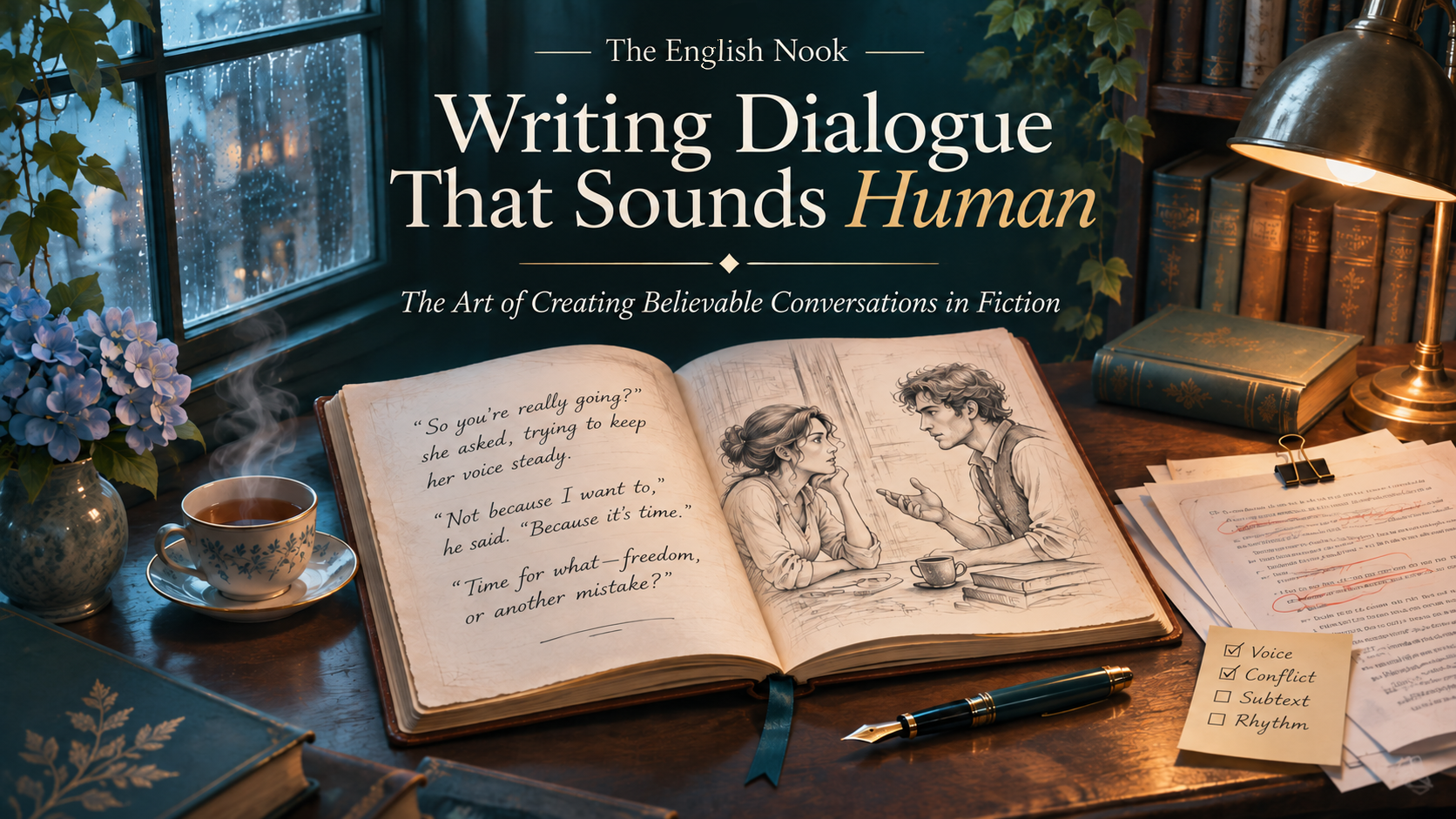

Writing Dialogue That Sounds Human
A writer’s guide to voices that disagree, hesitate, conceal—and reveal.
Good dialogue rarely sounds exactly like a transcript. Real conversations are full of unfinished sentences, repetitions, misunderstandings, and words that do no useful work on the page. Fiction uses those features selectively, creating the impression of spontaneous speech without reproducing every hesitation.
A writer chooses which hesitations carry meaning. The pause before a confession may matter; the ordinary pauses on the way to the door probably do not. The aim is selective realism: dialogue shaped by intention but still alive to surprise.
This is especially important when writing in a second language. Correct grammar is a starting point, not the whole craft. The scene must also tell us who is speaking, what each person needs and why their words cannot do all the work.
1. Information Is Not the Same as Conversation
Consider a stiff exchange: “Hello, Peter. I am upset because you did not telephone me yesterday.” “Hello, Anna. I apologise for failing to telephone you.” The information is clear, but the speakers sound as though they are reading a report.
Now try: “You didn’t call.” “I know.” “You said you would.” “Anna—” “Don’t.” The facts have not changed. The scene now has rhythm, resistance, and something left unsaid.
The revised exchange is shorter, but that is not why it succeeds. Anna expects Peter to understand the accusation. Peter knows exactly what it means. Neither needs to announce the emotional history. His unfinished reply tells us he wants to say more; her interruption tells us she does not intend to let him.
A useful test: cover the dialogue tags and read only the spoken lines. If each character repeatedly explains facts they both already know, the conversation may be delivering information for the author’s benefit rather than serving the scene.
Writers often need to provide background. The solution is not to ban explanation entirely. Let a new fact surface because someone wants to defend it, hide it, challenge it, or use it as leverage.
2. Give Each Speaker Something to Want
Dialogue works through purpose. Each speaker wants something: reassurance, information, permission, an advantage, or a way out. A character may answer a question without addressing what the other person actually needs. “Where were you?” can receive the reply, “Do we have to do this now?” The avoidance becomes part of the story.
Imagine a museum curator and a cleaner standing before a locked storeroom. The curator wants a missing key reported. The cleaner wants to finish the shift without being blamed. One may ask an apparently harmless question; the other hears the accusation beneath it.
“You were here after six?”
“The floors don’t clean themselves.”
“That’s not what I asked.”
“It’s what you meant.”
Nobody has said, “You suspect me of stealing the key.” We nevertheless understand that suspicion has entered the room. Each line alters what the other person is willing to admit.
The best scenes often give speakers conflicting immediate goals. One wants an explanation while another wants to leave. One wants forgiveness while the other wants a confession. A simple contrast in purpose can sustain several lines without dramatic vocabulary.
3. Subtext: The Words Under the Words
Subtext is the meaning an audience infers beneath what a character literally says. It may come from a contradiction, an evasive answer, an overcareful politeness or a detail that seems too small to mention.
Consider two friends in a café. One has just accepted a job overseas, and the other has not been told directly.
“So,” Maya said, turning the cup by its handle. “When were you going to tell me?”
“I was waiting until it was definite.”
“Is it definite now?”
“My flight’s on Monday.”
The flight is a fact. The emotional turning point lies in the first question: Maya is not asking for the date of the flight. She is asking why she was excluded. The final line deepens that hurt precisely because it answers the wrong question.
Subtext does not mean keeping every intention mysterious. If readers must guess everything, dialogue becomes a riddle. Let them know enough about the situation to interpret what is left unsaid.
4. Voices Are Habits, Not Costumes
Voice matters too, but voice is more than an accent written phonetically. A person may speak in precise sentences, make jokes under pressure, avoid certain words, or offer details nobody requested. Such habits suggest personality without forcing readers to decode every line.
Different voices are made through choices. Does a character use short answers when uncomfortable? Do they turn serious questions into jokes? Do they speak precisely at work but loosely among friends? Does their vocabulary change when they are frightened?
A practical technique is to write a character’s speech profile in three notes: typical sentence length, favourite conversational move, and one thing they avoid saying. A cautious witness might qualify every statement. An impatient manager may move rapidly from problem to instruction. Their voices will contrast without forcing exaggerated spellings.
Dialect and accent can contribute to voice, but their written representation requires care. A page full of invented phonetic spelling often draws attention to the writer instead of the character, and may caricature a real community. Regionally appropriate vocabulary, word order and context are usually more effective than spelling every sound differently.
5. Tags, Action Beats and the Invisible Stage
Dialogue tags should usually be unobtrusive. Said and asked often do their jobs perfectly. Strong verbs such as whispered or shouted are useful when they describe something a reader needs to know, not when they merely decorate an ordinary line.
Physical action can interrupt dialogue naturally. “I didn’t touch it,” Martin said, placing the umbrella behind his chair. A gesture may reinforce the words—or quietly contradict them. The most effective scenes let readers notice that contradiction for themselves.
The distinction between a dialogue tag and an action beat matters. In a common punctuation pattern, “I know,” she said uses a comma before the speech tag. By contrast, “I know.” She closed the door. treats the action as a separate sentence. Quotation styles vary between publishers, but the underlying distinction is useful.
One essential layout rule: in conventional prose fiction, begin a new paragraph whenever the speaker changes. Keep an action with the character who performs it so the reader does not have to guess who is speaking. The examples below separate speakers accordingly.
“I didn’t touch the file,” Ben said.
Mara pointed to his name on the sign-out sheet.
“Then why did you sign it out?”
We do not need she accused furiously because the action and the question convey the pressure. Physical details can also slow the pace: a character who folds a receipt before answering may be buying time, avoiding eye contact or simply tidying the table. Let the scene establish which interpretation matters.
Beware of the opposite problem: one elaborate gesture after every line. People do not need to grip a chair, raise an eyebrow and stare into the distance every time they speak. Choose actions that change the scene or help readers interpret the exchange.
6. Silence, Interruptions and Timing
Real speech has pauses; fictional dialogue gives pauses a function. An interruption may be an attempt to seize control. A delayed answer may tell us a character is choosing between truth and convenience. Silence may represent consent, refusal, shock, calculation—or simply a person who has not yet found the words.
Punctuation can suggest rhythm, but not solve a weak scene. An em dash often marks a sharp interruption: “I thought you—” “You thought wrong.” An ellipsis can suggest words trailing off. Use these devices with restraint. Too many visual interruptions make every character sound equally breathless.
A short sentence after a long one can also change the emotional temperature. Try letting a careful explanation end with a plain, unexpected answer: “No.” Sometimes one word carries the weight of a paragraph.
7. Before and After: A Scene Rewritten
First attempt
“I am disappointed that you moved my mother’s desk without consulting me,” Leah said.
“I moved your mother’s desk because it blocked the hallway,” Simon explained.
“The desk is emotionally important to me,” Leah responded.
This explains everything and dramatises almost nothing. The reader learns the facts without experiencing the relationship.
Revised
Leah stopped at the end of the hall.
“Where’s the desk?”
“I put it upstairs.”
“You put it upstairs.”
“Nobody could get past it.”
“Mum could.”
The new version changes very little of the event, but turns the physical object into a point of conflict. Leah’s repetition signals disbelief; Simon’s practical defence reveals his priorities; the last line exposes a loss without the words emotionally important.
That final line is deliberately subjective rather than a factual rebuttal. Leah is not conducting an argument about hallway dimensions. She is defending an association. Letting her answer from grief rather than logic is what makes the exchange human.
8. Try It Yourself — Six Dialogue Challenges
Challenge 1 · Remove the report
Rewrite: “I am angry because you arrived late for the third time,” Nora said. “I regret being late again,” Luis replied. Keep the same factual situation but reveal the frustration through rhythm, not explanation.
Show a possible answer
“Third time this week.”
“I know.”
“You always know afterwards.”
This keeps the repeated lateness visible without having Nora describe her emotional state directly.
Challenge 2 · Give the speaker a motive
A tenant asks a landlord why the heating is still broken. The landlord wants to avoid a firm promise. Write four to six lines. Use one evasive answer but make the reader understand the dispute.
Show a possible answer
“When will the heating be fixed?”
“I’ve spoken to the contractor.”
“When is he coming?”
“As soon as he’s available.”
“Is that this week?”
“I don’t want to give you the wrong date.”
The avoidance itself becomes the evidence of the conflict.
Challenge 3 · Put the argument in an object
Two colleagues disagree over who should present a shared project. Neither may say credit, fair or promotion. Let something on the table stand for their disagreement.
Show a possible answer
“You put your name first.”
“That’s how the slide opened.”
“You made the slides.”
“You sent the figures.”
Each character notices a different contribution. Neither has yet said what they actually want.
Challenge 4 · Change the voice
Write the line “I don’t think that will work” for three speakers: a cautious scientist, an exhausted teacher and a friend trying not to hurt someone’s feelings. Keep the meaning but change the rhythm.
Show a possible answer
Scientist: “I’m not convinced the result will hold.”
Teacher: “Not with thirty students and one printer, it won’t.”
Friend: “I can see why you like it. I’m just not sure it’ll help.”
Their registers reflect situation and relationship.
Challenge 5 · Replace the tag
Rewrite “I believe you,” Maria exclaimed suspiciously. Use an ordinary speech tag or a small physical action to carry the suspicion more convincingly.
Show a possible answer
“I believe you,” Maria said, keeping the unsigned form between them.
The action creates doubt without asking an adverb to do all the work.
Challenge 6 · The siblings and the house
Try this exercise. Write a short exchange between two siblings who disagree about selling their childhood home. Neither may use the words sell, money, or childhood. Give each one a distinct reason for the disagreement. Then remove any line that explains what the reader can infer.
Read the result aloud. If every character sounds like the same narrator, revise the rhythm and vocabulary. If the conflict disappears whenever a line is shortened, keep the line that carries it.
As an additional constraint, let the brother or sister who seems most practical reveal a personal reason only in the final two lines. The exercise is not about producing a clever plot twist. It is about noticing how a character can conceal a feeling even while speaking accurately.
Show a possible answer
“The blue curtains are still there.”
“They can stay.”
“You said the rooms had to be cleared.”
“I said the rooms. Not everything.”
The last line can begin to reveal what the practical speaker is protecting. Your own scene may end very differently.
9. One Final Read-Aloud Test
Natural dialogue does not mean random conversation. It means purposeful speech that still sounds as though the characters could surprise themselves.
Read the scene twice. The first time, listen for stiffness, repeated words and sentences nobody would say with this audience. The second time, listen for the moment each speaker adjusts to the other. Does a question cause a different answer? Does an unexpected sentence change the direction?
The possible revisions above are models, not answer keys with one acceptable wording. To test your work, ask: what changes between the first and last line? What does each person want? Which part is understood rather than explained? If the answers are clear, the dialogue is probably doing its job.
Give the scene to another reader without explaining the characters. Ask what each person wants and which line made them think so. Where interpretations disagree, decide whether the ambiguity is productive or accidental. Dialogue belongs equally to the characters who speak and the readers who listen.
Need a Spark? — Continue in the Nook
When Silence Becomes Part of a Conversation
Explore how pauses, hesitation and unfinished sentences communicate what characters cannot—or will not—say.
The Dictionary of Lost Apologies
See how dialogue between family members reveals regret, resentment and reconciliation without explaining every emotion.
When a Word Becomes a Warning
Discover how identical words can convey reassurance, uncertainty or threat depending on context and intention.