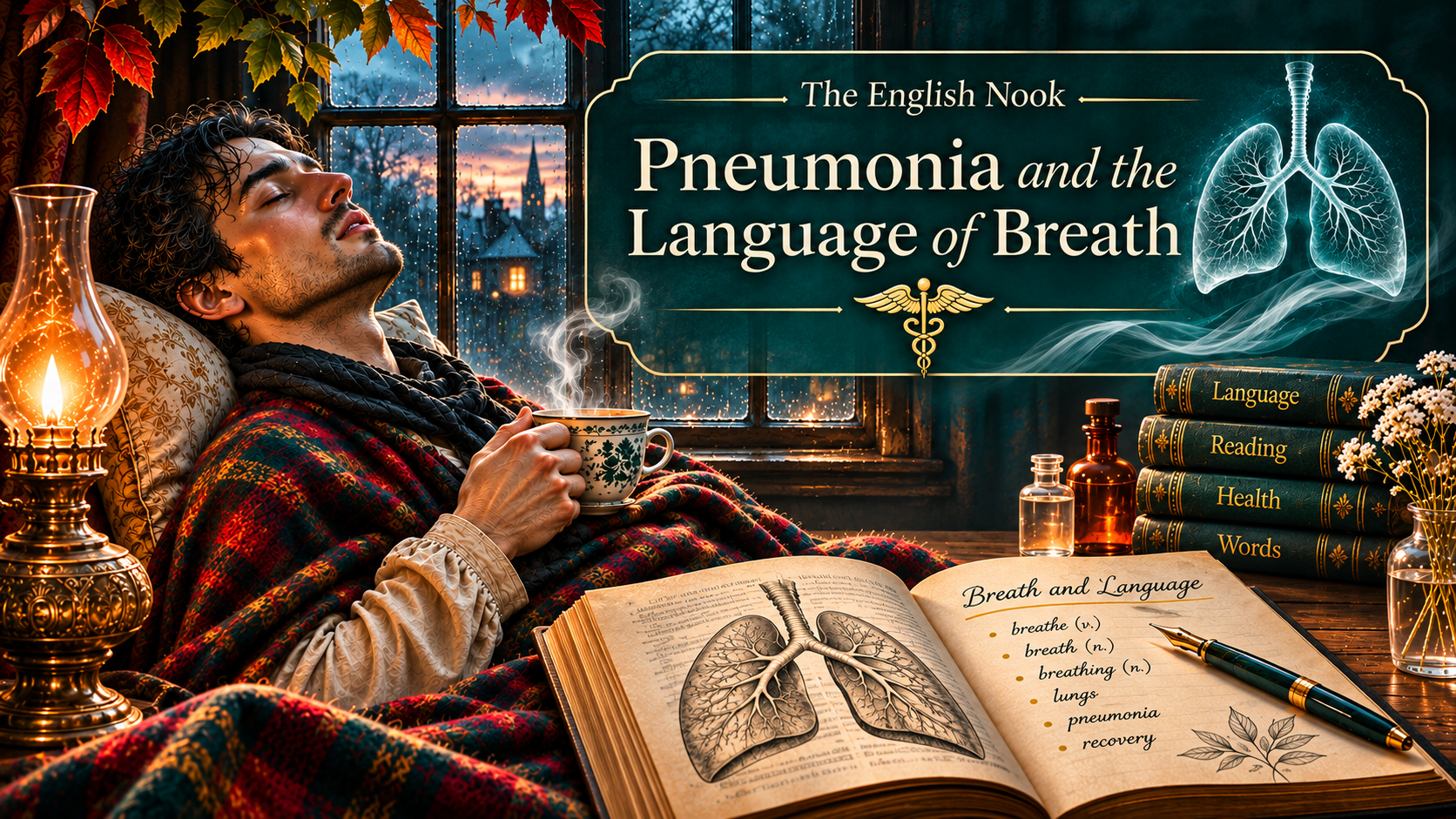

Pneumonia and the Language of Breath
A Silent Letter, Ancient Roots, and the Words We Use to Explain Illness
The first letter of pneumonia is never heard.
The p stands at the beginning of the word, perfectly visible on the page, and contributes nothing to its ordinary English pronunciation. It is a curious beginning for a word so closely associated with the difficulty of drawing breath.
On 12 November, World Pneumonia Day invites us to consider a serious illness that affects people across the world. Here at The English Nook, it also gives us an opportunity to consider something we sometimes overlook: the language we use to name illness, explain symptoms, and make ourselves understood.
Because pneumonia is not merely a medical term. It is a small record of the history of English—and a reminder that clear words can matter enormously.
The P That Refuses to Speak
In standard British English, pneumonia is pronounced /njuːˈməʊniə/; in American English, /nuːˈmoʊniə/. The stress falls on the second syllable. What neither pronunciation contains is a spoken initial p.
The explanation lies less in a mysterious rule of English than in the history of borrowing. Ancient Greek allowed certain consonant combinations, including an initial pn, that English speakers generally do not pronounce at the beginning of a word. When scholarly terms travelled from Greek into English, their spellings often kept more of their origins than their sounds did.
Something similar happens in pneumatic, psychology, and pseudonym. The written word carries a letter that ordinary modern English speech leaves behind.
To a learner, this may look unreasonable. To a historian of language, it is evidence. English spelling does not always tell us how to pronounce a word today; sometimes it tells us something about where that word has been.
Before the Illness Had an English Name
The route into English begins with ancient Greek pneumonía, a term for disease of the lungs, formed from pneúmōn, meaning “lung”. English acquired pneumonia through medical Latin around the beginning of the seventeenth century.
Nearby in the Greek vocabulary is pneûma: “breath”, “air”, or “wind”. It could also carry philosophical meanings associated with life and spirit. The words belong to a related history of thinking about breathing, air, and the body, although pneûma should not be mistaken for the direct source of the disease name.
That distinction matters. An attractive explanation is not always an accurate etymology. We may be tempted to say that pneumonia simply means “breath sickness”. It does not. Its more immediate Greek ancestry points specifically to the lungs.
Still, the association is revealing. Long before modern respiratory medicine, people understood that breath was more than an ordinary bodily function. To lose it was to lose something essential. The history of a word can preserve that understanding even as medical knowledge changes.
One Pair of Lungs, Several Languages
English has several ways to speak about the same part of the body, and each comes with a different history.
Lung belongs to the older, everyday Germanic vocabulary of English. Pulmonary comes from Latin pulmō, meaning “lung”. Pneumonia belongs to the Greek-derived vocabulary of medicine. Respiratory, from Latin, concerns breathing and the respiratory system more broadly.
Consider three sentences: “The lungs are affected.” “The patient has a pulmonary infection.” “The patient has pneumonia.” They concern related ideas, but they are not identical statements. Pulmonary describes a connection with the lungs; pneumonia names a particular illness.
A doctor may use specialist vocabulary because precision is necessary. A patient may prefer ordinary words because they are easier to understand. Neither kind of language is inherently better. The important question is whether the words fit the purpose and the audience.
English often lets us choose between an inherited everyday word and a Greek- or Latin-derived technical one. Learning to recognise that choice is useful far beyond medicine.
Breath and Breathe: A Small Difference with a Large Job
The ordinary English words are interesting too. Breath is a noun: “Take a deep breath.” Breathe is a verb: “Try to breathe slowly.” The final e changes both the grammatical job and the pronunciation. Breath is /breθ/; breathe is /briːð/.
Then come the phrases we use when something feels wrong: short of breath, having trouble breathing, breathing rapidly, and struggling to breathe. They are understandable descriptions, and their differences may be important.
Compare “He is breathless after running up the stairs” with “He is breathless while sitting still.” The same adjective appears, yet the circumstances change what the listener needs to understand. Good communication does not depend on an impressive word; it depends on useful detail.
Medical English has dyspnoea (American spelling: dyspnea) for difficult or uncomfortable breathing. Knowing the technical term may help someone read a report, but the simpler phrase shortness of breath can be more helpful in an ordinary conversation.
Being clear is not the opposite of being accurate. Often, it is part of accuracy.
When a Phrase Makes an Illness Sound Smaller
Some expressions are vivid enough to influence how we judge the illness they describe. Consider walking pneumonia.
The phrase is used informally for forms of pneumonia in which someone may feel well enough to carry on with ordinary activities rather than remain in bed. The image is memorable: a person is still walking, so perhaps they are not very ill.
But the expression can mislead if it becomes a promise of harmlessness. Pneumonia varies greatly in severity, and being able to walk does not mean that an infection deserves no attention. The phrase describes a common pattern; it does not guarantee an outcome.
Notice the difference between “It’s only walking pneumonia” and “They have pneumonia, but their symptoms have been relatively mild so far.” The second sentence is more careful. It tells us what is known without turning reassurance into certainty.
Words such as just, only, and nothing serious can be comforting when they are justified. When they are not, they may minimise a problem. One of the most useful language skills is knowing when not to make a situation sound smaller than it is.
The Grammar of Listening
Imagine someone trying to explain a symptom in a language they are still learning. They may know the word cough but not persistent. They may know tired but not fatigued. They may pause, search for a phrase, or describe what they feel with an imperfect comparison.
A poor listener hears the missing vocabulary. A careful listener looks for the meaning.
“When did the cough begin?” “Does it hurt when you breathe?” “Is the difficulty getting worse?” These are examples of direct questions that invite useful descriptions. They do not require a speaker to master medical terminology before being understood.
The same principle applies to written health information. A page can be scientifically accurate and still fail its reader if every sentence requires a dictionary. Explaining an unfamiliar term, choosing a concrete verb, or dividing a complicated thought into two sentences can make essential information more accessible.
Plain language is not childish language. It is language that takes the reader seriously.
Why This Word Matters Today
Pneumonia is an infection of the lungs, most commonly caused by viruses or bacteria, though fungi can also cause it. In some cases, inflammation and fluid in the tiny air sacs of the lungs interfere with breathing and oxygen exchange. The illness can affect people of any age, and it remains a major cause of preventable illness and death, particularly among young children.
World Pneumonia Day is therefore not simply a date on a calendar. It draws attention to prevention, recognition, treatment, and access to care. Information needs to travel between researchers, health workers, families, teachers, and communities. Along the way, complicated ideas must become understandable words.
That is where a language lesson becomes something more than a language lesson. The old Greek spelling explains why the p is silent. The contrast between breath and breathe helps us speak more accurately. The difference between a technical term and a plain description reminds us to consider who is listening.
None of this replaces medical knowledge or professional care. But knowledge can be difficult to use when it cannot be communicated.
The first letter of pneumonia may be silent. The people who need to speak about it should not have to be.
Check Your Understanding
Read the article carefully, then answer the questions in full sentences. Use details from the text rather than assumptions. The aim is to practise comprehension and precise expression—not to make a medical diagnosis.
1. Why is the initial p in pneumonia silent in ordinary English pronunciation? What does its spelling reveal?
2. Which Greek word lies directly behind pneumonia? Why would “breath sickness” be an inaccurate literal definition?
3. What is the difference between pulmonary and pneumonia? Explain using the information in the reading.
4. How do breath and breathe differ in grammar and pronunciation?
5. Why might the expression walking pneumonia lead a listener to underestimate an illness?
6. Compare “It’s only walking pneumonia” with “Their symptoms have been relatively mild so far.” Which is more careful, and why?
7. What does the author mean by saying that plain language is not childish language?
8. Explain the final sentence in your own words. How does it connect language learning with World Pneumonia Day?
Language in Use
A. Choose the right form. Complete the sentence: “She took a deep ______ and tried to ______ more slowly.” Use breath and breathe correctly.
B. Say it plainly. Rewrite “The patient is experiencing dyspnoea” in everyday English without changing the meaning.
C. Choose your words carefully. Rewrite “It’s just walking pneumonia, so there’s nothing to worry about” without claiming more certainty than the information allows.
Suggested Answers and Explanations
1. The initial p is retained in the Greek-derived spelling but is not pronounced in ordinary modern English. The spelling preserves part of the word’s history even though English pronunciation adapted.
2. It comes from Greek pneumonía, based on pneúmōn (“lung”). The related word pneûma refers to breath or air, but it is not the immediate source of the illness’s name.
3. Pulmonary means “relating to the lungs”; pneumonia names a particular lung infection. A pulmonary problem is not automatically pneumonia.
4. Breath is a noun (/breθ/), while breathe is a verb (/briːð/). Their spelling, vowel and final consonant sounds differ.
5. It can suggest that someone who can continue ordinary activities is necessarily well. In reality, the phrase does not guarantee that pneumonia is harmless or that symptoms will remain mild.
6. The second sentence is more careful. It reports the severity of symptoms so far, while the first minimises the illness with only and may imply unjustified reassurance.
7. Plain language explains difficult ideas in terms the reader can understand. Choosing clear expressions can improve accuracy because the audience is more likely to grasp what is meant.
8. Possible response: A silent letter is a harmless spelling peculiarity, but people describing illness must be listened to and understood. The observance highlights why access to clear health information and communication matters.
A. “She took a deep breath and tried to breathe more slowly.” The first gap requires a noun; the second requires a verb.
B. “The patient is finding it difficult to breathe.” This expresses the meaning without an unfamiliar specialist term.
C. Possible rewrite: “They have what’s sometimes called walking pneumonia, but symptoms and severity can vary.” This removes the unsupported guarantee of safety.
Further Reading and Sources
For the word itself, visit Pneumonia — Word Nook. For public-health context, see the World Health Organization’s overview of pneumonia and the CDC’s information about walking pneumonia.
For pronunciation and word history, consult the Oxford Advanced Learner’s Dictionary and the Online Etymology Dictionary.
Need a Spark?
Explore the word’s meaning, pronunciation, etymology and medical usage.
Almost the Same — Why English Synonyms Are Never Quite Equal
See why choosing one word instead of another changes the impression you create.
Reading Between the Lines — Understanding Inference in English
Practise drawing careful conclusions from what a text actually says.