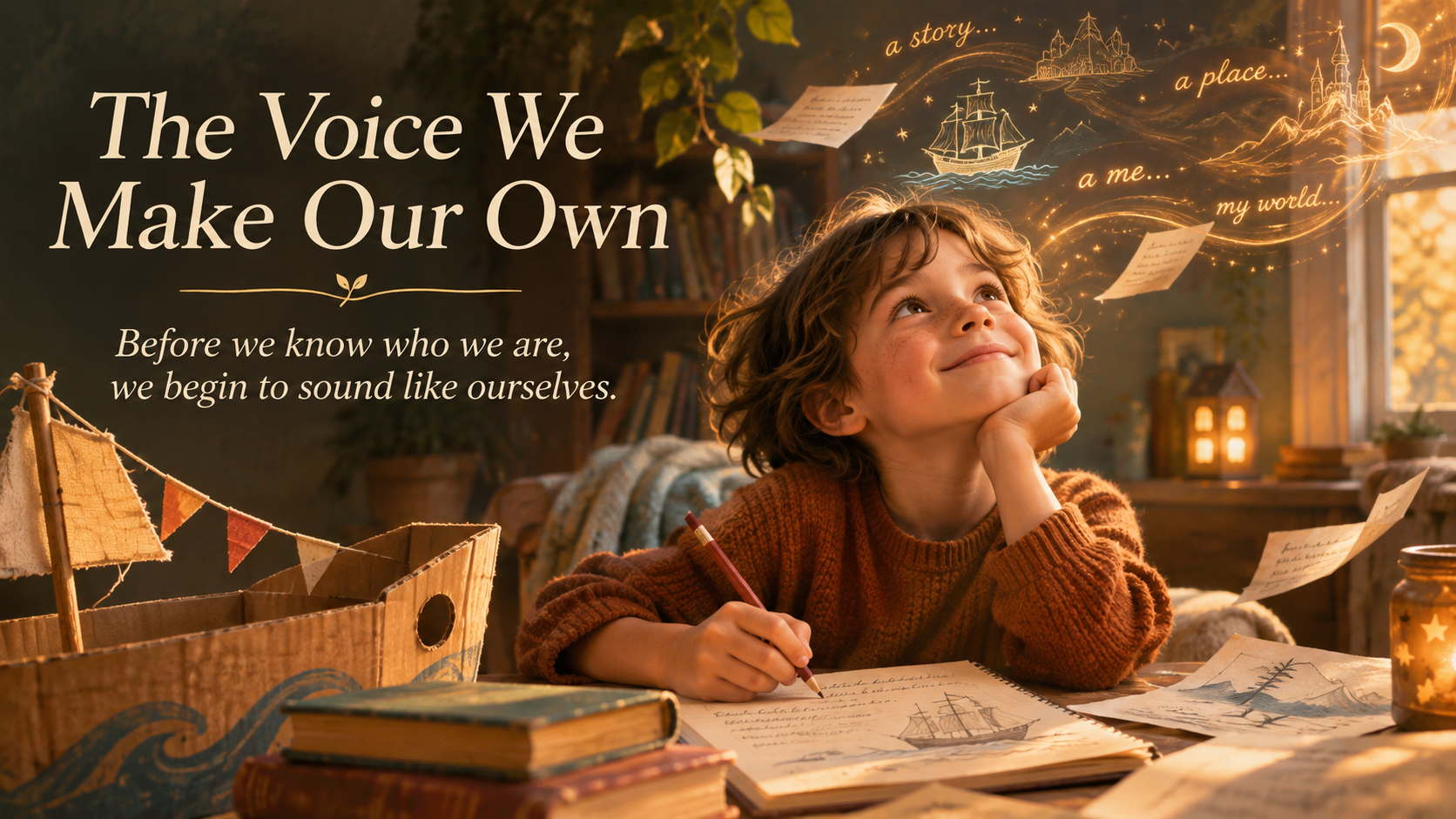

The Voice We Make Our Own
Before we know who we are, we begin to sound like ourselves.
There is a time in childhood when a cardboard box can become a ship, a puddle can hold a second sky, and the question “Where does the wind go when it stops?” seems too important to leave unanswered.
At first, nearly all our words belong to other people. We hear them around the table, in stories, in laughter, in the voices that call us home. We repeat them, occasionally misunderstand them, and slowly discover what they can do. A word can summon someone from another room. A sentence can turn a stranger into a friend. A question can make an ordinary afternoon last much longer than anyone expected.
Then something begins to change. A child no longer simply repeats the world as it has been described. They start describing a world that no one else has seen in quite the same way.
The World Before It Has Enough Names
Children do not meet the world as a collection of settled explanations. They meet it as an endless succession of discoveries. Why does the moon seem to follow the car? Who decided that flowers should be called flowers? Can yesterday ever come back?
Some questions have clear answers. Others are really expressions of astonishment. They reveal the strange privilege of encountering familiar things before they have become familiar. A leaf turning in the air may deserve the same attention as a distant planet. A stone may be a treasure simply because it is unlike the other stones.
Language gives these discoveries a place to live. A child who names a favourite corner of the garden creates a private geography. One who invents a story about the clouds makes the sky a little more personal. The words may be borrowed, but the meaning begins to belong to the person using them.
The Wonderful Things Children Say
Anyone who has spent time with children has heard an expression that no dictionary quite prepares us for. A cloud becomes a sleeping mountain. A shadow is something that follows without footsteps. The last light of evening is the sun putting its colours away.
Such expressions are not always clever attempts at poetry. Often they are simply the closest words available for something newly noticed. Children make comparisons because the world is still full of unfamiliar things, and the familiar ones offer a way of reaching towards them.
Sometimes an invented phrase survives in a family long after the child has forgotten saying it. It enters conversations, acquires a history, and becomes one of those peculiar expressions that make sense to a few people and almost nobody else. What began as a discovery becomes a small piece of shared memory.
A pronunciation may change. A curious expression may disappear. Yet the habit behind them—the desire to see things afresh, to find a name that feels right—can remain long after childhood.
Not Every Voice Sounds the Same
We often imagine a child’s voice as something bright, loud and full of questions. Some certainly are. Others prefer to observe before speaking. Some tell elaborate stories; some draw them. Some express themselves in songs, gestures, signs, writing, movement or a careful arrangement of objects that matters enormously to them.
There is no single way for a personality to become visible. A child who builds the same imaginary city every afternoon may be exploring an entire world without giving it a speech. Another may have a hundred questions and ask only one of them aloud. A quiet voice is still a voice, and it need not resemble anybody else’s to be unmistakably its own.
Over time, these small preferences begin to form a pattern. Particular jokes, favourite stories, stubborn curiosities and unexpected ways of seeing things gather around a growing person. An identity is not announced all at once. Often it emerges in details so ordinary that we scarcely notice them until they have changed.
The First Time We Say “I”
There is something remarkable about learning to speak of oneself. The word I is among the shortest in English, but it opens an enormous space. I think. I remember. I wonder. I want to try. Each sentence places a small, developing person somewhere in the world.
Of course, that voice is never formed entirely alone. We inherit expressions, accents, stories, silences and habits from those around us. We learn by listening, watching and being part of other people’s lives. Yet even within the same home, no two children gather precisely the same meanings from what they hear.
One remembers a joke. Another remembers the way the rain sounded on the roof. Someone asks why things are the way they are; someone else imagines how they might be different. From the same surroundings, different worlds begin to grow.
Perhaps that is what makes finding a voice so extraordinary. It is neither a complete invention nor a simple inheritance. It is the gradual making of something personal from all that has reached us.
What We Carry Into the World
As we grow older, our questions change. We become better at explaining what we mean, and sometimes less willing to say something that might sound foolish. We learn which words suit a classroom, a friendship, a family conversation or a room full of strangers. We also discover that being understood is not always easy.
Still, childhood leaves traces in the way we speak. They survive in a nickname for a familiar place, an expression borrowed from home, a story we keep retelling, or the sudden wish to ask a question that everybody else seems to have stopped asking.
We begin with voices that reach us from outside. Little by little, we answer in words, images, laughter, questions and stories of our own. And somewhere in that long exchange, a voice emerges that could never belong to anybody else.
We are given the words. We spend a lifetime discovering what only we can say with them.
Need a Spark? — Continue in the Nook
The First Voice We Learn
Return to the earliest sounds of comfort, recognition and human connection.
The Hands That Teach
Explore the quiet lessons we carry from the people who showed us how to meet the world.
Voice — Word Nook
Follow a familiar word from the sound we make to the identity we express.