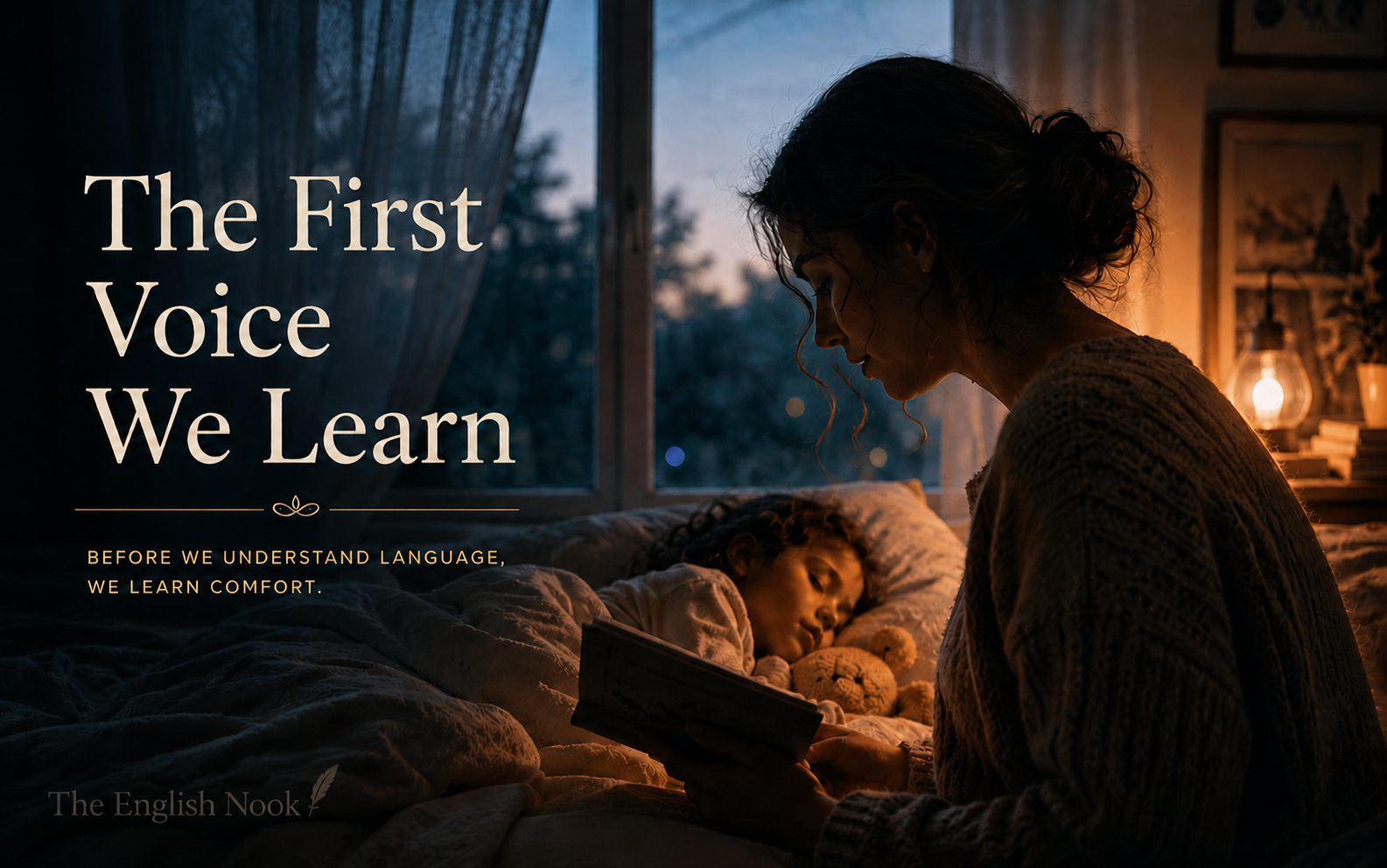

The First Voice We Learn
Before we understand language, we learn comfort.
There is a moment in every human life before grammar, before vocabulary, before meaning itself becomes clear.
And yet, language has already begun.
Not through definitions.
Not through rules.
But through voice.
Long before children understand words, they begin recognizing rhythm, tone, repetition, warmth, and emotional intention. A familiar voice can calm fear before meaning is understood. A gentle tone can create safety before language is fully formed.
Perhaps this is why the earliest layer of language is not intellectual.
It is emotional.
Language Begins as Sound
Scientists have long observed that babies respond to voices even before birth. Rhythm and tone arrive before vocabulary does. A child may not understand a sentence, but they often understand whether it carries comfort, tension, affection, or calm.
In this sense, language begins musically.
The human voice becomes one of the first ways we experience the world:
- soft or harsh
- patient or hurried
- near or distant
- safe or uncertain
Meaning comes later.
First comes feeling.
This may explain why certain voices remain emotionally powerful long after childhood. Even as adults, people often remember not only what was said to them, but how it sounded.
The emotional shape of language stays with us.
Before Words, There Was Rhythm
Many early interactions between adults and children are repetitive:
- lullabies
- nicknames
- short phrases
- gentle repetition
- familiar sounds
These patterns help children recognize structure before they understand content.
A repeated:
“It’s okay.”
may become meaningful emotionally before it becomes meaningful linguistically.
The same is true across cultures. Almost every language develops softer forms of speech when speaking to children:
- slower rhythm
- melodic intonation
- simplified sounds
- repeated emotional cues
Not because children understand less — but because humans learn connection before abstraction.
Language first arrives as presence.
Why Certain Words Feel Different
Some words carry emotional weight far beyond their literal meaning.
A name spoken gently.
A familiar greeting.
A phrase repeated through childhood.
These expressions often remain emotionally charged for years because they were connected to safety, routine, affection, or memory.
Sometimes we think memory is attached to events.
But often, memory is attached to voices.
The way someone said:
“Come here.”
“Good night.”
“Are you okay?”
“I’m here.”
Language becomes part of emotional architecture.
And perhaps this is why human speech can never be entirely reduced to information.
Even the simplest sentence carries tone, intention, and emotional texture.
The Voice Inside Language
As people grow older, vocabulary expands and language becomes more complex. We learn persuasion, explanation, precision, analysis.
But underneath all of it, the older layer often remains.
The emotional layer.
The human voice still carries:
- reassurance
- urgency
- tenderness
- distance
- care
- exhaustion
- love
Sometimes without a single explicit word.
This is why reading aloud feels different from reading silently. Why hearing someone speak can feel more intimate than receiving a message. Why certain accents or rhythms immediately evoke memory.
The voice reminds us that language was never only built for information.
It was built for connection.
Why It Matters
We often think language begins when we learn our first words.
But perhaps language begins earlier than that.
Perhaps it begins:
- when someone comforts us
- when a voice becomes familiar
- when rhythm creates calm
- when sound begins to feel safe
Long before we understand language, we begin learning what human closeness sounds like.
And maybe that is why the first voice we learn is never fully forgotten.
Even after words change, the feeling remains.
A language is never only grammar.
Sometimes, it is the memory of being understood
before we even knew how to speak.
→ Read more interesting articles
→ Read a story
If this stayed with you, consider leaving a like, sharing it, commenting, or all three — some voices remain with us long after the words themselves are gone.