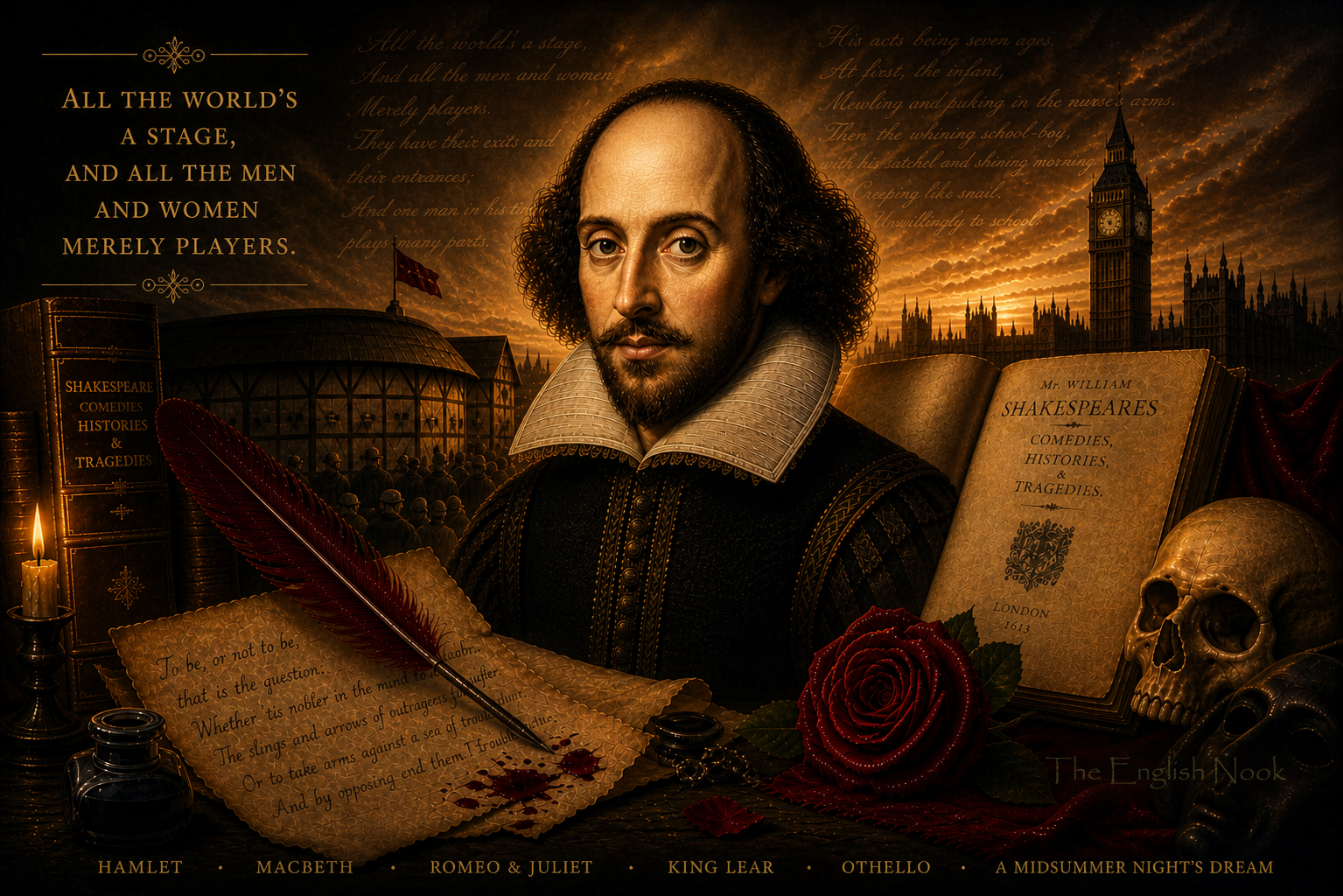

Shakespeare — Why English Feels Different After Him
April 23 and the moment expression in English became something more
Some changes are not immediate.
They settle slowly—until one day, everything feels different.
A Language That Could Speak, But Not Yet Stretch
Before Shakespeare, English was already a functional language.
It could describe actions, give instructions, tell stories. It was capable, structured, and increasingly used across different domains of life. But in many ways, it still lacked flexibility. Expression often remained direct, sometimes rigid, and limited in how far it could extend into emotion, ambiguity, or subtle thought.
Language existed.
But it had not yet fully learned how to move.
When Expression Began to Expand
Shakespeare did not simply use English—he pushed it.
He stretched meanings, combined words in unexpected ways, and allowed language to reflect thought more naturally. Instead of forcing ideas into fixed forms, he let sentences unfold with rhythm, hesitation, and variation.
He introduced new words.
He reshaped existing ones.
He allowed language to follow emotion, rather than control it.
This is where something shifted.
English became more than a tool for communication.
It became a medium for exploration.
Rhythm, Thought, and the Shape of Meaning
One of Shakespeare’s most powerful contributions was not only what he said, but how he structured it.
His use of rhythm—particularly in verse—allowed language to carry meaning beyond vocabulary. The movement of a line, the pause within it, the way a thought extended or broke—these became part of the message itself.
A sentence could hesitate.
A word could arrive later than expected.
A line could carry tension simply through its structure.
Language began to feel alive—not because it changed completely, but because it became capable of reflecting how people actually think and feel.
Not Just Words, But Ways of Saying Things
Many of the expressions we still use today are connected, directly or indirectly, to the flexibility Shakespeare helped establish.
But his real impact goes beyond individual phrases.
He expanded:
- how emotion could be expressed
- how contradiction could exist in a sentence
- how meaning could remain open, rather than fixed
This is why his influence is still present—not only in literature, but in everyday language.
We don’t just use words he wrote.
We use the possibilities he created.
The Language We Still Inhabit
Modern English is fluid, adaptable, and capable of expressing complex emotional and intellectual ideas.
That flexibility did not appear suddenly—but Shakespeare represents a moment where it became visible.
A moment where language stopped being only a structure,
and became something that could shift, stretch, and respond.
That is why English feels different after him.
Not because everything changed at once—
but because the limits quietly moved.
Why It Matters
Understanding Shakespeare is not about memorizing texts or studying history.
It is about recognizing how language evolves.
When you read poetry, when you notice rhythm, when meaning feels implied rather than directly stated—you are already experiencing that shift.
The language you use today carries traces of that transformation.
And once you notice it,
you begin to understand not just what English says—
but what it allows.
Final Thought
Language does not change in a single moment.
But sometimes, it reaches a point where it begins to move differently—
more freely, more deeply, more like thought itself.
And once it does,
everything that follows carries that movement forward.

English didn’t change overnight.
But after Shakespeare,
it never felt the same again.
If you’ve read everything, please consider leaving a like, sharing, commenting, or all three!