
The Firebreak
He had spent twelve years in the forest and had learned one rule above all others:
Fire does not move like weather.
It moves like intent.
By the time Elias saw the smoke turn from gray to black, it was already too late.
The wind shifted once, hard and sudden, and the ridge behind him vanished beneath a wall of heat. Pines began to crack like gunshots. Dry brush ignited in bursts. The fire did not spread—it lunged.
He ran.
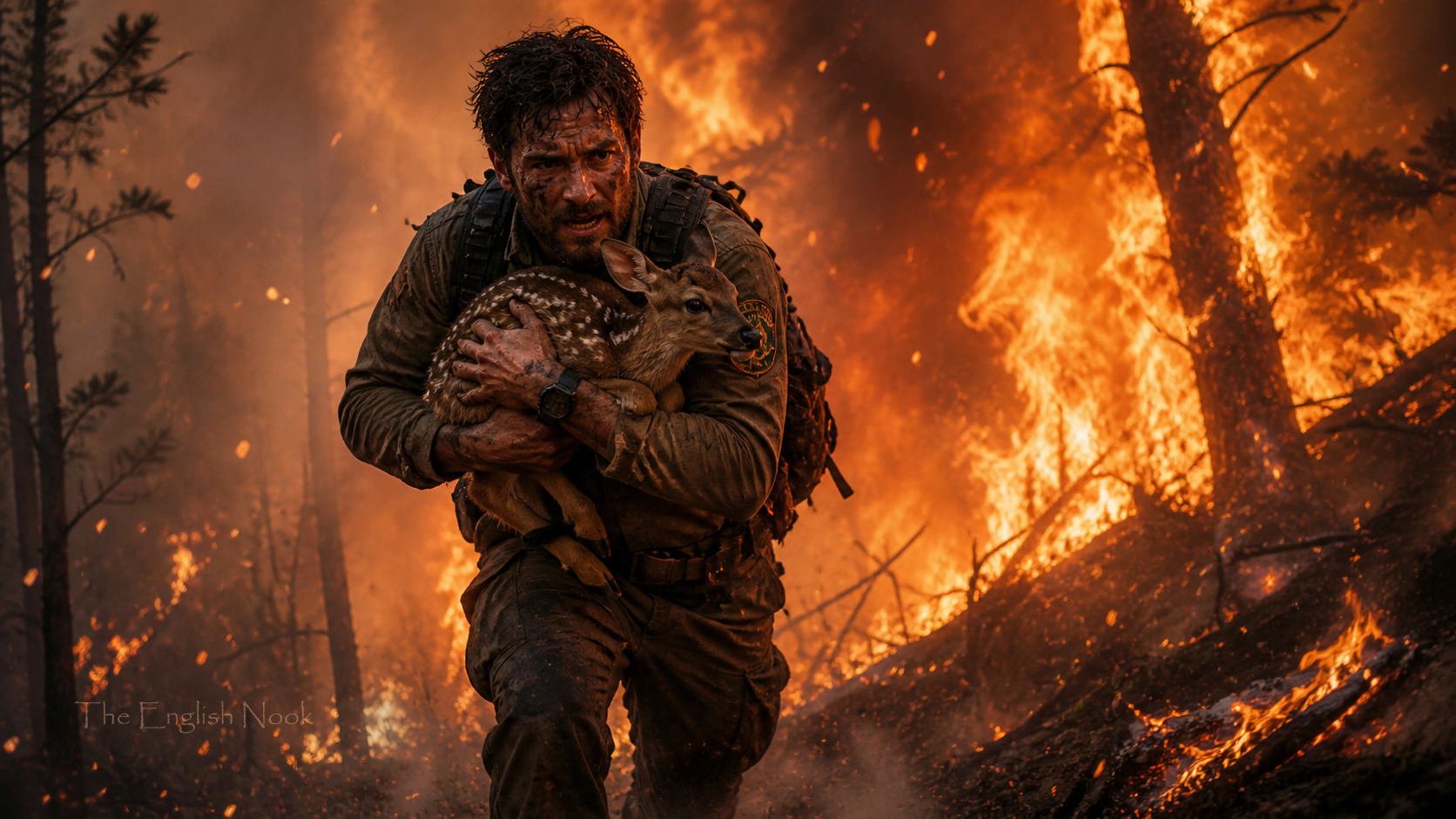
Downhill first, boots tearing through ash and roots, one arm over his mouth, the other shielding his face from the sparks falling around him like burning rain. The air thickened fast. Every breath tasted scorched. The smoke pressed low, turning the world into flickering orange and shadow.
He knew better than to outrun the flames uphill. Knew better than to trust open ground. Knew better than to panic.
He panicked anyway.
A cedar exploded somewhere behind him.
He ducked instinctively and kept moving, lungs burning, eyes watering, ears full of wind and crackling timber. Branches rained embers. The heat was everywhere now—at his back, at his sides, beneath his feet.
Then he saw it.
A fawn, no bigger than a dog, standing rigid in the brush beside the trail.
Too still.
Too quiet.
Its ears twitched toward him, but it didn’t run.
Elias stopped just long enough to see what the smoke had already hidden from mercy: no mother in sight, no movement in the trees, no call coming back for it.
The fire snapped through the brush behind them.
“Bad place to freeze, kid.”
He lunged, scooped the animal into his arms, and ran again.
It kicked once in panic, then went rigid against his chest, trembling so hard he could feel it through the smoke and sweat and pounding in his own ribs.
He carried it through flame-shadow and falling ash, through gullies choked in smoke and trails already gone. The world narrowed to instinct: run where the wind thinned, duck when the trees groaned, breathe when the smoke lifted, move when it didn’t.
The fawn stayed pressed against him, heart hammering like a second pulse.
Once, he nearly dropped it crossing a fallen trunk half-swallowed in flame.
Once, he stumbled into a patch of burning brush and came out with his sleeve smoking.
Once, he thought he saw the fire ahead of him too.
That was when fear became something simpler.
Not terror.
Math.
Distance. Wind. Breath. Heat.
How much farther.
How much longer.
How much left.
His legs began to fail before his will did.
The ridge opened into blackened scrub and stone, but by then his lungs were raw and each breath came thin and sharp. His knees buckled once. Then again.
He kept moving.
The fawn wriggled suddenly in his arms.
“No.”
It kicked harder.
“Not now.”
He tightened his hold and took three more steps before the world tilted under him.
He fell hard to one knee, then both.
The impact knocked the breath from him. The fawn slipped free, stumbled into the smoke, and disappeared.
Elias dropped a hand into the ash and tried to stand.
Nothing answered.
The fire roared somewhere behind him, closer than it had any right to be.
He lowered his head.
That, he thought dimly, was that.
Then came the sound of tiny hooves.
He looked up.
The fawn stood several yards ahead, half-veiled in smoke.
Watching him.
It turned and bounded forward.
Stopped.
Looked back.
Elias stared.
The fawn stamped once.
Then ran again.
Not away.
Leading.
Elias dragged in a breath like broken glass and pushed himself upright.
The animal darted ahead, weaving through stone and scrub, pausing just enough each time to make sure he followed. Elias staggered after it, half blind, half spent, one step and then another, following the pale shape through smoke he no longer trusted himself to read.
Then, all at once, the heat broke.
The smoke thinned.
The ground dropped sharply beyond the brush into a narrow river cut hidden behind the ridge—stone, water, clean air.
A firebreak.
Twenty more steps and he collapsed beside the stream, coughing black into the current while the flames tore past above them, close enough to hear, too far now to touch.
The fawn stood at the bank watching him.
Alive.
Hours later, when the smoke cleared and the rescue crews found him, the fawn was still there.
They tried to lead it away.
It came back.
They brought Elias into town.
The fawn appeared two days later in the yard behind the ranger station.
Someone from rehabilitation came to collect it.
It came back again.
And again.
In the end, Elias kept it—not because he had meant to, and not because it belonged with him.
But because, for reasons neither of them seemed interested in explaining, the little thing had already decided he did.

Some things survive the fire. Some stay.
Thank you for reading “The Firebreak”! This is a story in a series created for avid readers and English learners who want to enjoy captivating tales while practicing their language skills. Stay tuned for more stories and language tips to enhance your journey!
Explore more short stories in English and Spanish by visiting the section:
Short Stories / Cuentos Cortos
When the world feels dull, your mind restless, or your heart heavy, let a story be your escape. Just one page, one sentence, one word—and suddenly, you’re somewhere new, where imagination breathes life into the ordinary and turns the simplest moments into magic.
Liked it? Smash that like button!