
The Hidden Order Beneath Human Chaos
Why human language keeps returning to nature to describe itself
Cities expanding.
Traffic flowing.
Voices crossing voices until everything begins sounding like movement more than meaning.
Crowds gathering. Crowds dissolving.
Information spreading faster than reflection.
Millions moving through invisible systems nobody fully sees.
Humans often describe modern life as chaotic.
And perhaps it is.
Yet something strange happens when humans try to describe that chaos.
Language keeps returning to nature.
We speak about viral ideas, social ecosystems, waves of migration, swarm behavior, echo chambers, roots of conflict, information flowing, branching systems, hive minds.
Even surrounded by technology, people continue borrowing the language of forests, rivers, insects, weather, and migration to explain themselves.
Perhaps that is not accidental.
For a long time, humans imagined civilization as something separate from nature — more rational, more controlled, more organized.
But the deeper people looked into the natural world, the stranger that separation became.
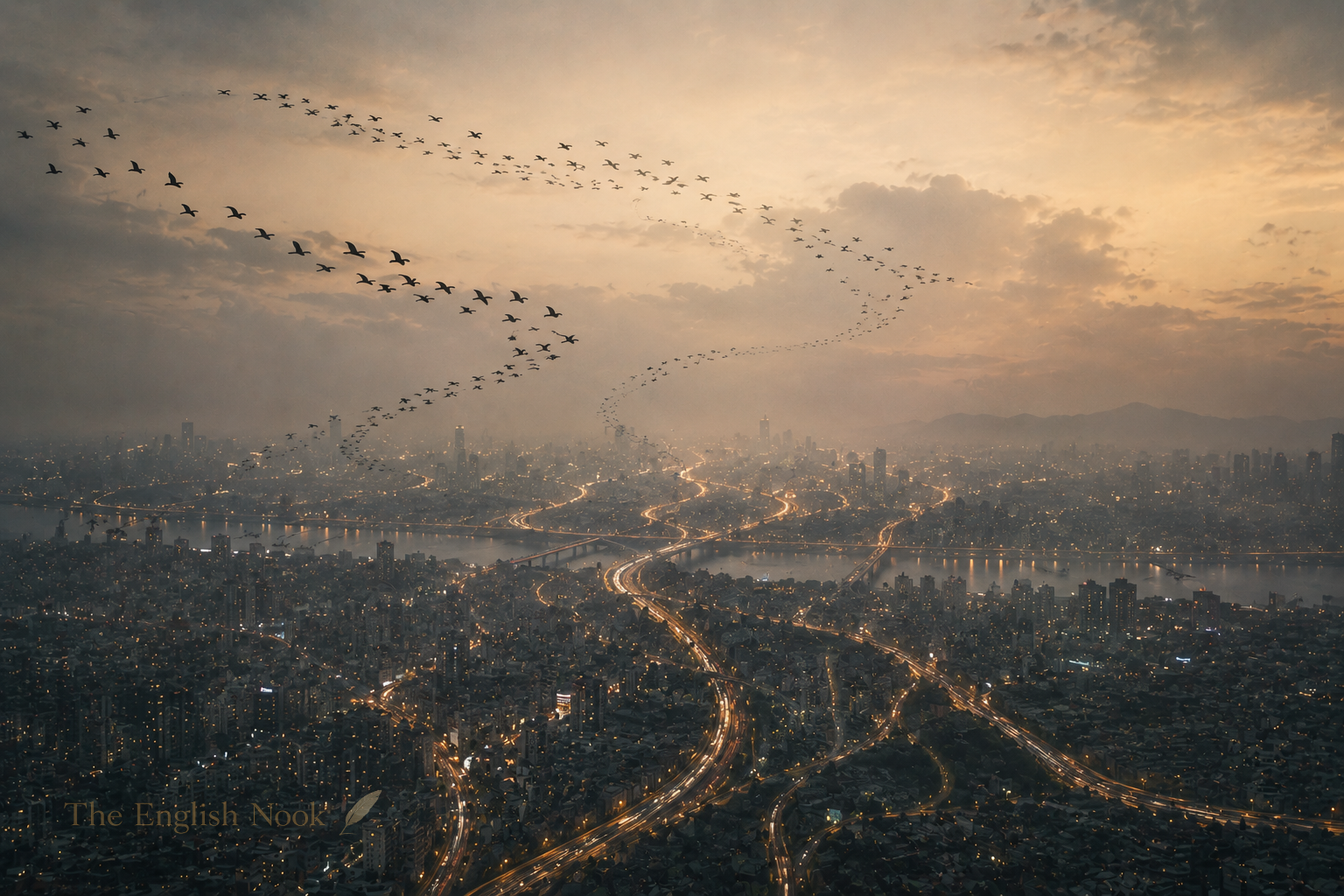
Birds move together almost like shared thought. Ant colonies organize without central leadership. Forests communicate underground through networks hidden beneath the soil. Hives pulse with coordination that feels almost architectural.
Again and again, what first appeared chaotic revealed another kind of order underneath.
And maybe that recognition never fully disappeared from human language.
A rumor does not simply spread.
It spreads like wildfire.
Ideas branch outward. Communities develop roots. Crowds swarm. Emotions ripple through populations almost like weather systems moving across a landscape.
Even the digital world increasingly depends on ecological language:
streams, clouds, webs, viral content, digital ecosystems.
As if modern life eventually became too complex to describe without returning to older patterns.
Perhaps that is the part humans recognize instinctively.
Not that civilization escaped nature.
But that it may still behave more like nature than people are comfortable admitting.
And maybe that is why human language keeps circling back toward rivers, storms, migration, roots, and hives — not simply because nature is poetic, but because somewhere beneath the noise, humans still recognize those systems inside themselves.
Perhaps what humans call chaos is sometimes only a pattern too large — or too alive — to immediately understand.
→ Continue wandering
→ Read a story