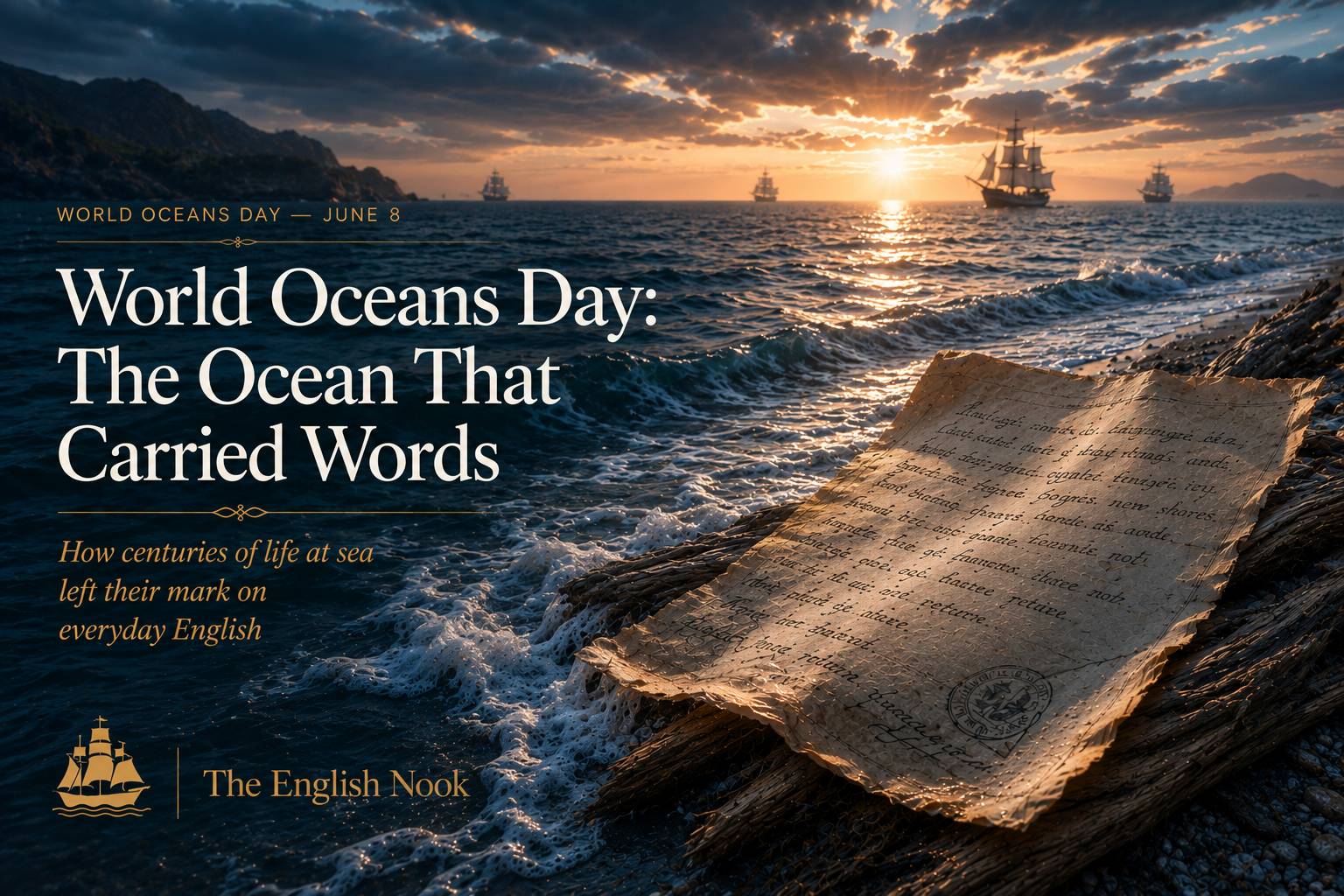

World Oceans Day: The Ocean That Carried Words
From “starboard” to “all hands on deck,” how centuries of life at sea left their mark on everyday English.
Long before airplanes crossed continents and trains connected cities, the sea was humanity’s great highway. Oceans carried explorers, merchants, migrants, armies, and ideas across the world. They also carried words. Many expressions that English speakers use every day began aboard ships, in ports, or among sailors navigating uncertain waters. On World Oceans Day, it is worth remembering that the ocean shaped not only history and trade, but also the language we speak.
A World Connected by Water
World Oceans Day is observed every year on June 8 and highlights the importance of the world’s oceans to life on Earth. Oceans regulate climate, support ecosystems, provide food, and connect distant regions of the planet.
The idea for World Oceans Day was first proposed during the 1992 Earth Summit in Rio de Janeiro. In 2008, the United Nations officially recognized June 8 as World Oceans Day, helping establish it as a global occasion for reflection on the role oceans play in our lives.
For much of human history, oceans also served as the primary routes of communication and commerce.
Before modern transportation, the sea was often the fastest way to move people, goods, and information. As English-speaking sailors, merchants, and explorers traveled across oceans, maritime vocabulary spread into everyday speech.
The result is a language filled with traces of life at sea.
When Sailors Gave English New Words
Many common English words began as technical nautical terms.
Consider:
Starboard – the right side of a ship.
Port – the left side of a ship and, later, a place where ships dock.
Cargo – goods transported by sea.
Harbor – a sheltered place where ships can anchor safely.
Buoy – a floating marker used to guide navigation.
These words remain closely connected to maritime life, but many others have traveled much farther into everyday English.
Expressions That Left the Ship
Some familiar expressions originated in the language of sailors.
Learn the ropes
Originally referred to sailors learning which ropes controlled different parts of a vessel. Today it means becoming familiar with a new activity, profession, or skill.
By and large
Generally believed to come from sailing terminology describing a vessel’s ability to sail effectively under different wind conditions. Today it means “generally” or “on the whole.”
Take the wind out of someone’s sails
Originally a literal sailing situation in which one vessel disrupted another’s wind. Today it means removing someone’s confidence, advantage, or momentum.
All hands on deck
Once a command used when every sailor was needed to assist the crew. Today it refers to situations requiring everyone’s participation and effort.
Many speakers use these expressions without realizing they carry centuries of maritime history.
Oceans, Trade, and the Growth of English
The rise of English as a global language cannot be separated from the ocean.
Ships connected England to Europe, the Americas, Africa, Asia, and Oceania. Trade routes transported not only goods but also vocabulary, introducing English speakers to new products, technologies, ideas, and cultural influences.
English did not become a global language through geography alone. It traveled aboard ships. Merchant fleets, fishing vessels, explorers, and naval routes carried English to distant ports, while bringing foreign words back into the language. The ocean became one of history’s greatest channels of linguistic exchange.
As English expanded through maritime networks, it absorbed influences from numerous languages and cultures, enriching its vocabulary and broadening its reach.
The Sea in Literature and Imagination
The ocean has also shaped English through storytelling.
From Beowulf and medieval voyage narratives to the adventures of sailors, explorers, and pirates, the sea has long occupied a central place in English literature.
It often represents:
- freedom
- danger
- discovery
- uncertainty
- possibility
These associations continue to appear in modern novels, films, and everyday metaphors.
Even people who have never sailed often describe life as a journey, challenges as storms, and opportunities as new horizons.
The language of the sea remains deeply woven into the language of imagination.
Why It Matters
World Oceans Day reminds us that oceans are more than physical spaces. They are routes through which ideas, cultures, and languages have traveled for centuries.
Many of the words and expressions we use every day began on ships crossing uncertain waters.
Language preserves these journeys.
The next time someone learns the ropes, calls for all hands on deck, or takes the wind out of someone’s sails, they are unknowingly repeating phrases shaped by generations of sailors and the vast oceans that connected the world.
Long after the ships have disappeared, their words continue to sail through the language.
→ Read more interesting articles
→ Read a story
If this stayed with you, consider leaving a like, sharing it, commenting,
or all three!