
World Bee Day
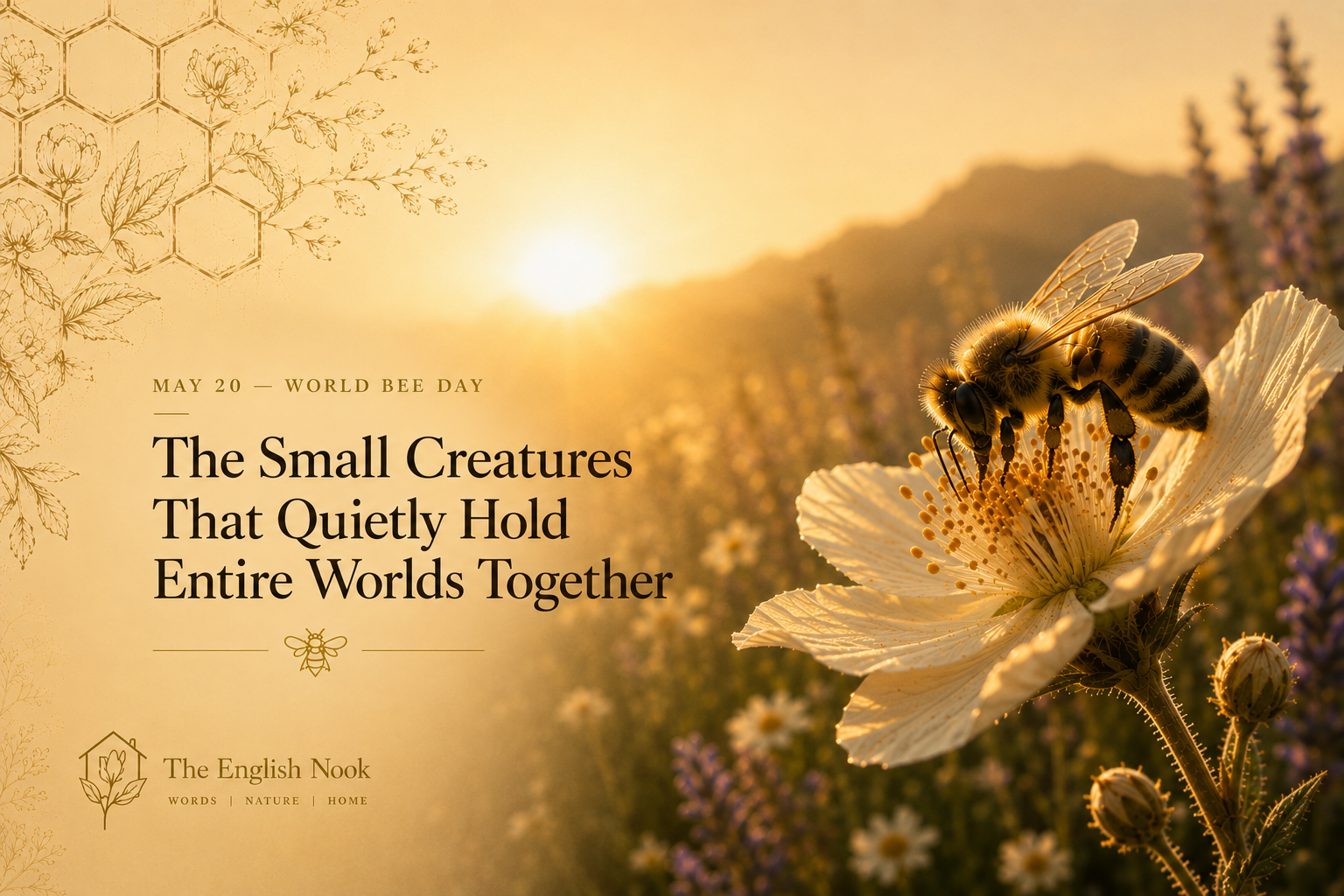
The Small Creatures That Quietly Hold Entire Worlds Together
May 20 — World Bee Day
How bees entered language, symbolism, and the human imagination
There are some creatures humans notice immediately because they are powerful, dangerous, or impossible to ignore.
Bees became important for almost the opposite reason.
They are small enough to disappear into flowers. Easy to overlook individually. Quiet compared to storms, predators, or larger animals. And yet, for thousands of years, human beings repeatedly understood that something essential was happening around them.
Fields became fertile. Fruit returned each season. Wildflowers spread across meadows. Entire landscapes remained alive because countless insects continued moving silently from plant to plant beneath human attention.
Long before modern ecology explained pollination scientifically, people already sensed that bees were connected to continuity itself.
Perhaps that is why they entered human imagination so deeply.
Across ancient cultures, bees became associated with harmony, cooperation, discipline, abundance, and survival. A hive seemed almost mysterious: thousands of insects moving together with a precision that felt strangely organized, almost architectural. Honeycombs appeared geometric and deliberate. Swarms moved like living clouds. The low hum surrounding a hive sounded less like chaos and more like rhythm.
Humans did not simply observe bees.
They began building meaning around them.
The Language Bees Left Behind
That meaning eventually entered language itself.
English is filled with words and expressions shaped by the behavior, sound, and movement of bees. Some entered language directly through imitation. Others became metaphors for human activity, work, communication, or collective life.
The word buzz is one of the clearest examples. It imitates vibration almost physically. Even today, when people talk about:
- media buzz
- social buzz
- buzz surrounding an event
the original sound of insect wings still survives quietly inside the word.
Something similar happened with hum. Unlike buzz, which feels energetic and sharp, hum became softer and more atmospheric — the kind of continuous background sound associated with hives, electricity, distant conversation, or life continuing quietly somewhere nearby.
Other expressions moved even further into metaphor.
To describe a crowded, energetic place as:
“a hive of activity”
is to borrow imagery humans have carried for centuries. Meanwhile, words like swarm and drone expanded far beyond insects and became part of how English describes crowds, machines, technology, and collective movement.
Even the expression:
“busy as a bee”
survived because generations of people repeatedly associated bees with constant movement and tireless work.
Bees did not only shape environmental vocabulary.
They helped shape the language humans use to describe society itself.
The Hidden Work Beneath the Landscape
Modern science later revealed something extraordinary: the importance of bees was even greater than earlier societies imagined.
Bees are among the world’s most important pollinators. Their movement between flowers supports enormous portions of plant life and agriculture across the planet. Fruits, crops, wild plants, and ecosystems all depend, in different ways, on pollination continuing season after season.
Without pollinators, landscapes begin to change quietly at first: fewer flowers, weaker harvests, less biodiversity, and more fragile ecosystems.
This transformed bees from:
useful insects
into something far more foundational.
They became symbols of interdependence.
Perhaps that is why conversations about bees often feel strangely emotional compared to discussions about many other insects. People instinctively understand that bees represent more than themselves. A single bee may appear insignificant, but a world without pollination becomes difficult to imagine.
And maybe that idea resonates because human life itself depends on invisible systems functioning continuously in the background.
Most people rarely think about pollination while walking through a meadow or eating fruit. Yet entire landscapes remain alive because countless tiny exchanges continue happening silently every day.
Why Bees Continue to Fascinate Us
Part of the fascination surrounding bees comes from contradiction.
A hive feels organized yet alive, collective yet fragile, almost mechanical yet deeply natural at the same time. Thousands of individual insects create structures that appear strangely deliberate: hexagonal honeycombs, coordinated movement, shared labor, collective defense, and constant adaptation unfolding simultaneously inside a single living system.
For centuries, writers, philosophers, and societies repeatedly returned to bees because hives resemble structures larger than the individual itself — cities, communities, economies, even civilizations. And yet bees never fully lose their connection to the natural world. They remain tied to meadows, flowers, sunlight, seasons, and wild landscapes.
Perhaps that is why bees continue appearing so often in literature, environmental writing, documentaries, and public imagination. They remind humans that some of the most important systems in life are also the quietest.
A meadow at sunset may appear still, but inside that stillness, invisible exchanges continue happening constantly: pollen moving between flowers, plants reproducing, ecosystems sustaining themselves, life quietly preparing for another season.
And maybe that is why bees feel emotionally larger than they truly are.
Not because they dominate nature.
But because they help hold it together.
Why It Matters
In recent years, scientists and environmental organizations have repeatedly warned about declining bee populations in different parts of the world. Habitat loss, pesticides, climate change, disease, and intensive agricultural systems have all been linked to the weakening of pollinator populations — especially among species humans rely on most heavily for agriculture and food production.
For many people, this realization changed how bees are perceived.
They are no longer seen simply as insects connected to honey or gardens. They have become symbols of ecological fragility and interdependence — reminders that entire systems can begin to weaken quietly, almost invisibly, long before humans fully notice the consequences.
Perhaps that is why conversations about bees often feel surprisingly emotional. A world with fewer pollinators is not only an environmental concern. It also feels like the loss of a certain balance between human life and the natural rhythms surrounding it.
And maybe that is the deeper reason bees continue to resonate so strongly in language, literature, and imagination.
They remind us that some of the smallest forms of life are also the ones quietly helping hold entire worlds together.
Some of the smallest creatures on Earth became responsible for sustaining entire landscapes — and eventually, entire metaphors in human language.

→ Read more interesting articles
→ Read a story
If this stayed with you, consider leaving a like, sharing it, commenting,
or all three!