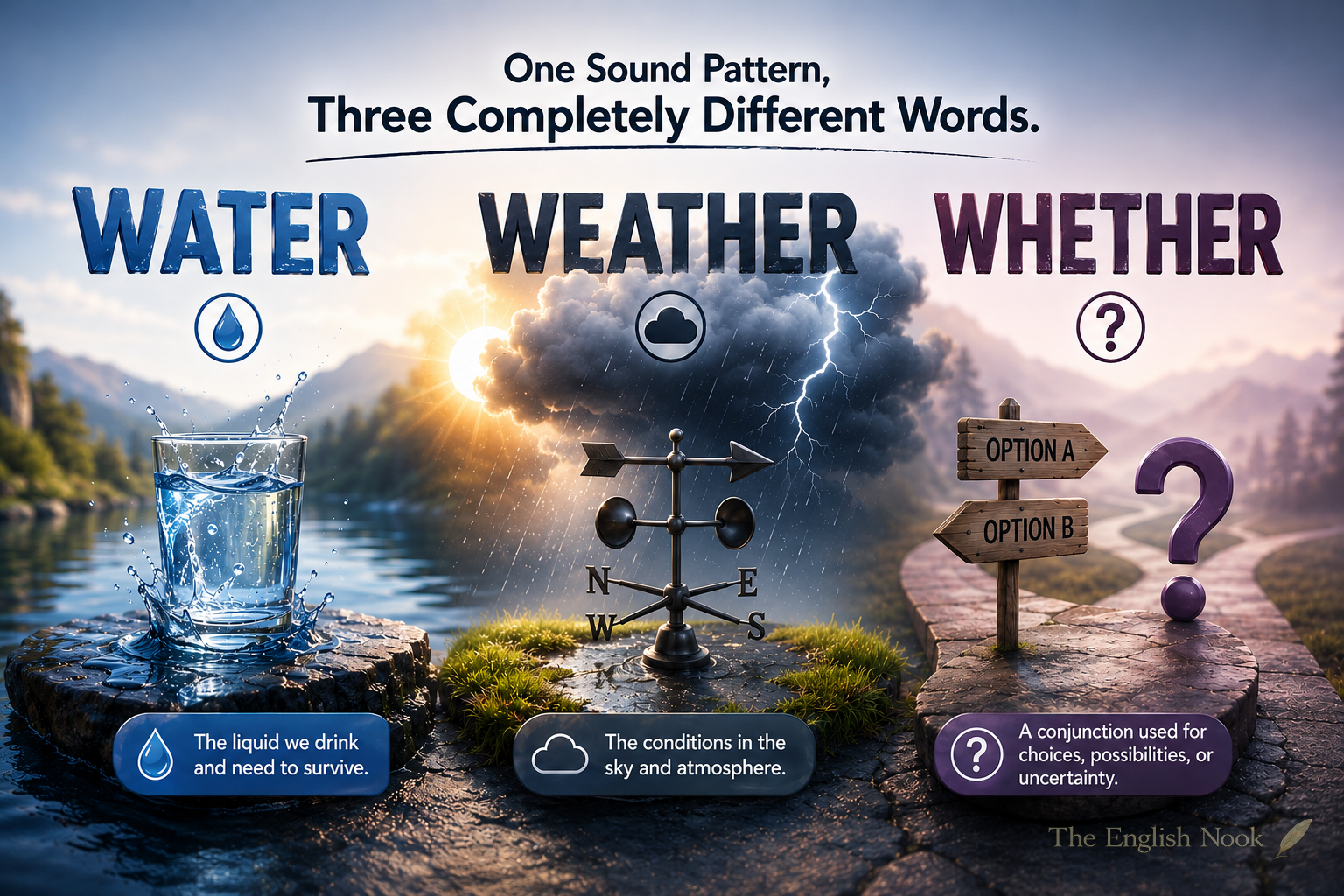

Water vs Weather vs Whether
One Sound Pattern, Three Completely Different Words
Three Common English Words That Sound Similar — But Mean Completely Different Things
Some English words are confusing not because they are especially difficult, but because they sound surprisingly similar in fast conversation.
Water, weather, and whether are a perfect example.
Although these three words look and sound related at first glance, they belong to completely different parts of English vocabulary and grammar.
And because native speakers often pronounce them quickly, many learners confuse them while listening, speaking, or writing.
Let’s separate them clearly.
Water
/ˈwɔː.t̬ɚ/ (American English) · /ˈwɔː.tə/ (British English)
Meaning:
Water is the transparent liquid that people, animals, and plants need to survive.
Examples:
- The water in the lake was freezing cold.
- Plants need water and sunlight to grow.
- We stopped near the river to drink water.
- After hours of walking through the forest, they finally found fresh water.
Pronunciation:
In many English accents, especially American English, water is pronounced more softly than learners expect. The t often becomes a quick flap sound, almost similar to a soft d.
This is one reason why learners sometimes confuse it with weather in fast speech.
Weather
/ˈweð.ɚ/ (American English) · /ˈweð.ə/ (British English)
Meaning:
Weather refers to atmospheric conditions such as rain, wind, heat, fog, storms, or sunshine.
Examples:
- The weather changed suddenly during the afternoon.
- Southern Chile is known for rainy weather.
- We stayed inside because the weather was terrible.
- Foggy weather covered the mountains all morning.
Important Difference:
Unlike water, weather is not a physical substance.
It describes atmospheric conditions and climate.
Common Expressions:
- good weather
- bad weather
- stormy weather
- weather forecast
Whether
/ˈweð.ɚ/ (American English) · /ˈweð.ə/ (British English)
Meaning:
Whether is a conjunction used when talking about possibilities, alternatives, or uncertainty.
Examples:
- I don’t know whether it will rain tomorrow.
- She asked whether we were ready to leave.
- Whether you agree or not, the decision has already been made.
- We were trying to decide whether to continue the hike.
Important Difference:
Unlike water and weather, whether is not connected to nature or physical things at all.
It is a grammatical word used to introduce alternatives, possibilities, or uncertainty.
Common Structures:
- whether or not
- whether we should…
- whether it is possible…
- whether they agree…
Seeing Them Together
Sometimes these three words can appear surprisingly close to each other in real English.
Example:
- We didn’t know whether the weather would improve, so we carried extra water during the hike.
Another Example:
- The hot weather made everyone drink more water, but nobody knew whether the storm would arrive before nightfall.
When learners see the words together inside real sentences, the differences usually become much easier to remember.
Common Learner Mistakes
❌ Incorrect:
- The whether is beautiful today.
✅ Correct:
- The weather is beautiful today.
❌ Incorrect:
- I don’t know weather we should leave now.
✅ Correct:
- I don’t know whether we should leave now.
❌ Incorrect:
- Can I have a glass of weather?
✅ Correct:
- Can I have a glass of water?
Why Learners Confuse Them
These three words create confusion for several reasons:
- similar pronunciation
- rapid native speech
- unfamiliar spelling patterns
- weak unstressed sounds in conversation
For many learners, weather and whether sound identical in spoken English.
And when water is pronounced quickly — especially in American English — it can also become surprisingly difficult to distinguish from the other two.
Quick Practice
Choose the correct word:
water, weather, or whether.
- We didn’t know ______ the storm would arrive before sunset.
- The ______ in the mountains changed very quickly.
- After the long hike, everyone needed fresh ______.
- She asked ______ we wanted to continue walking.
- Rainy ______ often covers the volcanoes in fog.
Answers
- whether
- weather
- water
- whether
- weather
A Simple Way to Remember Them
- Water → something you drink
- Weather → atmospheric conditions
- Whether → possibilities or alternatives
English sometimes hides completely different meanings inside nearly identical sounds.
And often, understanding them is less about memorizing rules — and more about learning to notice the small patterns hidden inside the language.

→ Profundiza más tu Inglés!
→ Lee una Historia
→ Explore English/Spanish sessions