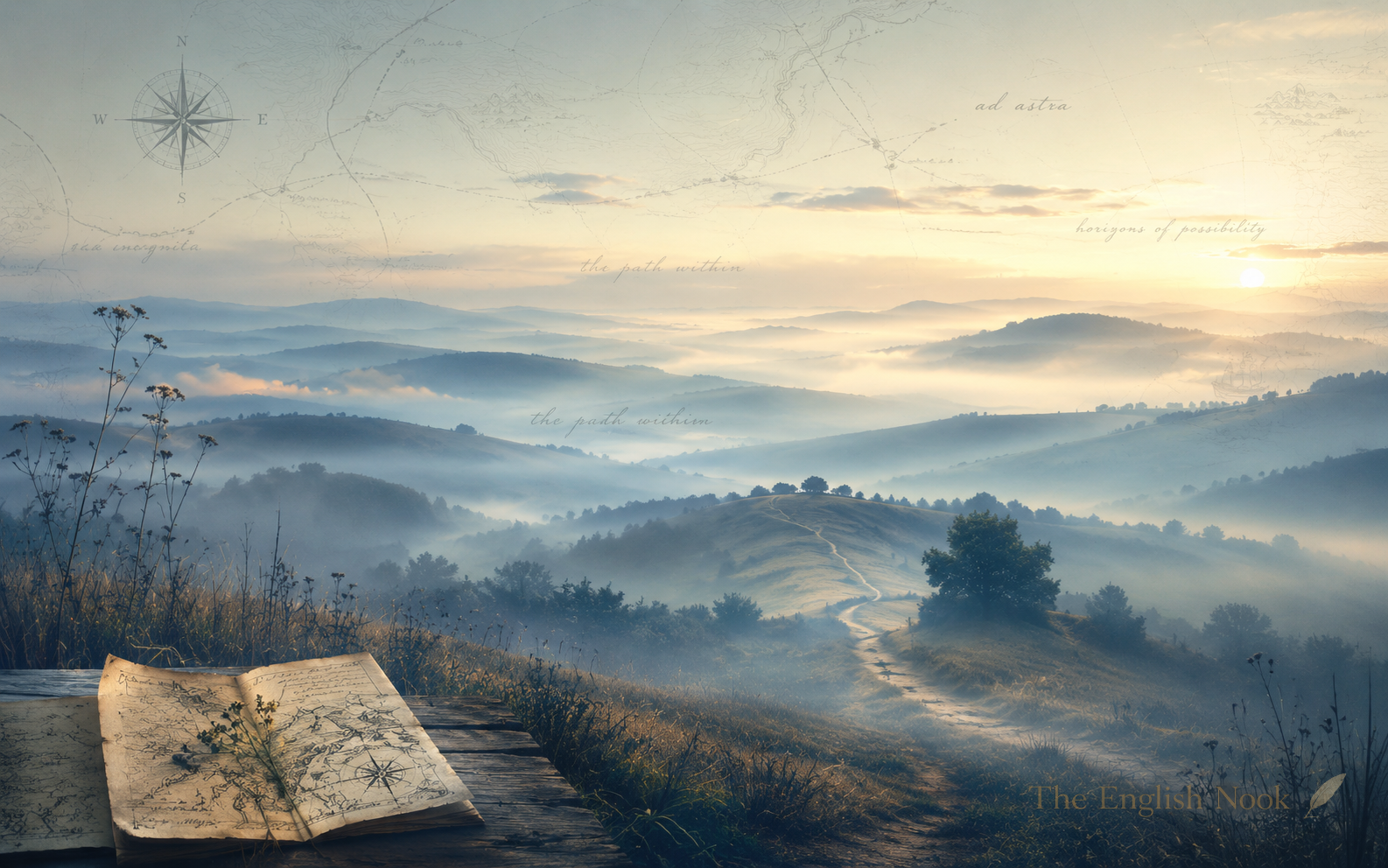

The Maps We Carry in Our Minds
The landscapes hidden inside the way we think and speak
Some ideas are difficult to see.
A decision has no shape. A hope cannot be touched. The future has no color, no sound, and no clear outline. Yet when we speak about these things, we often describe them as though they belonged to a landscape.
We talk about being at a crossroads. We speak of finding our way or losing our way. We imagine a long road ahead. New opportunities appear on the horizon. Personal growth becomes a journey.
At first glance, these expressions seem ordinary. Most of us use them without a second thought. Yet together they reveal something curious about the way language works. When faced with ideas that are abstract, uncertain, or invisible, we often turn to the language of movement and place.
A path is easier to imagine than a decision. A horizon is easier to picture than the future. A journey is easier to understand than the slow and often unpredictable process of change.
Perhaps this is not surprising. For most of human history, paths, horizons, and journeys were not metaphors. They were realities. People followed trails through forests, crossed mountains, sailed toward distant shores, and walked roads without knowing exactly what awaited them. The experience of moving through an uncertain world became deeply familiar, and over time it found a permanent home in language.
What is remarkable is that these images remain powerful even when many of us encounter them only symbolically. We may spend our days in offices, classrooms, or cities, yet we continue to speak as though life unfolds across a landscape. We move forward. We change direction. We reach turning points. We search for a path.
The horizon may be the most fascinating example of all. It is always visible, yet never reachable. No matter how far we travel, it remains in the distance. Perhaps that is why it has become such a natural symbol of possibility. The future often feels much the same way: close enough to imagine, distant enough to remain uncertain.
Language does more than describe the world around us. It helps us understand experiences that have no physical form. Sometimes it does this through definitions and explanations. At other times, it does so through images that quietly shape the way we think.
The path, the horizon, and the journey are among those images.
They remind us that some of the most important movements in life are not measured in miles, but in choices, hopes, and the directions we choose to follow. Perhaps that is why these words endure. They help us navigate places that exist not on any map, but within ourselves.
Perhaps the maps we carry in our minds are not meant to tell us where we are. They exist to help us imagine where we might go next.
→ Continue wandering
→ Read a story