
Thought vs Through vs Though — One Pattern, Three Completely Different Words
They look predictable.
They are not.
English gives you patterns — and then quietly breaks them.
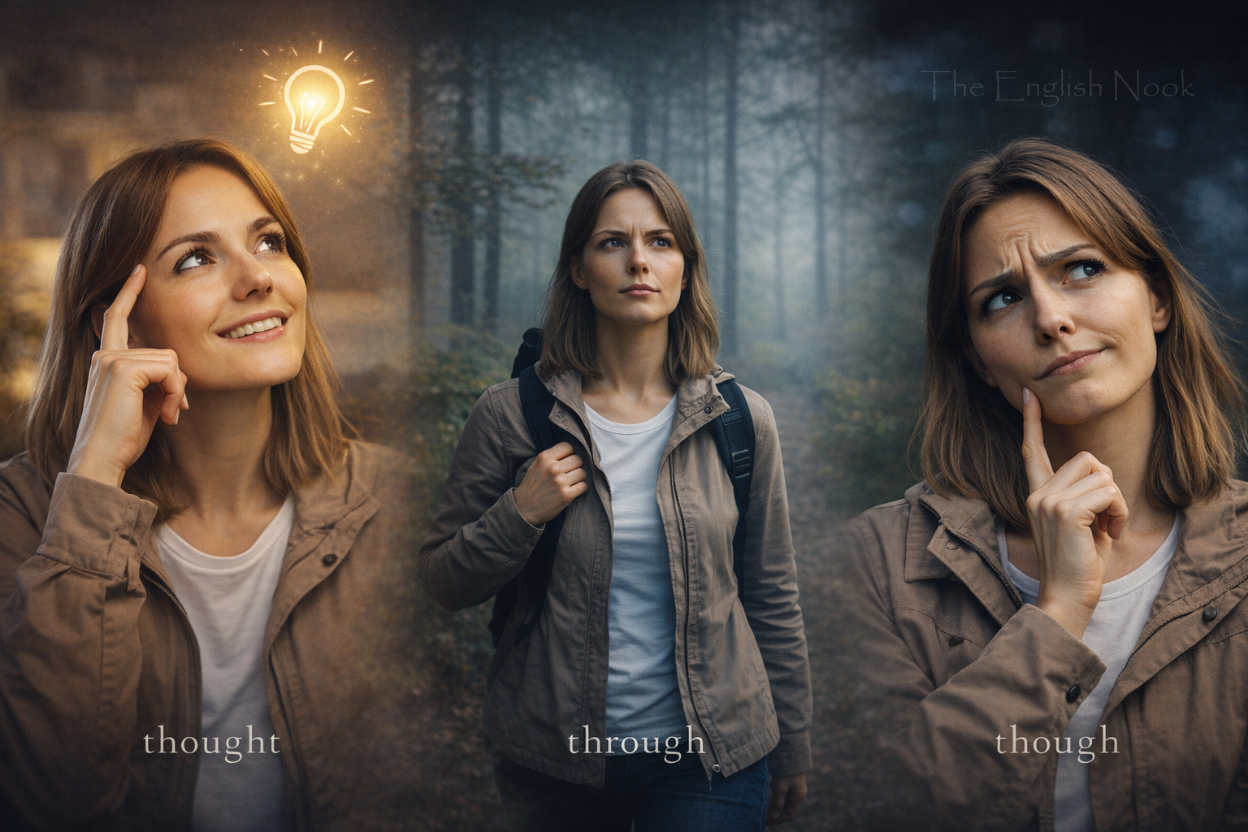
Thought, through, and though seem like they belong together.
Same letters. Same ending. Same visual rhythm.
But once you hear them… everything falls apart.
Why these three words confuse almost everyone
At first glance, your brain tries to simplify:
→ “Same spelling pattern = similar pronunciation or meaning”
That works in many languages.
Not in English.
Here:
- the sounds change
- the meanings separate
- the functions diverge completely
These are not variations of one idea.
They are three independent words that just happen to look alike.
Thought — the language of the mind
Meaning:
- past of think
- an idea or mental concept
I thought you were at home.
That’s an interesting thought.
Pronunciation: thawt – /θɔːt/ (BrE) | /θɔt/ (AmE)
Not “thowght”. Not “thot”.
The spelling doesn’t guide you — experience does.
Use it when:
→ something happens in the mind
→ you refer to ideas, opinions, or memories
Through — the language of movement and completion
Meaning:
- from one side to another
- from beginning to end
We walked through the park.
She worked through the problem carefully.
He read the book through in one night.
Pronunciation: throo – /θruː/
Clean, direct — almost like the word true.
Use it when:
→ something crosses space
→ something continues until completion
Though — the language of contrast
Meaning:
- introduces contrast (like but or however)
It was expensive. I bought it, though.
Though it was raining, we went out.
Pronunciation: thoh – /ðoʊ/ (AmE) | /ðəʊ/ (BrE)
Short, soft, and often placed at the end of a sentence.
Use it when:
→ you introduce an opposing idea
→ you soften or adjust a statement
A quick comparison (this is where it clicks)
- Thought → inside the mind
- Through → across / from start to end
- Though → contrast / unexpected turn
If you remember nothing else, remember this.
Common mistakes (and how to avoid them)
❌ I walked thought the park
✔️ through → movement
❌ I liked it through it was expensive
✔️ though → contrast
❌ That’s an interesting through
✔️ thought → idea
Why English does this (and why it matters)
English spelling is not built for clarity.
It is built on history.
These words come from different origins, but over time:
- their spellings merged visually
- their pronunciations evolved differently
- their meanings remained separate
So what looks like a system…
is actually a coincidence shaped by time.
Mini test (1 minute)
Choose the correct word: thought / through / though
- I _____ you said the meeting was tomorrow.
- We walked _____ the forest without speaking.
- It was difficult. I finished it, _____ .
- She carefully worked _____ every detail of the plan.
- I never _____ this would happen.
- He pushed _____ the crowd to reach the exit.
- _____ it seemed impossible, they continued anyway.
- That’s an interesting _____ — I hadn’t considered it before.
- We sat _____ the entire movie without moving.
Answers
- thought
- through
- though
- through
- thought
- through
- Though
- thought
- through
Final reflection
Some of the hardest parts of English are not the long words.
They are the simple ones that look familiar.
Because they invite you to assume —
and English often punishes that assumption.
So next time you see one of these, pause and ask:
Is this about a mind, a movement, or a contrast?
That single question is usually enough.
Same letters, different worlds
—English hides complexity in plain sight.
→ Profundiza más tu Inglés!
→ Lee una Historia
→ Explore English/Spanish sessions