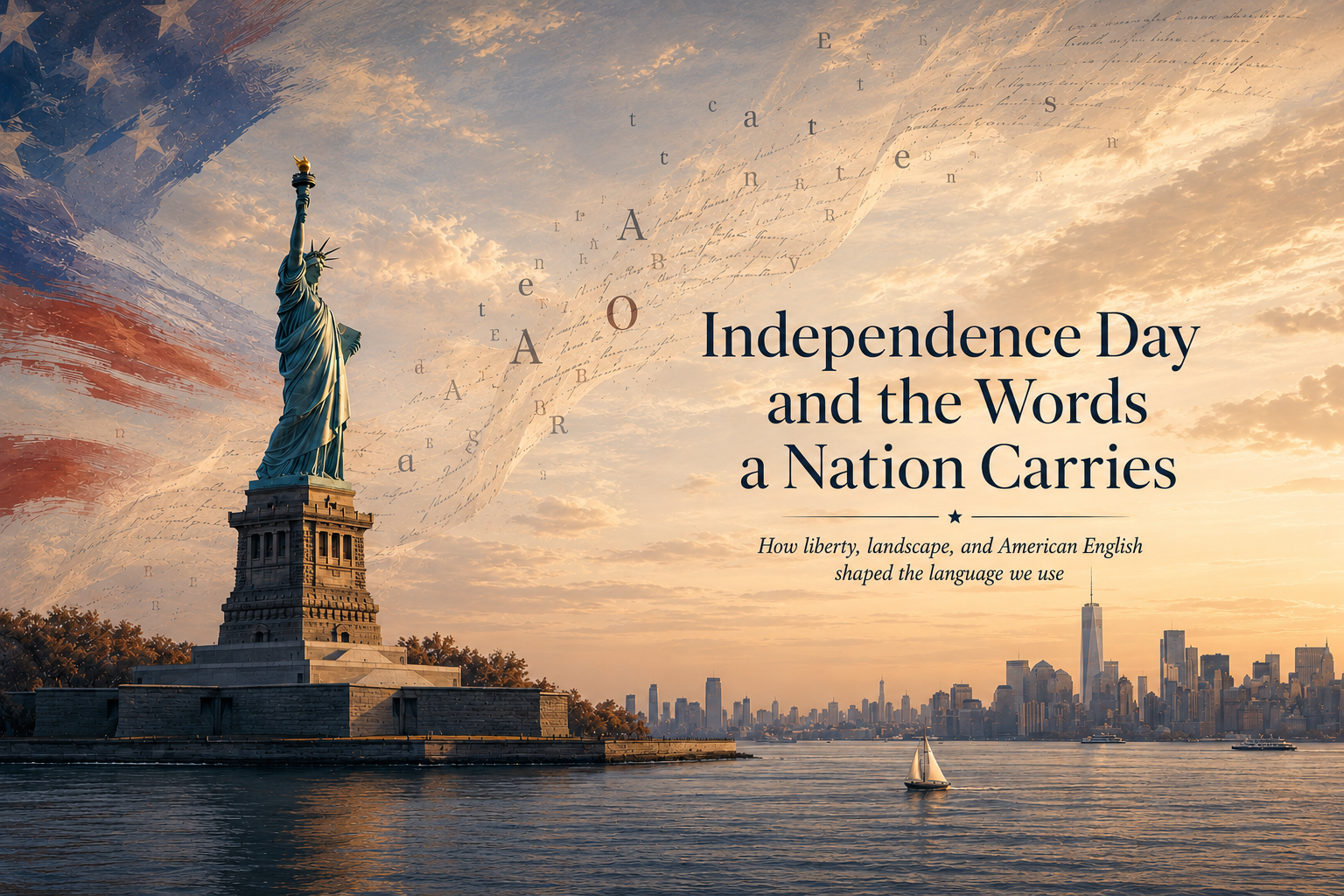

Independence Day and the Words a Nation Carries
How liberty, landscape, and American English shaped the language we use
A Nation Written in Words
Every country carries more than borders.
It carries stories, symbols, names, and ideas that gradually become part of its language.
Some nations give the world inventions. Others leave behind works of art. The United States has done something slightly different.
Over the past two centuries, it has helped shape many new words, expressions, and ways of speaking that have travelled far beyond its own borders.
Some describe landscapes found nowhere else. Others emerged from technology, music, politics, science, or everyday life.
Many have become so familiar that we no longer notice where they came from.
Language, like a nation, is always growing.
Liberty Before It Became a Symbol
Few ideas are more closely connected with the United States than liberty.
Yet the word itself is much older than the country.
English inherited liberty from Old French liberté, which ultimately comes from the Latin libertas, meaning “the condition of being free.”
Centuries before the Declaration of Independence was written, English speakers were already using the word to describe freedom from restraint, oppression, or unjust authority.
When the United States adopted liberty as one of its founding ideals, it gave an ancient word a renewed place in history.
Today, the Statue of Liberty has become one of the world’s most recognizable symbols — not because it invented the idea, but because it continues to remind millions of people of it.
Sometimes a nation does not create a word.
It simply helps the world remember it.
Words That Travelled Across a Continent
American English developed across landscapes unlike those known in Britain.
Immense forests, wide plains, deserts, mountains, rivers, and unfamiliar wildlife all helped reshape the vocabulary of English in North America.
Many existing English words acquired new meanings. Others were borrowed from Indigenous languages. Still others appeared because new experiences demanded new vocabulary.
Words such as moose, raccoon, skunk, pecan, opossum, and squash remind us how many English words in North America came through Indigenous languages and local encounters.
These words remind us that English did not simply remain unchanged in America.
It listened.
It borrowed.
It adapted.
Like every living language, it grew through encounter.
American English Around the World
During the twentieth century, the influence of American English expanded dramatically.
Cinema, radio, television, aviation, science, technology, popular music, and later the internet carried American vocabulary across continents.
Words such as teenager, road trip, movie, mailbox, highway, downtown, software, startup, and countless others became part of everyday English for millions of people.
Some expressions remained strongly American.
Others quietly became international.
Today, many learners encounter American English long before they ever visit the country itself.
Sometimes through films.
Sometimes through music.
Sometimes through a computer screen.
Language often travels farther than people do.
More Than a Flag
Every national celebration invites us to remember history.
Language invites us to notice something else.
It reminds us that ideas survive because they continue to be spoken.
The United States has helped shape modern English in countless visible and invisible ways. Not because one variety of English replaced another, but because languages never stop exchanging ideas.
British English.
American English.
Canadian English.
Australian English.
Each carries its own voice.
Together, they tell the ongoing story of English itself.
Closing Thought
Perhaps that is the quiet lesson hidden behind every national celebration.
Countries leave monuments.
Languages leave echoes.
And those echoes often travel farther than any border ever could.

Countries leave monuments.
Languages leave echoes.
→ Read more interesting articles
→ Read a story
If this stayed with you, consider leaving a like, sharing it,
commenting, or all three!