
The Language of Stories
12 Essential Words for Understanding How Stories Work
Stories are among the oldest ways human beings have shared ideas, preserved memories, explored difficult questions, and imagined different worlds.
Some stories last only a few sentences. Others fill hundreds of pages. They may be realistic, mysterious, humorous, frightening, historical, or entirely fantastical. Yet beneath these differences, most stories are built from several recognisable elements.
Knowing the language used to describe those elements helps us understand stories more clearly. It allows us to explain who is involved, where events happen, what the characters want, what stands in their way, and how their decisions shape what follows.
Let’s explore twelve essential words that form the basic language of stories.
📖 Story Vocabulary
1. Story
IPA: /ˈstɔː.ri/ (UK), /ˈstɔːr.i/ (US)
Spanish: Historia, relato
Definition: An account of connected events involving characters and actions.
Example: The old woman told the children a story about a fox that tried to capture the moon.
Translation: La anciana les contó a los niños una historia sobre un zorro que intentó atrapar la luna.
2. Character
IPA: /ˈkær.ək.tər/ (UK), /ˈker.ək.tɚ/ (US)
Spanish: Personaje
Definition: A person, animal, creature, or other being who takes part in a story.
Example: The main character is a young baker who dreams of travelling beyond her village.
Translation: El personaje principal es una joven panadera que sueña con viajar más allá de su aldea.
3. Setting
IPA: /ˈset.ɪŋ/ (UK), /ˈset̬.ɪŋ/ (US)
Spanish: Escenario, ambientación
Definition: The place and time in which a story happens.
Example: The setting is a remote coastal town during a particularly cold winter.
Translation: El escenario es un pueblo costero aislado durante un invierno especialmente frío.
4. Narrator
IPA: /nəˈreɪ.tər/ (UK), /ˈner.eɪ.t̬ɚ/ (US)
Spanish: Narrador, narradora
Definition: The voice that tells a story and presents its events to the reader.
Example: The narrator describes the journey but never reveals why the traveller left home.
Translation: El narrador describe el viaje, pero nunca revela por qué el viajero abandonó su hogar.
5. Plot
IPA: /plɒt/ (UK), /plɑːt/ (US)
Spanish: Trama, argumento
Definition: The sequence of important events that forms the main action of a story.
Example: The plot begins when a mysterious letter arrives at the house.
Translation: La trama comienza cuando una carta misteriosa llega a la casa.
6. Goal
IPA: /ɡəʊl/ (UK), /ɡoʊl/ (US)
Spanish: Objetivo, meta
Definition: Something a character wants to obtain, achieve, discover, protect, or change.
Example: Her goal is to find the missing book before the library closes forever.
Translation: Su objetivo es encontrar el libro perdido antes de que la biblioteca cierre para siempre.
7. Obstacle
IPA: /ˈɒb.stə.kəl/ (UK), /ˈɑːb.stə.kəl/ (US)
Spanish: Obstáculo
Definition: Something that prevents or delays a character from reaching a goal.
Example: The flooded bridge became the travellers’ greatest obstacle.
Translation: El puente inundado se convirtió en el mayor obstáculo de los viajeros.
8. Conflict
IPA: /ˈkɒn.flɪkt/ (UK), /ˈkɑːn.flɪkt/ (US)
Spanish: Conflicto
Definition: The central struggle, tension, or problem that drives a story forward.
Example: The main conflict begins when the two brothers claim the same piece of land.
Translation: El conflicto principal comienza cuando los dos hermanos reclaman el mismo terreno.
9. Choice
IPA: /tʃɔɪs/
Spanish: Elección, decisión
Definition: A decision between two or more possible actions.
Example: The character must make a choice between protecting his secret and helping his friend.
Translation: El personaje debe elegir entre proteger su secreto y ayudar a su amigo.
10. Turning Point
IPA: /ˈtɜː.nɪŋ ˌpɔɪnt/ (UK), /ˈtɝː.nɪŋ ˌpɔɪnt/ (US)
Spanish: Punto de inflexión, momento decisivo
Definition: A moment when the direction of a story changes significantly.
Example: The turning point comes when the child discovers who has really been protecting the village.
Translation: El punto de inflexión llega cuando el niño descubre quién ha estado protegiendo realmente la aldea.
11. Consequence
IPA: /ˈkɒn.sɪ.kwəns/ (UK), /ˈkɑːn.sə.kwens/ (US)
Spanish: Consecuencia
Definition: Something that happens as a result of an action, event, or decision.
Example: One unexpected consequence of opening the gate was that the animals began to leave the forest.
Translation: Una consecuencia inesperada de abrir la puerta fue que los animales comenzaron a abandonar el bosque.
12. Ending
IPA: /ˈen.dɪŋ/
Spanish: Final, desenlace
Definition: The final part of a story, where its main events are brought to a close.
Example: The ending does not answer every question, but it shows that the family has begun to heal.
Translation: El final no responde todas las preguntas, pero muestra que la familia ha comenzado a sanar.
✨ Useful Phrases
Tell a story — To describe connected events in a meaningful way.
Set the scene — To establish where and when a story begins.
Move the story forward — To cause the plot to develop or progress.
🌍 Common Expressions
There are two sides to every story — Every situation may be understood from more than one perspective.
The plot thickens — A situation is becoming more complicated or mysterious.
A twist in the tale — An unexpected development that changes the direction or meaning of a story.
📖 Reading Practice
🇬🇧 The First Line
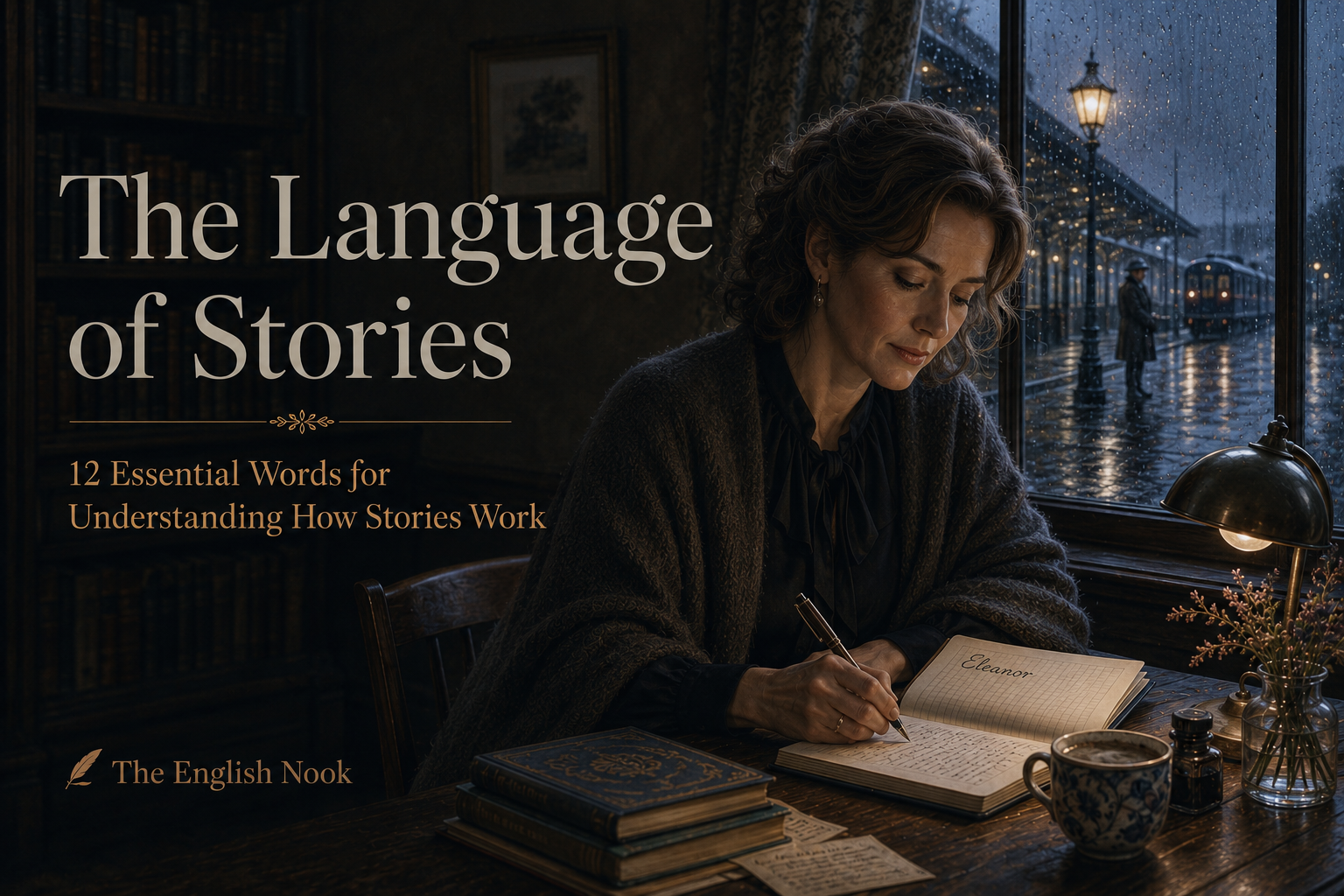
Beatriz opened her notebook and stared at the empty page. She already knew the setting: a small railway station on a rainy evening. Her main character would be a woman waiting for someone who might never arrive. The plot, however, was still unclear. She wrote one sentence, crossed it out, and tried again. Her greatest obstacle was deciding how the story should begin. Then she imagined the sound of an approaching train. That became the turning point. Beatriz smiled, lowered her pen, and continued writing. The ending was still far away, but the story had finally begun.
🇪🇸 Leer en español — Haz clic para abrir
La primera línea
Beatriz abrió su cuaderno y observó la página vacía. Ya conocía el escenario: una pequeña estación de tren durante una tarde lluviosa. Su personaje principal sería una mujer que esperaba a alguien que quizá nunca llegaría. Sin embargo, la trama todavía no estaba clara. Escribió una oración, la tachó y volvió a intentarlo. Su mayor obstáculo era decidir cómo debía comenzar la historia. Entonces imaginó el sonido de un tren acercándose. Ese fue el punto de inflexión. Beatriz sonrió, bajó la pluma y continuó escribiendo. El final todavía estaba lejos, pero la historia por fin había comenzado.
🇵🇹 Ler em português — Clique para abrir
A primeira linha
Beatriz abriu seu caderno e ficou olhando para a página em branco. Ela já conhecia o cenário: uma pequena estação de trem em uma tarde chuvosa. Sua personagem principal seria uma mulher esperando por alguém que talvez nunca chegasse. O enredo, porém, ainda não estava claro. Ela escreveu uma frase, riscou-a e tentou novamente. Seu maior obstáculo era decidir como a história deveria começar. Então imaginou o som de um trem se aproximando. Esse foi o ponto de virada. Beatriz sorriu, abaixou a caneta e continuou escrevendo. O final ainda estava distante, mas a história finalmente havia começado.
Why These Words Matter
Stories become meaningful when events affect someone.
A character wants something. An obstacle makes that desire difficult. Conflict forces the character to respond. A choice changes the direction of events, and a consequence shows that the choice mattered.
Sometimes the change is enormous. A kingdom falls, a journey begins, or a hidden world is discovered.
At other times, the change happens quietly. A character understands something, abandons an old belief, or finally makes a decision.
The language of stories helps us recognise these movements and explain why they matter.

✍️ Writing Challenge
Write a short story of between 100 and 150 words using at least six of today’s vocabulary words.
Include one main character, a clear setting, a goal, an obstacle, an important choice, and one consequence.
Before writing the ending, ask yourself:
What has changed because of the character’s decision?
📚 Vocabulary Quick Reference
| English | Español | Português |
|---|---|---|
| Story | Historia, relato | História, relato |
| Character | Personaje | Personagem |
| Setting | Escenario, ambientación | Cenário, ambientação |
| Narrator | Narrador, narradora | Narrador, narradora |
| Plot | Trama, argumento | Enredo, trama |
| Goal | Objetivo, meta | Objetivo, meta |
| Obstacle | Obstáculo | Obstáculo |
| Conflict | Conflicto | Conflito |
| Choice | Elección, decisión | Escolha, decisão |
| Turning point | Punto de inflexión | Ponto de virada |
| Consequence | Consecuencia | Consequência |
| Ending | Final, desenlace | Final, desfecho |
If these words stayed with you, pass them on—or drop an acorn before you go.