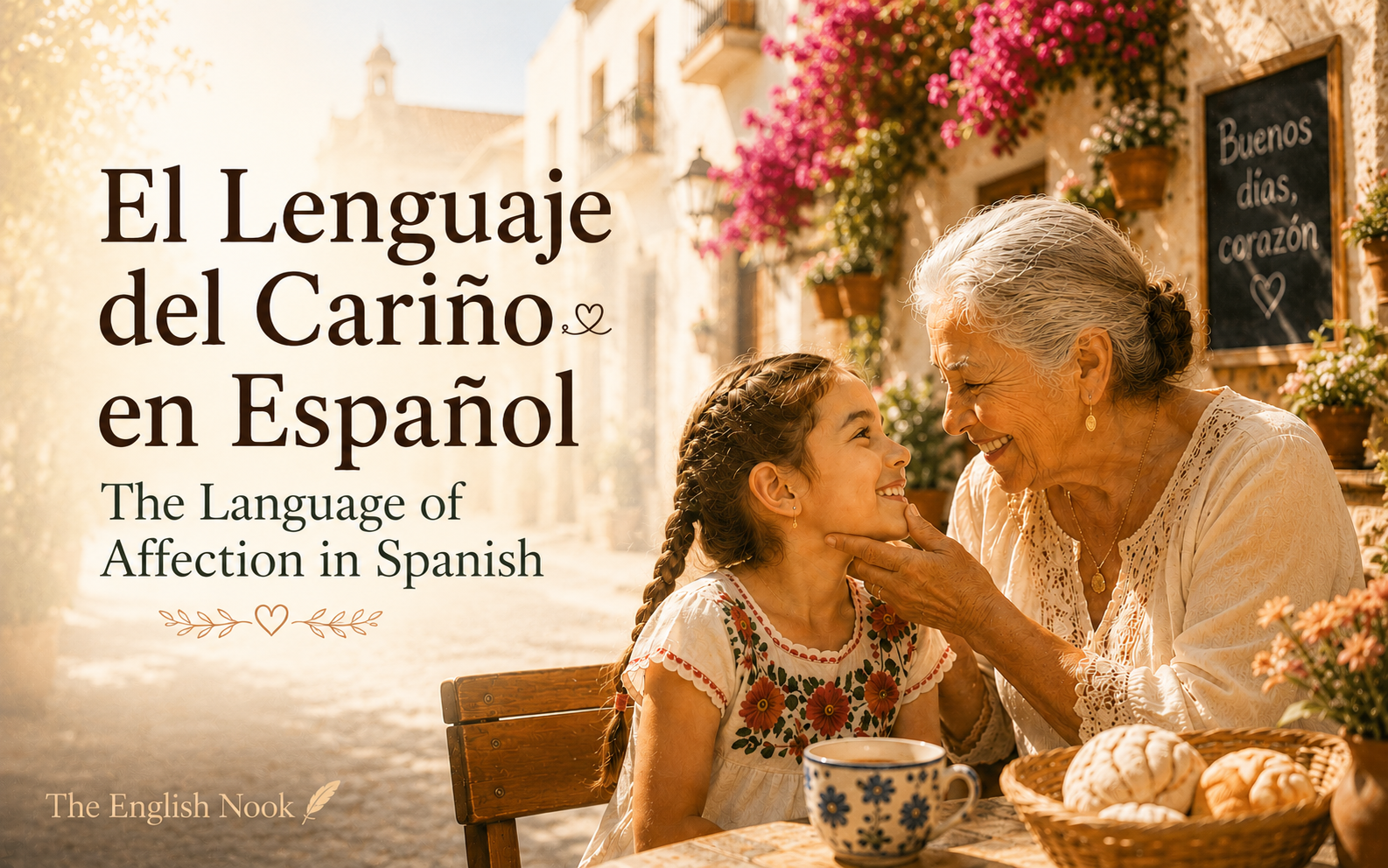

El Lenguaje del Cariño en Español
How Spanish Expresses Warmth, Closeness, and Affection
Some languages feel emotionally distant. Others feel naturally warm.
For many learners, Spanish is often described as a language of closeness — not only because of pronunciation or rhythm, but because affection appears constantly in everyday speech. Small words, diminutives, nicknames, and expressions of care are woven into ordinary conversations.
In Spanish, warmth is not always reserved for special moments. It often appears naturally in greetings, family interactions, friendships, and daily life.
This is part of what gives the language its emotional texture.
Warmth in Everyday Spanish
One of the most distinctive aspects of Spanish is how easily affection becomes part of ordinary speech. Many expressions that sound deeply emotional in English can feel completely natural and everyday in Spanish.
A waiter may call someone:
- corazón
- cariño
- mi vida
A grandmother may say:
- hijito
- mi niño
- mi amor
Friends, couples, parents, and even strangers often soften language through affectionate forms that create emotional closeness.
For English learners, this can feel surprisingly intimate at first.
But in many Spanish-speaking cultures, warmth in language is not unusual — it is part of social connection itself.
Mamá, Mami, Mamita
Spanish has several ways to refer to a mother, and each carries a different emotional tone.
Mamá
The standard and most neutral affectionate form.
Natural, warm, and common across the Spanish-speaking world.
Example
“Mamá está en casa.”
Mami
More intimate, playful, or emotionally close.
Often used:
- by children
- inside families
- affectionately between adults in some regions
Example
“Te quiero, mami.”
Mamita
A softer and even more affectionate variation.
Depending on the country, it can sound:
- tender
- nurturing
- comforting
- deeply emotional
In some places, it can also be used casually or socially outside the family context.
The Power of Diminutives
Spanish frequently uses diminutives to soften words emotionally.
The endings:
- -ito
- -ita
often express:
- affection
- tenderness
- familiarity
- emotional warmth
Examples:
- hijo → hijito
- abuela → abuelita
- amor → amorcito
- mamá → mamita
These forms do not always indicate “smallness.”
Very often, they indicate emotional closeness.
That difference is important.
Cariño, Corazón, Mi Amor
Spanish also uses emotional nouns as everyday forms of address.
Cariño
Literally connected to affection or tenderness.
Example
“Gracias, cariño.”
Corazón
Literally “heart.”
Used warmly toward:
- children
- partners
- close family
- sometimes customers or guests
Example
“¿Cómo estás, corazón?”
Mi amor
“My love.”
In English, this can sound extremely intimate.
In Spanish, however, it may appear naturally in many family or caring contexts.
Why Spanish Often Feels Warm to Learners
Part of the emotional effect comes from sound itself.
Spanish tends to:
- favor open vowels
- use flowing syllables
- avoid harsh consonant clusters
- encourage rhythmic speech
But culture also plays a major role.
In many Spanish-speaking communities:
- emotional expressiveness is socially natural
- affection is spoken openly
- closeness is reinforced verbally
Language becomes a way of maintaining emotional connection.
A Small Conversation
— ¿Cómo está tu mami?
— Bien. Hablé con ella ayer.
— ¿Y tu abuelita?
— También bien. Siempre me llama para preguntarme si estoy comiendo bien.
— Las abuelas siempre hacen eso.
— Sí… y siempre dicen “cuídese, mi niño”.
Translation
— How is your mom?
— Good. I spoke with her yesterday.
— And your grandmother?
— She’s good too. She always calls me to ask if I’m eating properly.
— Grandmothers always do that.
— Yes… and they always say “take care, my boy.”
Why It Matters
Learning a language is not only about understanding words. It is also about understanding emotional habits.
Every language has its own way of expressing:
- closeness
- politeness
- affection
- respect
- distance
Spanish often communicates warmth more openly and verbally than English. What may sound overly emotional or deeply personal in English can feel completely natural in Spanish-speaking environments.
For learners, this can sometimes create confusion at first.
A cashier saying:
- corazón
- mi amor
- cariño
may sound unusually intimate to someone used to more emotionally neutral communication styles.
But these expressions are usually not romantic.
They are social signals of warmth, familiarity, and human connection.
Understanding this helps learners move beyond literal translation and begin understanding the emotional culture behind the language.
Because fluency is not only knowing what words mean.
It is also understanding what they feel like to the people who use them.
Some languages teach us how to speak.
Others quietly teach us how to connect.
→ Read more interesting articles
→ Read a story
If you’ve read everything, please consider leaving a like, sharing, commenting, or all three!