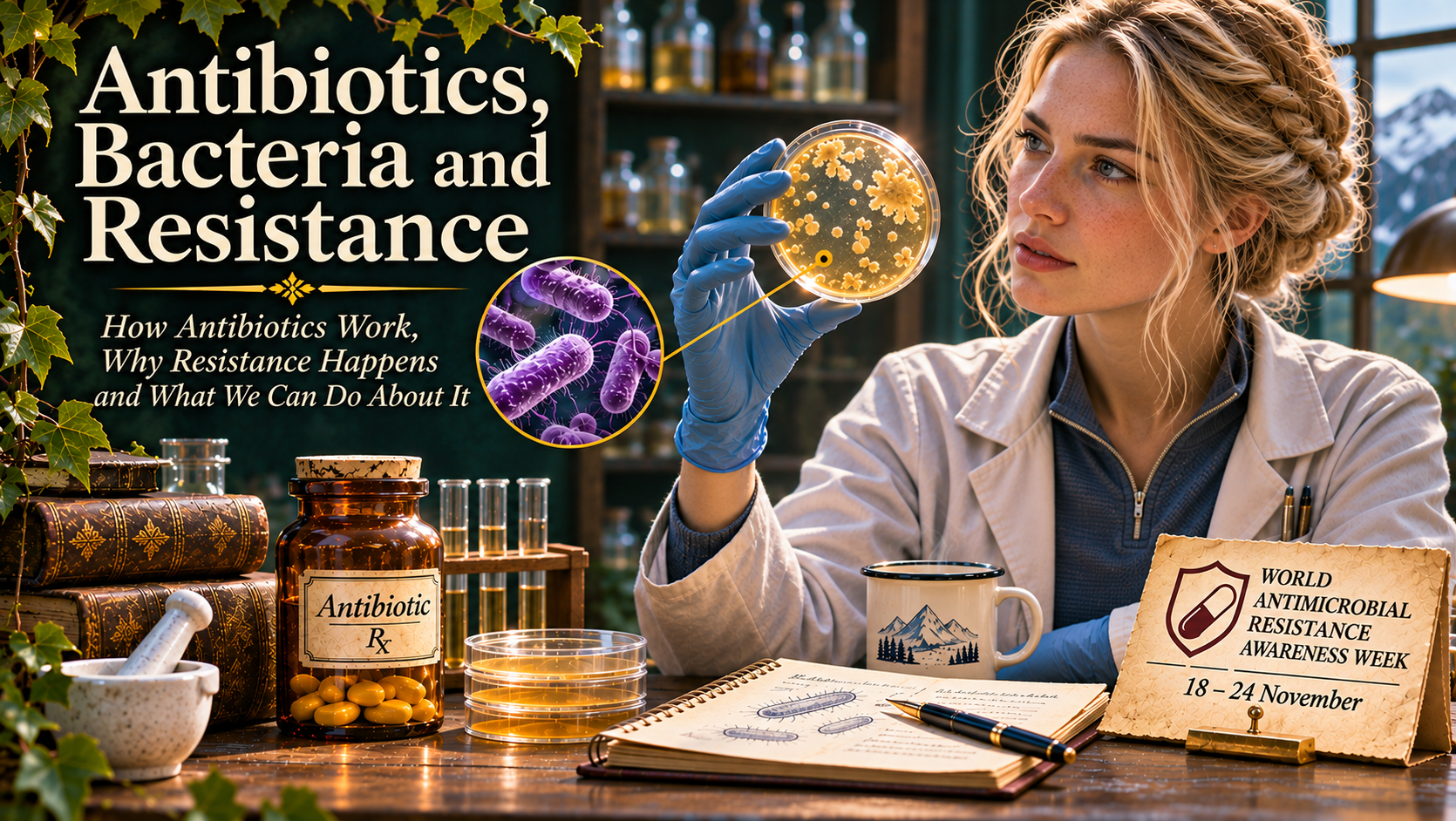

Antibiotics, Bacteria and Resistance
Why Treatment Works, Why Bacteria Adapt, and Why Our Words Matter
World AMR Awareness Week · 18–24 November 2026
A doctor says an infection may be bacterial. A patient asks whether antibiotics will help. Someone nearby worries that they have “become resistant” to the medicine. These are familiar conversations, yet the words involved do not all mean what people assume.
Bacteria, infection, antibiotics and resistance describe different parts of the same problem. Understanding those distinctions matters because precise language can help people ask useful questions without creating unnecessary fear.
The subject is especially relevant during World AMR Awareness Week, observed each November from the 18th to the 24th. Its central concern is how to preserve medicines that treat infections while recognising that resistant microorganisms can spread between people, animals and the environment.
Not Every Bacterium Is an Enemy
Bacteria are microscopic, single-celled organisms found in soil, water, on surfaces and throughout the human body. Many are harmless; some are useful, including members of the communities of microorganisms that live in our digestive system. A smaller proportion can cause disease under particular circumstances.
A pathogen is an organism or agent capable of causing disease. An infection occurs when a pathogen enters or multiplies in the body; whether it causes noticeable illness depends on the organism and the circumstances. Finding bacteria somewhere does not always mean that a person has a bacterial disease requiring medicine.
Viruses are different. They reproduce using living cells, and medicines designed to act against bacteria do not simply work against them. Both bacteria and viruses can be involved in respiratory illness, which is one reason a cough or fever alone cannot reliably establish the cause.
Antibiotics Are Powerful, Not Universal
Antibiotics are medicines used to treat certain bacterial infections. Some kill susceptible bacteria; others prevent them from multiplying effectively. They have transformed the treatment of serious illness, but the fact that they are valuable does not make them useful for every infection.
The common cold and influenza are caused by viruses. Antibiotics do not treat those viral infections. Some illnesses are bacterial but still do not always require antibiotic treatment; the decision depends on the diagnosis, severity, medical history and other clinical factors. A qualified healthcare professional assesses those questions rather than relying on one symptom.
Unnecessary antibiotics can expose people to adverse effects without providing a benefit. When an antibiotic is prescribed, the appropriate instruction is to take it exactly as directed and ask a clinician or pharmacist about any uncertainty—not to share tablets, save leftovers or change the course independently.
What Does Resistance Actually Mean?
Here is the most important distinction in the reading: the bacteria become resistant, not the patient. If a particular bacterium can survive exposure to an antibiotic that would usually stop it, the treatment may be less effective. That does not mean that the person’s body has developed immunity to the medicine.
Bacteria vary. Some already carry characteristics that help them survive a drug, while genetic changes can also produce resistance. When an antibiotic removes susceptible bacteria, resistant ones may have a better chance of multiplying. This is called selection pressure. Antibiotic exposure helps select resistant populations; it is not a simple story in which every bacterium consciously learns to defeat a medicine.
Resistance can spread in more than one way. Resistant bacteria may pass between people or settings, and some bacteria can exchange genetic material carrying resistance traits. That is why it is inaccurate to picture antibiotic resistance as a problem confined to one patient or one hospital.
The Difference Between Antibiotic and Antimicrobial
The terms sound similar, but one is broader. Antibiotic resistance concerns bacteria and antibiotics. Antimicrobial resistance includes the failure of medicines used against other microorganisms too, such as certain viruses, fungi and parasites. In public-health discussions, the abbreviation AMR stands for antimicrobial resistance.
The scale matters, but statistics must be explained carefully. According to the World Health Organization’s 2025 global surveillance report, approximately one in six laboratory-confirmed bacterial infections assessed worldwide in 2023 was resistant to antibiotic treatment. This is not the same as saying that one in six of all illnesses—or one in six people—was resistant.
The result is serious without being hopeless. Resistant infections can reduce treatment options and may require different medicines, more testing or longer care. But resistant does not necessarily mean that no treatment exists. A precise sentence acknowledges the difficulty without exaggerating it.
What Do Laboratory Results Actually Tell Us?
A laboratory may perform a culture, growing microorganisms from a sample to help identify them. When appropriate, it may also conduct susceptibility testing to examine how the identified bacterium responds to particular antibiotics under defined conditions.
The terms susceptible and resistant describe the laboratory’s interpretation for a bacterium and a drug; they are not labels for the person’s character or resilience. Results need interpretation alongside symptoms, the site of infection and clinical judgement. No single word on a report can replace that assessment.
Imagine a clinician explaining a result: “The test suggests this bacterium is resistant to one antibiotic but susceptible to another. We will consider the findings alongside your symptoms before deciding on treatment.” The explanation is more precise than saying that a medicine has simply “stopped working”. It names what the test examined and leaves room for clinical judgement.
Another useful term is stewardship. Outside healthcare it may suggest guardianship or responsible management. In medicine, antibiotic stewardship refers to organised efforts to make antibiotic use appropriate, effective and safer. It is not simply a demand to prescribe fewer antibiotics: people who need these medicines must also have access to them.
How to Speak Without Causing Alarm
Medical communication often becomes less accurate when certainty is overstated. Compare “Antibiotics never work now” with “Some bacteria are resistant to particular antibiotics, so treatment may need to be adjusted.” The second version is longer, but it describes the actual problem instead of implying universal failure.
The same applies to diagnosis. “This must be bacterial because I have a fever” makes a claim the symptom cannot establish. “A clinician may need to determine whether the infection is bacterial or viral” is more cautious, and more useful.
Cautious wording is not evasive when the evidence is incomplete. Words such as may, some, likely and depending on can mark the limits of what is known while still providing meaningful information.
One Health: A Problem Beyond the Clinic
Resistance is shaped not only by prescribing in human medicine but also by infection prevention, animal care, agriculture, sanitation and environmental conditions. The phrase One Health recognises that the health of people, animals and ecosystems is connected.
Preventing infections can reduce the need for treatment in the first place. Clean water, safe food handling, hygiene, appropriate vaccination and well-run healthcare systems all belong to the broader response. So do access to diagnostics, effective medicines and informed healthcare workers.
The goal is not to make patients afraid of antibiotics. It is to preserve their effectiveness while ensuring that people who need them can receive appropriate care.
Why It Matters
Health information is full of technical words that enter everyday conversation. When those words lose their distinctions, people may misunderstand a diagnosis, worry unnecessarily or expect a medicine to do something it cannot do.
Antibiotics remain essential medicines. Bacteria remain extraordinarily adaptable organisms. Understanding both truths—and choosing language that does not confuse the two—helps readers follow public-health discussions with greater confidence and better questions.
Good health communication does not replace medical judgement. It makes that judgement easier to understand.
This reading is for general education and language learning. It is not individual medical advice; questions about treatment should be discussed with a qualified healthcare professional.
Need a Spark? — Continue in the Nook
Pneumonia and the Language of Breath
Explore how medical terminology and careful explanation shape our understanding of respiratory illness.
The Language of Diabetes
See why precise medical language matters when discussing conditions, symptoms and everyday care.
Why Doctors Say “Might”
Explore how careful words such as “may” and “might” help clinicians explain uncertainty without leaving people confused.
Further Reading & Sources
For the medical overview and global data, consult the World Health Organization’s antimicrobial resistance fact sheet and its Global Antibiotic Resistance Surveillance Report 2025, the source of the 2023 one-in-six estimate. The World AMR Awareness Week 2026 page explains the campaign and its One Health theme.
For practical information about antibiotic use, consult the CDC’s Antibiotic Do’s and Don’ts and About Antimicrobial Resistance. These resources help distinguish bacterial infections, appropriate treatment and the spread of resistant microorganisms.


