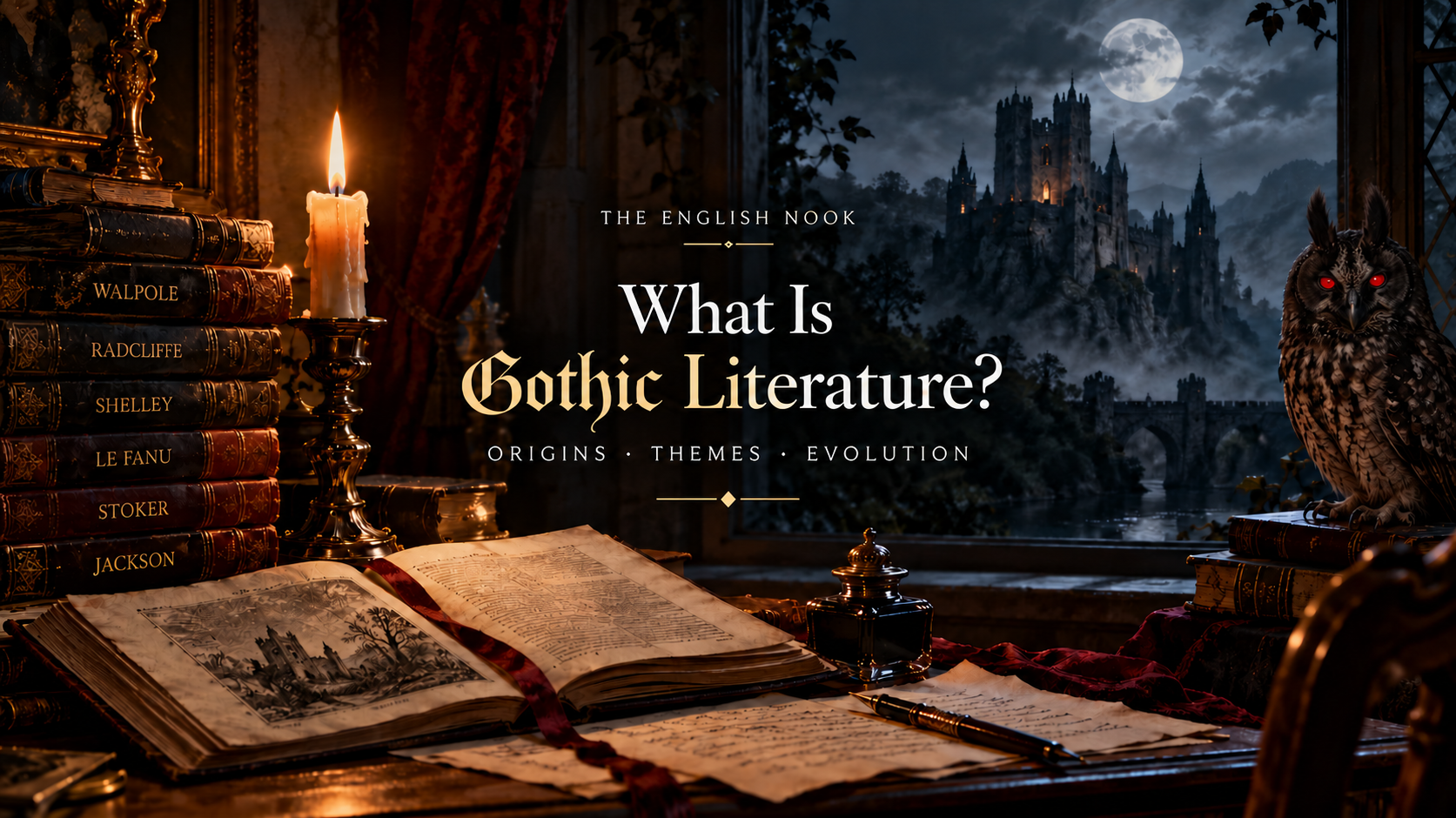

What Is Gothic Literature?
A door opens onto an empty corridor. Somewhere beyond it, footsteps stop. The house is familiar, yet something about it has changed. Perhaps there is a ghost. Perhaps there is a secret. Or perhaps the person who knows the truth is deliberately keeping silent.
This is the territory of Gothic literature: a tradition in which mystery, fear and the weight of the past disturb the ordinary world. Its stories often contain castles, storms and shadows, but those details are only the surface. Gothic fiction asks what happens when the things we trust—a home, a family, a memory, even our own senses—become uncertain.
How Gothic Fiction Began
The word Gothic originally referred to the Goths, and later became associated with medieval art and architecture. By the eighteenth century, it could suggest something ancient, irregular or unfashionable, particularly when compared with the classical ideals of order and proportion.
In 1764, Horace Walpole published The Castle of Otranto, widely regarded as the first Gothic novel. Its enormous supernatural helmet, moving portraits, prophecies and underground passages seem extravagant today. Yet Walpole was experimenting with a new literary possibility: what if the marvellous events of old romances unfolded among characters with recognisable human reactions? In the second edition, published in 1765, he called his book A Gothic Story.
Walpole also transformed his own residence, Strawberry Hill, into a Gothic Revival house. Architecture and storytelling were closely connected in his imagination. Our History Nook explores that double achievement in The Man Who Built Gothic Twice.
When a Setting Becomes a Character
In many Gothic works, the setting does more than provide scenery. A castle can conceal a crime; a locked chamber may protect a dangerous truth; a ruined abbey can suggest the survival of beliefs that supposedly belong to another age.
Architecture shapes what characters can know. Corridors delay discovery. Doors separate those who possess power from those denied it. Windows promise escape while reminding the reader how far away safety may be.
Nature can exert a similar influence. Mountains, forests and immense storms make human beings feel small beside forces they cannot easily measure or command. This mingling of wonder and fear is closely related to the sublime: the experience of something so vast or overwhelming that admiration and apprehension meet.
Of course, a modern Gothic story need not feature a castle. An apartment, school, hospital or ordinary suburban house can become equally unsettling if the place seems to keep a secret.
Fear Without a Visible Monster
Gothic fiction often works through uncertainty. A sound comes from an empty room. A character finds evidence that contradicts a trusted account. Someone appears to recognise a stranger who should be impossible to know.
The writer may reveal a supernatural presence—or may never prove that one exists. Either choice can be effective. What matters is the growing suspicion that familiar explanations are no longer sufficient.
Ann Radcliffe helped refine this art of suspense in novels such as The Mysteries of Udolpho (1794). Her landscapes, enclosed spaces and threatened characters create tension through suggestion as much as through events. She sometimes offers natural explanations for incidents that initially appear supernatural, but the experience of fear remains real to the characters and readers. Learn more in History Nook’s Ann Radcliffe: Pioneer of Gothic Fiction.
This is one reason Gothic literature and horror are not identical. Gothic writing may frighten us, but its central interest can also lie in atmosphere, secrecy, grief, confinement or the uncertainty of perception. Our next reading will examine the distinction between terror and horror more closely.
The Past That Will Not Remain Buried
Gothic stories repeatedly return to inheritance: old houses, family names, forgotten promises, disputed property and histories that someone has tried to suppress. The past is rarely finished. It enters the present through documents, portraits, objects, memories or people who refuse to disappear.
These mysteries can also expose unequal power. A guardian controls an inheritance. A young woman finds herself trapped by family expectations. A stranger knows something that could destroy a respectable household. The apparent safety of home becomes a form of confinement.
The Gothic therefore does more than decorate a plot with darkness. It can ask who is believed, who is protected, who has authority, and whose suffering has been hidden to preserve appearances.
Not every work answers these questions directly. Sometimes the story’s unease comes from the suspicion that the truth, once revealed, will change everything.
From Gothic Castles to Modern Anxieties
The tradition soon grew beyond Walpole’s medieval scenery. In Frankenstein (1818), Mary Shelley joined Gothic dread to questions about scientific ambition, responsibility and abandonment. The terrible consequences arise not merely from the existence of a created being, but from the creator’s refusal to care for him. History Nook considers this in Giving Creation a Conscience.
Nineteenth-century writers continued reshaping the form. Sheridan Le Fanu brought supernatural danger into intimate domestic spaces; his Carmilla, first published in 1871–72, makes a seemingly welcome visitor a source of fascination and dread. Bram Stoker’s Dracula (1897) places an ancient threat amid the technologies, documents and anxieties of a changing world.
Later, writers such as Shirley Jackson showed that the ordinary can be deeply Gothic. A family house, an apparently peaceful community or a familiar custom may conceal something disturbing without needing medieval towers or elaborate supernatural machinery.
The Gothic survives because its settings can change while its central questions remain. What can we know? Whom can we trust? What happens when the past intrudes upon the present?
Recognising the Gothic
When reading a potentially Gothic story, look beyond the weather and the architecture. Notice what the characters fear discovering, how the setting limits their freedom, and which facts remain uncertain. Ask whether the threat comes from a ghost, another person, a social rule, or an unresolved memory. Often several possibilities coexist.
A work may also be Gothic without belonging neatly to horror. It may be a romance, mystery, historical novel or work of fantasy. Genres overlap; Gothic is both a literary tradition and a way of creating meaning through atmosphere, hidden histories and disturbance.
The deepest Gothic question is not simply What is waiting in the darkness? It is Why was it kept there—and what happens when it finally comes into the light?
Reading the Dark
Reading 1 of 8
An eight-part journey through the darker imagination.
Next: Terror and Horror — Two Ways of Frightening the Reader →
Continue Exploring the Gothic
Sheridan Le Fanu — When the Vampire Came Closer
Discover how Gothic fear moved from distant castles into familiar homes, private relationships and the unsettling intimacy of Carmilla.
Edgar Allan Poe — The Writer Who Made Darkness Think
Explore how Poe transformed Gothic storytelling through unreliable narrators, psychological tension and the disturbing possibilities of the human mind.
Shirley Jackson — When Ordinary English Became Unsettling
See how modern Gothic literature found its darkness in ordinary houses, familiar communities and seemingly harmless traditions.