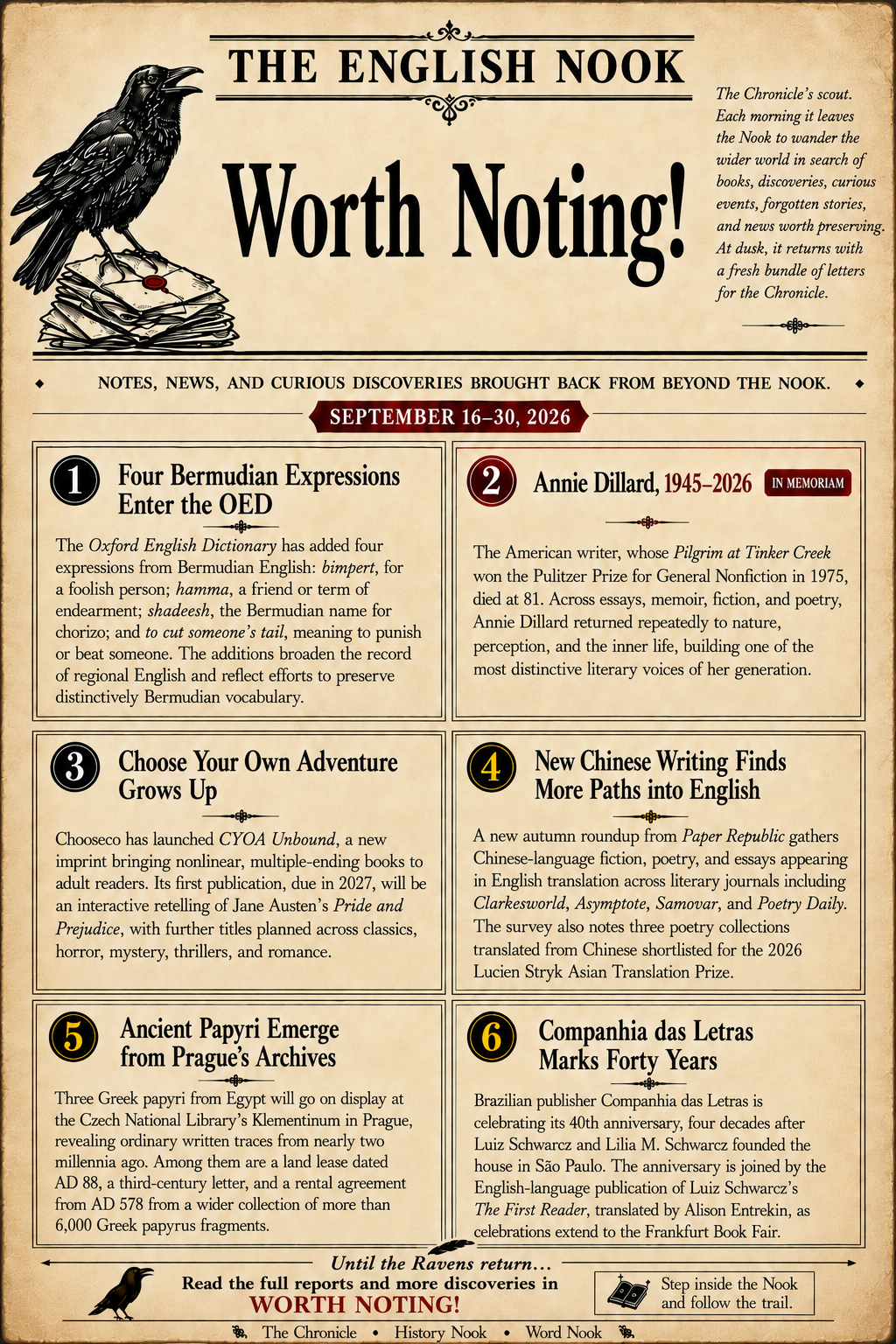
What Curiosity Leaves Behind
A question may begin the journey. It is rarely the only thing that comes home.
This week began by asking whether curiosity is a force or an impulse.
Then a distracted woodland discovered that seeing is not the same as observing, and a red panda climbed toward something he thought was fruit only to discover that the real reward was everything he had learned on the way up. Is Curiosity a Force or an Impulse?, El zorro y los oyentes distraídos, and The Red Panda and the Height approach the same movement from very different directions.
Curiosity begins with What is that?
The archive suggests a more interesting question:
What are we carrying by the time we find out?
🐦⬛ Fetched from the Archive
Answers are strangely temporary things.
We discover them, absorb them, and often forget the moment when we did not know.
But the search can leave other traces behind: a sharper eye, a new skill, courage that did not exist before, a changed view of somewhere familiar—or occasionally a consequence we did not expect.
The question ends.
The traveller may not.
When Looking Becomes Seeing
▸ The Fisherman’s Daughter
Mira spends more time watching the sea than speaking. What others dismiss as imagination becomes attention sustained long enough to notice something useful: she follows the ocean’s strange whispers, finds the hidden cove, and returns no longer simply the quiet girl on the shore.
Curiosity leaves her with more than an answer.
It leaves her able to trust what she notices.
▸ Feathers Full Circle
Kavi leaves his island because the horizon refuses to remain merely scenery. He finds jungles, deserts, storms, strange skies—and eventually comes home.
The island has not changed.
He has.
Having seen more of the world, he can finally see home differently too.
Sometimes discovery enlarges the place we started from.
When Trying Becomes Knowing
▸ The Hands That Teach
A child watches someone tie the knot, repair the chair, plant the seed.
Then tries.
Repeats.
Fails differently next time.
What began as attention eventually becomes something the hands themselves remember. The article puts it beautifully: we often practise before we become confident and repeat before we become skilled.
Curiosity may open the lesson.
Practice is what lets us keep it.
▸ What to Expect in Your First 3 Months of Language Learning
Language learning makes the same process impossible to hide. Questions produce mistakes; mistakes expose patterns; patterns slowly become instinct.
The old piece calls mistakes our construction materials.
That may be one of curiosity’s less glamorous gifts.
It does not merely teach us something new.
It gives failure somewhere useful to go.
When Discovery Changes the Cost
Curiosity is not automatically wise.
▸ The Collector of Impossible Things
The Collector steals something almost invisible: the hesitation before an important choice.
Only once it disappears does its value become clear. Without that pause, every possibility becomes something to enter immediately.
Curiosity needs movement.
But sometimes judgment is the thing that tells movement where not to go.
▸ The House That Held Its Breath
Daniel enters an abandoned house and finds something impossible: a realm where thought, memory, colour, and wonder seem almost tangible.
Then he comes back.
The ordinary world has not become worse.
But after seeing what was possible, ordinary suddenly feels different.
Discovery has left him with a new measure for reality—and no simple way to forget it.
🌾 Into Word Nook
The same journey has been leaving words behind.
Curiosity notices the unanswered thing and moves closer. Observation stays long enough for detail to become evidence. Discernment decides which of those details actually matters. And Wonder keeps open the possibility that knowing more need not make the world feel smaller.
A question can begin with any one of them.
A good journey may leave us carrying all four.
📚 Into History Nook
Meriwether Lewis — Writing the Unknown into English was sent across a continent not simply to travel, but to observe and record. Plants, animals, landscapes, languages, names: exploration became useful because somebody kept stopping long enough to notice.
Santiago Ramón y Cajal — When Science Learned to Describe the Invisible followed another frontier entirely. His disciplined observation of the nervous system did not merely produce discoveries; it demanded more precise ways of seeing, drawing, describing, and eventually speaking about what had previously remained hidden.
One crossed landscapes.
The other looked through a microscope.
Both left better ways of noticing behind them.
What Comes Home
Perhaps curiosity is an impulse.
Perhaps it becomes a force.
But neither description quite captures what happens afterwards.
The red panda eventually reaches the seedpod.
Mira finds the cove.
Kavi returns to his island.
The learner finally understands the sentence.
The answer arrives.
And then something quieter remains.
A steadier paw.
A sharper eye.
A mistake we now know how to use.
A familiar place seen differently.
A little more judgment about which door deserves opening.
Curiosity begins with wanting to know.
Perhaps its greater gift is everything we become while finding out.
Until the next path opens,
keep something from the journey.