
What Happens to a Poem When It Changes Language?
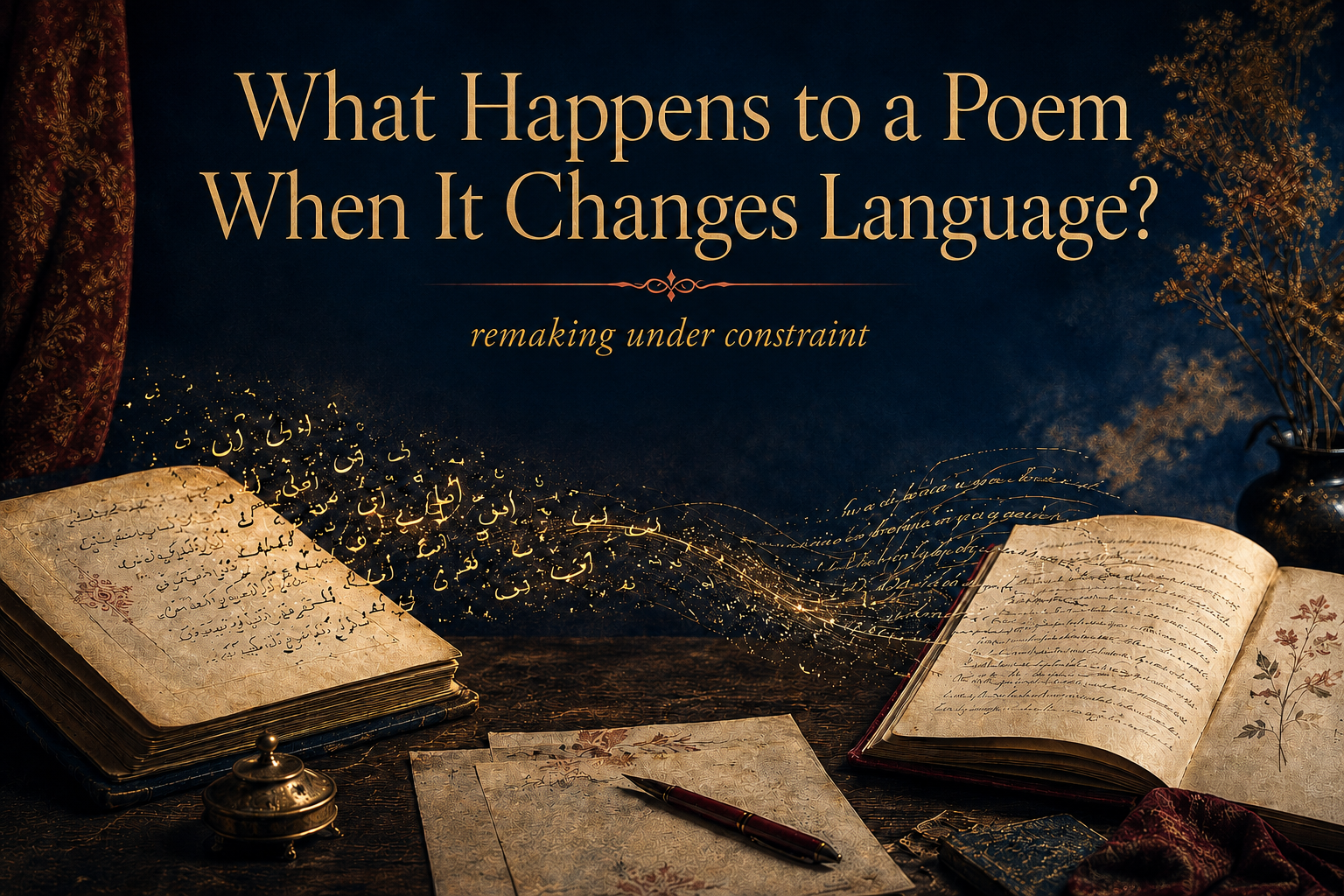
A poem can cross into another language without arriving unchanged. Translation does not simply carry it over; it asks what must be preserved, what may change, and what has to be created again.
Translating a sentence can already be difficult. Translating a poem is something stranger.
A poem does not carry meaning through vocabulary alone. It may depend on rhythm, rhyme, sound, ambiguity, word order, cultural memory, or the particular weight a single word has acquired within its language. Move that poem elsewhere and all of those elements must somehow travel with it.
They cannot always travel together.
This is why translating poetry is not simply a matter of finding equivalent words. The translator must decide what matters most, what can survive intact, and what must be reshaped so that the poem can live naturally in another language.
Meaning Is Only the Beginning
At first, translation can seem almost mechanical: understand the word, find its equivalent, and continue.
Languages refuse to cooperate so neatly.
One language may distinguish between ideas that another compresses into a single word. A familiar expression may carry cultural associations that disappear when translated literally. A word may feel intimate, archaic, comic, harsh, or tender in ways that its nearest dictionary equivalent does not.
Even apparently ordinary words can carry different emotional histories from one language to another.
The translator therefore has to ask more than What does this word mean? The more important question is often What is this word doing here?
Is it creating an image? Establishing a tone? Echoing another phrase? Deliberately sounding awkward? Carrying an association that native readers would recognise immediately?
Meaning is the beginning of the problem, not the end of it.
Sound Does Not Travel Easily
Poetry also asks us to hear language.
Rhyme, alliteration, repeated vowels, consonant patterns, stress, and cadence may contribute as much to the experience of a poem as the literal meaning of its sentences. Yet these effects belong to the sounds and structures available within a particular language.
A rhyme may disappear instantly in translation. A short line may become longer because the new language needs more syllables. A delicate rhythm may become heavy, while an apparently simple sequence of sounds may prove impossible to reproduce without changing the wording.
The translator then has choices to make. Preserving the exact meaning may destroy the music. Recreating the sound may require greater freedom with the words. Sometimes neither can be preserved completely, and the translator must build a different pattern that creates a comparable effect.
This is one of the paradoxes of poetry translation: the most literal version is not always the most faithful poem.
Form and the Problem of Fidelity
The problem becomes more difficult when form matters strongly.
A sonnet has limits. A villanelle depends upon recurrence. A tightly rhymed poem may build its argument partly through the expectation created by its structure. If those formal elements disappear, something important may disappear with them.
Yet preserving every structural feature can make the translation stiff or unnatural.
A translator may therefore keep the rhyme but alter the phrasing, preserve the line structure while loosening the sound, or abandon part of the original form in order to retain its pace, tone, or emotional pressure.
None of these decisions is automatically correct.
The real question is what kind of fidelity the poem requires.
For one poem, the images may be central. For another, it may be the rhythm. Elsewhere, the humour, restraint, repetition, or strange syntax may be what gives the poem its identity.
Translation becomes an act of judgement because not every element can always be preserved with equal force.
What Cannot Be Carried Across
Some features resist translation almost completely.
A pun may depend on two meanings contained within one word. A phrase may echo a proverb familiar to readers of the original language. Grammatical gender may quietly influence an image. Two words may resemble one another in sound and create an association that simply does not exist elsewhere.
The translator can explain such things in a note, invent another piece of wordplay, or allow the effect to disappear.
None of those solutions is perfect.
This is where the idea of translation as a transparent window becomes difficult to maintain. Every translated poem contains decisions about what to preserve, what to transform, and what to let go.
Something is almost always lost.
But loss is not the whole story.
The Translator as a Second Maker
A new language can also give the poem possibilities it did not possess before.
An image may acquire another shade of meaning. A rhythm may become slower or sharper. A phrase may gain associations created by the history of the receiving language. A translated poem can therefore become different without necessarily becoming poorer.
This also makes the translator more visible.
The original poet chose the first words. The translator chooses the second ones, and those choices shape tone, pace, diction, emphasis, and sometimes even imagery. Two skilled translators may produce strikingly different versions of the same poem while both remaining recognisably faithful to it.
Reading several translations can be revealing for exactly this reason. Their differences show us where the original poem resists easy transfer—and where each translator has decided to place the weight.
The translator is not replacing the poet, but neither are they invisible.
They are making something.
A Poem Arrives Changed
Perhaps the most useful way to think about poetry in translation is not as copying, but as remaking under constraint.
The translator receives a poem already shaped by one language and must discover how much of that shape another language can hold. Meaning is carried across, but so are attempts at rhythm, tone, image, silence, and form. Some elements survive almost untouched; others need to change so that the poem does not become lifeless in the process of being preserved.
And despite everything that may be altered, translation is one of the reasons poetry has travelled so widely at all. Without it, enormous parts of the world’s poetic traditions would remain inaccessible beyond their original languages.
A translated poem is therefore neither a perfect copy nor automatically a lesser version.
It is the result of one language listening closely to another.
The original poem provides the voice.
The translator decides how that voice might speak again.
Continue Exploring
› Why Some Words Refuse to Translate
Some meanings travel poorly because words carry culture, memory, atmosphere, and histories that no simple equivalent can reproduce.
› When Sound Carries Meaning
Rhythm, stress, repetition, and silence are among the qualities a translated poem must somehow make live again.
› The Measure of a Line
Meter and rhythm reveal why preserving a poem’s words is not always enough to preserve the way it moves.
Related Words
From History Nook
Death of Rabindranath Tagore (1861–1941) — When a Bengali Voice Entered English Literature
Tagore’s own English versions of his Bengali poems show translation becoming selection, reshaping, and creation—not simple substitution.