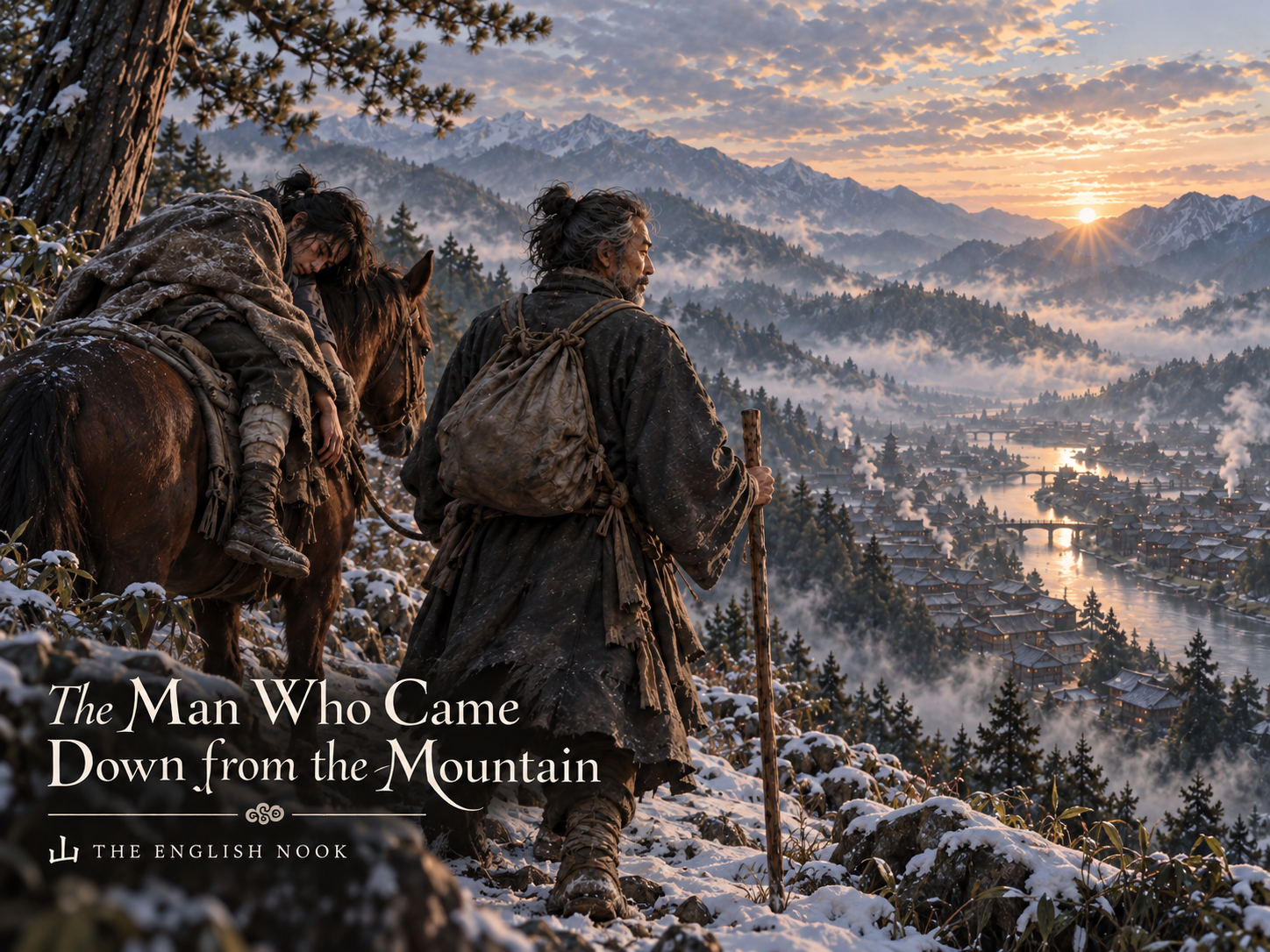

The Man Who Came Down from the Mountain
For twenty years, the mountain had asked very little of him.
Wood before winter. Water before dark. Rice when there was rice, roots when there was not. A roof repaired before the rains. A fire watched through the night when the snow came heavily.
These were honest demands.
People had always required more.
He had gone into the mountains not long after the war, when banners disappeared, stipends vanished, and men who had spent their lives knowing precisely where they stood discovered that the ground beneath them had moved.
At first, he had intended to remain only through one winter.
Then spring came.
Then another winter.
Years stopped arriving individually after that.
He built a small house beneath the cedars where the slope softened beside a stream. It was hardly more than a shack in the beginning, but he strengthened it little by little. He added a stone hearth. Shelves. A covered place for firewood. A narrow stable beside the eastern wall.
The horse had been young when they first climbed there together.
He was no longer young.
Neither of them was.
The old Kiso had gone almost white around the muzzle. His winter coat grew thick and uneven, and he took longer now when the path became steep. But his legs remained sound, and he still placed each hoof upon mountain stone with the deliberate certainty of an animal that had spent a lifetime learning where not to fall.
The man asked little of him.
They understood each other that way.
On cold mornings, the horse waited beside the door while the man split wood.
On warmer days, they travelled slowly to the lower meadows.
Sometimes the man spoke.
The horse listened.
It was enough.
Then, one autumn afternoon, someone entered their mountain.
The man saw him first between the cedar trunks.
Young. Perhaps twenty.
A travelling cloak. A small pack. Boots too fine for those paths.
Lost, almost certainly.
The man watched from above until the stranger disappeared beneath the trees.
He did not follow.
People became troublesome once they knew where you lived.
Near sunset, he saw the young man again.
This time he was sitting beside the stream.
The next morning, he was still there.
The man stood behind a cedar and watched him attempt to rise.
The traveller managed two steps before reaching for a tree.
Then he sank back to the ground.
The man frowned.
For several minutes he did nothing.
Then he returned home.
He came back carrying water.
The traveller looked up when he approached.
“You are lost,” the man said.
The young man tried to smile.
“I believe I may be.”
His voice was weak.
The man placed the water beside him.
“Drink.”
The traveller obeyed.
Only when the cup shook against his teeth did the man notice how badly his hands were trembling.
He touched the stranger’s forehead.
Hot.
Very hot.
That evening, there were two men in the shack.
The younger one slept beside the fire beneath three blankets. The older man prepared rice water, cooled his forehead with wet cloths and listened to his breathing.
By morning, the fever had worsened.
“Where are you from?” the man asked.
The traveller opened his eyes.
“East.”
“That is not a place.”
The young man almost laughed, then began coughing.
The old man looked toward the stable.
He disliked the answer forming in his mind.
The mountain could provide water.
It could provide shelter.
It could provide herbs he had trusted for years.
But the mountain could not tell him why this stranger burned with fever.
By midday, he had made his decision.
He brought the Kiso outside and laid an old blanket across his back.
The horse turned his head.
“I know,” the man said.
He helped the traveller up carefully and secured him as comfortably as he could.
The Kiso shifted once beneath the unfamiliar weight.
Then settled.
The man took the reins.
“Slowly.”
One ear turned toward him.
They began the descent.
He walked the entire way.
Where the path narrowed, he kept one hand against the traveller’s leg. Where stones were loose, he let the horse choose his footing. Twice they stopped beside streams. Once, the old Kiso simply refused to continue until he had rested.
The man did not argue.
“You have earned worse manners than that,” he told him.
The horse lowered his head.
They continued.
Late the following morning, the forest began to thin.
Then came fields.
Then fences.
Then roofs.
The man stopped.
Below them lay the town.
He remembered a place of wooden houses, narrow streets and muddy wheels.
There were still wooden houses.
There were still narrow streets.
But something had happened to the spaces between them.
New roofs rose among the old ones. Glass caught the morning sun. Strange poles stood beside the road, joined by black wires that stretched from one end of the town to the other.
The man stared for a moment.
Then the traveller groaned.
That ended his curiosity.
He led the horse onward.
The first farmer they passed stopped working.
The man gave him no attention.
A little farther on, an elderly shopkeeper stepped outside.
He bowed.
The samurai inclined his head in return.
Another man bowed.
Then a woman.
This seemed proper enough.
What seemed less proper was that they continued staring afterwards.
At the edge of the market, a group of children fell silent as he passed.
One whispered something.
The others followed.
He ignored them.
Two boys eventually gathered enough courage to approach.
They stood several paces away, looking first at the sword at his side, then at the horse, then at his clothes.
The man sighed.
Children had always been obvious creatures.
He reached into the old pouch beneath his belt.
There were only a few coins inside. He had carried them for years because there had never been much reason to spend them.
He selected one and held it toward the older boy.
The child hesitated.
“Take it.”
The boy accepted the coin.
Both children stared at it.
Then at him.
Then again at the coin.
“What is this?” the younger one asked.
The man’s eyebrows drew together.
“Money.”
Neither moved.
He straightened slightly.
The old command returned to his voice before he had even noticed it.
“Take it. Buy yourselves some bread. And do not stand there gawking.”
The boys froze.
The man gave them a look that had once caused armed men to correct their posture.
“Go.”
They went.
Very quickly.
The old Kiso breathed heavily beside him.
“At least someone still understands an order,” the man muttered.
They continued into town.
People moved aside.
Some bowed.
Others merely stared.
One young man wore a dark uniform unlike anything the samurai recognised. Another passed in a Western coat and hat.
No one carried a sword.
That was the strangest thing.
Still, he had no time to consider it.
He stopped an elderly merchant.
“Physician.”
The merchant blinked.
“A physician?”
“The boy is ill.”
The merchant looked at the traveller slumped over the horse.
His expression changed immediately.
“Three streets ahead. House with the green shutters. Doctor Nakahara.”
The samurai nodded.
The merchant bowed deeply.
Again.
The doctor’s house had green shutters.
The samurai knocked once.
A woman opened the door.
Behind her stood a man in spectacles wearing a white shirt beneath a dark vest.
“I need a physician.”
“I am one.”
The samurai looked at his clothes.
The doctor looked at his sword.
For a moment neither spoke.
Then the traveller coughed.
Everything else became irrelevant.
They carried him inside.
The samurai remained near the doorway while the doctor worked.
There were instruments he did not recognise.
Glass bottles.
Metal objects.
A curious device the doctor placed against the young man’s chest.
The samurai watched all of it without asking questions.
Questions had a way of multiplying.
Eventually, the doctor covered the traveller and stood.
“He is very ill,” he said.
The samurai’s face did not move.
“But?”
The doctor smiled slightly.
“But you brought him in time.”
The samurai looked toward the sleeping traveller.
“He will live?”
“I believe so.”
Something inside him loosened.
He had not realised how tightly he had been holding it.
“Good.”
He turned toward the door.
Outside, perhaps a dozen people had gathered.
Among them stood the two boys.
One still held the old coin.
Everyone was looking at him.
The samurai stared back.
No one moved.
Finally, he turned to the doctor.
“Why do they stare?”
The doctor glanced outside.
“They have been staring since you arrived.”
“They bow as well.”
“Yes.”
The samurai frowned.
“Why?”
The doctor studied him for several seconds.
Not mockingly.
Almost kindly.
Then he smiled.
“You look like a relic of an old era.”
The samurai said nothing.
He looked down.
At the sword.
At the patched sleeves he had repaired the same way for twenty years.
At the old bindings around his sandals.
Outside, the Kiso waited exactly where he had been left, grey muzzle lowered, ancient saddle across his back.
Beyond him stood the town.
The strange uniform.
The Western coat.
The glass windows.
The wires stretching above the roofs.
Children holding coins they no longer recognised.
And everywhere he looked—
no swords.
For the first time since entering the town, he understood the bows.
They were not bowing because everything remained as it had been.
They were bowing because it did not.
He stepped outside.
The crowd parted.
Some bowed again.
This time he watched them carefully.
The two boys remained near the road.
The older one lifted the coin.
“Sir?”
The samurai looked at him.
“Can we really buy bread with this?”
For a long moment, the man considered the question.
Then, unexpectedly, he laughed.
It was a rough sound.
Almost unused.
“Apparently not.”
The boys grinned.
The samurai walked to the horse and rested a hand against his old neck.
The Kiso raised his head.
“You knew, didn’t you?”
The horse blinked.
The man looked back toward the physician’s house.
The traveller would live.
There was no reason to remain.
There was also, he realised, no reason to leave immediately.
For twenty years, he had believed the mountain had remained still while everything troublesome stayed below.
Only now did he understand.
The mountain had never held him there.
He had.

Thank you for reading “The Man Who Came Down from the Mountain”! This is a story in a series created for avid readers and English learners who want to enjoy captivating tales while practicing their language skills. Stay tuned for more stories and language tips to enhance your journey!
Explore more short stories in English and Spanish by visiting the section:
Short Stories / Cuentos Cortos
When the world feels dull, your mind restless, or your heart heavy, let a story be your escape. Just one page, one sentence, one word—and suddenly, you’re somewhere new, where imagination breathes life into the ordinary and turns the simplest moments into magic.
Liked it? Drop an acorn! 🌰