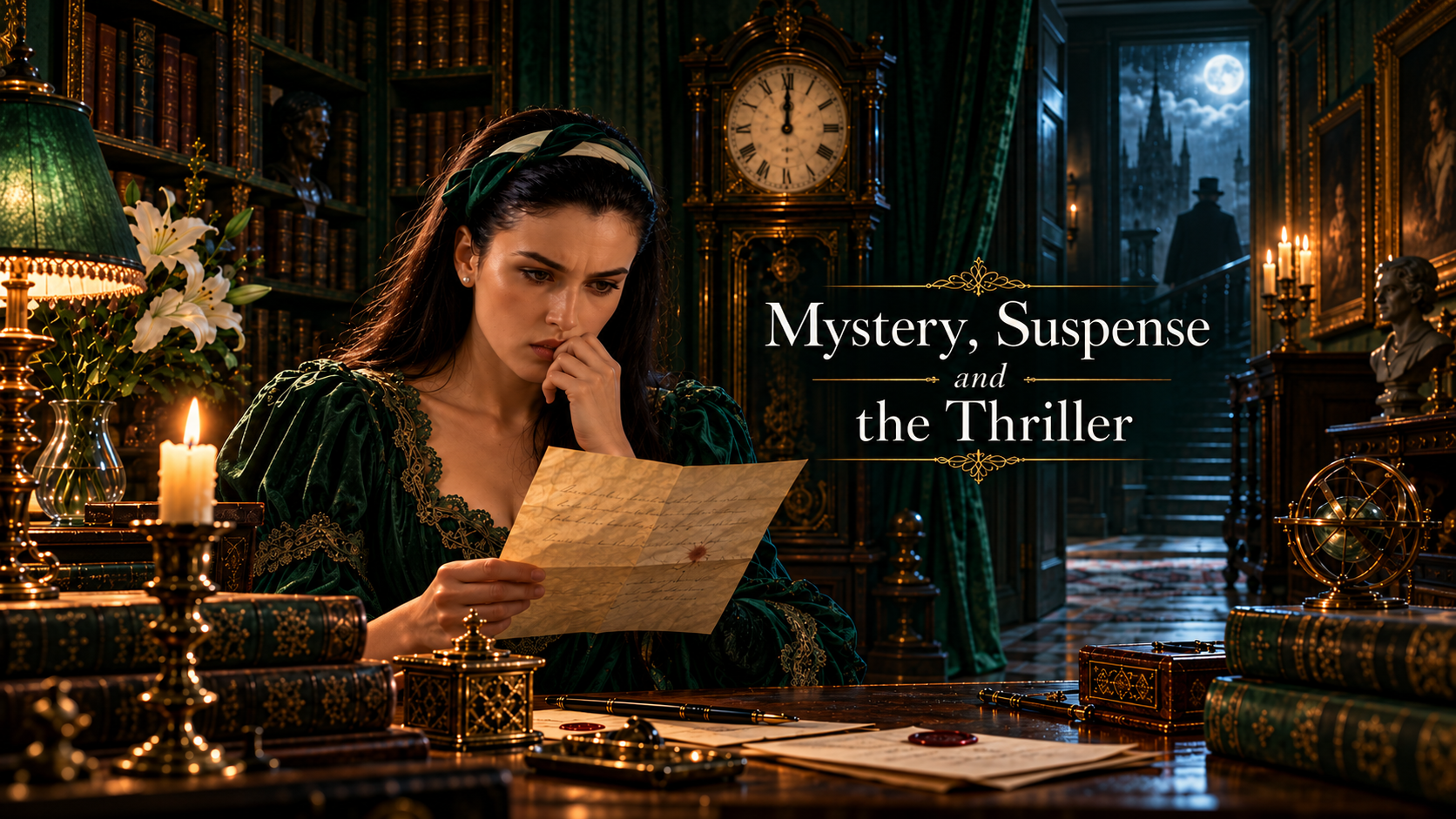

Mystery, Suspense and the Thriller
The letter arrives without a signature.
Inside is a single sentence:
You have until midnight.
There is no explanation, no demand, and no indication of who sent it.
At first, the message seems absurd. Then its recipient notices that the clock in the hallway has stopped, the telephone has been disconnected, and someone has left muddy footprints outside the locked study.
The reader has questions.
Who sent the letter? What will happen at midnight? Is someone already inside the house?
These questions reveal three closely related forces in storytelling: mystery, suspense, and the thriller.
They frequently operate together, but they are not identical.
Mystery encourages us to discover what is unknown. Suspense makes us anxious about an uncertain outcome. A thriller typically sustains urgency through danger, conflict, and high stakes.
Why does uncertainty make us turn the page, even when we are afraid of what the next page might reveal?
Mystery: The Pleasure of Not Knowing
A mystery begins with a gap in our understanding.
Something has happened, but its cause, meaning, or explanation remains concealed.
The reader follows a process of discovery, examining evidence, considering possibilities, and questioning assumptions.
Not every mystery concerns a crime. A missing traveller, an unexplained inheritance, or a troubling family secret may provide the central puzzle.
Nevertheless, detective fiction offers some of the most influential examples.
Edgar Allan Poe’s “The Murders in the Rue Morgue” (1841) is widely regarded as a foundational work of modern detective fiction.
Its investigator, C. Auguste Dupin, approaches an apparently baffling crime through observation and analytical reasoning.
Rather than accepting the first plausible explanation, Dupin examines details others have misunderstood or ignored.
The story helped establish several conventions later associated with detective fiction: the brilliant investigator, an observing companion who narrates events, the apparently impossible crime, and the reconstruction of its solution.
Wilkie Collins’s The Moonstone (1868) developed other possibilities.
The disappearance of a valuable diamond creates an investigation involving conflicting testimony, concealed motives, and uncertain memories.
Its multiple narrators demonstrate that individuals may describe events sincerely while possessing only partial knowledge of what occurred.
Mystery fiction thus explores more than the discovery of a culprit.
It asks how knowledge is assembled.
An apparently insignificant detail may become crucial. A reliable witness may be mistaken. A coincidence may conceal a pattern.
The reader participates by comparing possibilities against the evidence presented.
A satisfying solution allows earlier uncertainties to acquire new meaning.
Suspense: The Art of Waiting
Mystery asks questions. Suspense makes their consequences matter.
Imagine a character entering an empty house, unaware that someone is hiding upstairs.
The reader already knows about the intruder.
There is little mystery about whether danger exists. The tension comes from anticipating the encounter.
This is an example of suspense intensified by dramatic irony: the audience possesses information the character lacks.
But suspense can also arise when readers and characters know equally little.
We may not know whether a train will arrive in time, whether someone will survive an operation, or whether a dangerous secret will be discovered.
What matters is our investment in the outcome.
Writers create suspense through restricted viewpoints, interrupted conversations, approaching deadlines, conflicting expectations, and carefully managed pacing.
Speed can create urgency, but slowness is equally useful.
Consider a character waiting alone for an important telephone call.
The telephone does not ring.
Minutes pass. A sound comes from outside.
Still, the telephone does not ring.
Almost nothing has happened.
Yet if the reader understands the importance of that call, the delay can become unbearable.
Suspense depends not simply on withholding information, but on establishing why the uncertainty matters.
It is also far broader than horror or crime fiction.
A romance may create suspense around an unanswered declaration. A historical novel can sustain anxiety around an approaching disaster. A comedy may build anticipation before an embarrassing revelation.
Suspense is therefore a narrative effect that many genres employ.
The Thriller: When Danger Takes Control
A thriller often converts uncertainty into immediate pressure.
A character is pursued, threatened, deceived, or forced to act before a dangerous situation becomes irreversible.
Where many traditional detective stories reconstruct an earlier event, thrillers frequently direct their energy towards preventing a future catastrophe.
John Buchan’s The Thirty-Nine Steps (1915) is an influential example of the pursuit thriller.
Its protagonist, Richard Hannay, becomes involved in an espionage conspiracy after encountering a man who possesses dangerous information.
When that man is murdered, Hannay finds himself pursued by enemies while also facing suspicion from the authorities.
He must evade capture, interpret clues, and act before a larger threat can succeed.
Buchan transforms a conspiracy into a sequence of immediate dangers, where movement and improvisation become essential to survival.
The thriller’s appeal depends on urgency.
Yet it need not involve elaborate conspiracies or spectacular violence.
A person attempting to escape captivity, uncover a dangerous deception, or prevent a devastating mistake may inhabit a thriller if the story sustains sufficiently high stakes.
Thrillers also differ in emphasis.
Psychological thrillers explore manipulation and unstable trust. Political thrillers examine danger within struggles for power. Legal thrillers may transform an investigation or courtroom conflict into a matter of personal survival.
The common element is pressure.
Something important is at risk, and time, knowledge, or freedom may be running out.
Clues, Red Herrings and the Reader’s Trust
Mystery and thriller writers carefully control information.
A clue helps illuminate a situation, even if its significance is not immediately apparent.
A red herring encourages an incorrect interpretation, distracting attention from a more relevant explanation.
Both may contribute to a satisfying narrative.
Yet concealment must be handled carefully.
In many traditional detective mysteries, readers expect a reasonable opportunity to interpret the evidence.
A writer may disguise a clue’s importance, but a solution can feel disappointing if it depends entirely on information introduced at the last moment.
Agatha Christie’s The Murder of Roger Ackroyd (1926) became famous for challenging readers’ assumptions about narration and evidence.
Without revealing its solution, the novel demonstrates how dramatically an ending can change our understanding of earlier information.
A successful surprise does more than alter the answer.
It transforms the significance of what we thought we knew.
Thrillers employ similar techniques, although their revelations may intensify danger rather than resolve a puzzle.
The most effective twists feel surprising without being arbitrary.
They invite us to look backwards and recognise something we failed to appreciate.
Why We Keep Turning the Page
There is a peculiar pleasure in remaining uncertain while knowing that a writer has carefully constructed the uncertainty.
We want answers, but the pursuit of those answers is part of the experience.
Too little information produces confusion. Too much may destroy anticipation.
Between those extremes lies the tension that makes a mystery compelling.
As the narrative develops, solving the puzzle may cease to be our only concern.
We become invested in the characters, their mistakes, and the consequences of discovery.
What will the truth cost?
A mystery offers the possibility of understanding. Suspense tests our expectations. A thriller makes uncertainty feel urgently consequential.
Their boundaries overlap, and a single novel may combine all three.
But together they explain why readers return to dark narratives even when no ghosts, curses, or impossible creatures appear.
The ordinary world already contains enough uncertainty to sustain fear.
A mystery asks us to find the truth. Suspense makes us wait for an outcome. A thriller reminds us that knowing the truth may not be enough to survive it.
The final question is often no longer simply What happened?
It is something far more immediate.
What happens now?
Reading the Dark
Reading 7 of 8
An eight-part journey through the darker imagination.
← Previous: The Uncanny and Weird Fiction
Continue Exploring
An unexplained name appears in manuscripts written generations apart. A medieval researcher follows the clues towards a truth someone wanted history to forget.
2. Oarfish
A man in a grey coat keeps appearing wherever Lara goes, yet never seems to be watching her. A quiet exercise in mounting suspense and the fear of not knowing why.
A carpenter discovers a hidden room in a house abandoned after the Black Death. The investigation raises unsettling questions about the secrets a village has chosen to keep.