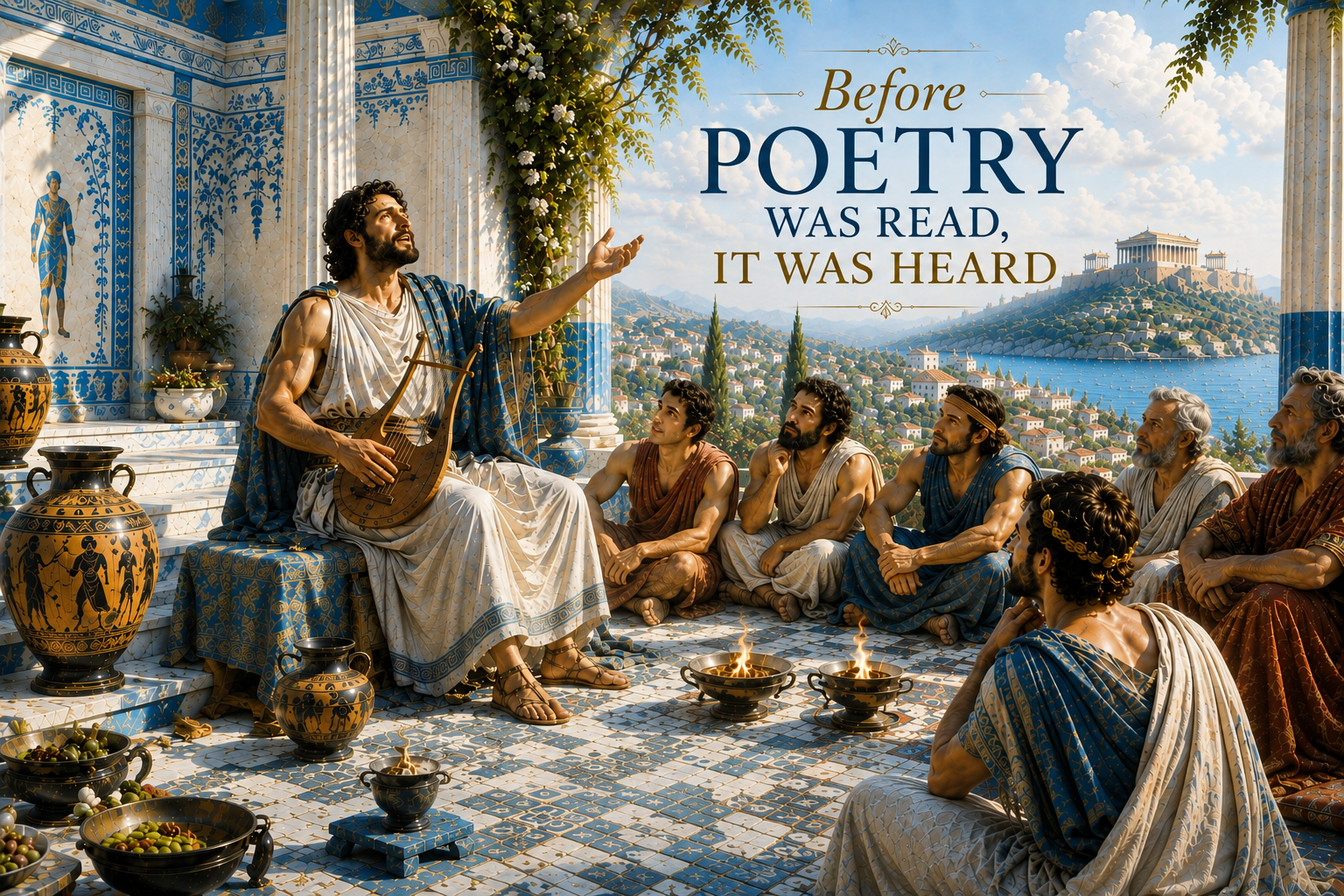

Before Poetry Was Read,
It Was Heard
Long before poetry belonged to books, it belonged to mouths.
Before the printed page, before silent reading, before punctuation could tell the eye where to pause, poetry travelled through voice, rhythm, repetition, and memory. It was spoken beside fires, sung during work, recited at ceremonies, carried through halls, repeated from one generation to another.
For much of human history, a poem was not primarily something one looked at.
It was something that happened.
Someone spoke.
Someone listened.
And if the words were to survive, they had to remain in the mind.
Poetry Before the Page
Writing is ancient, but human beings were telling stories, chanting, singing, lamenting, praising, and remembering long before writing became an ordinary means of preserving them.
Early poetry therefore developed under a very different pressure from poetry written for the page.
A poet could not assume that the audience would return to the previous stanza. There was no margin to annotate, no line to reread, no book to close and reopen tomorrow.
The poem had to carry itself forward through sound.
Rhythm helped.
Repetition helped.
Patterns helped.
Repeated phrases, recurring images, familiar structures, rhyme, alliteration, and predictable turns of language made long compositions easier both to remember and to follow.
These were not merely ornaments.
They were technologies of memory.
A repeated phrase might sound excessive to a modern reader encountering it silently on a page. To a listener hearing a long poem performed once, however, repetition could provide orientation. It could announce a character, mark a transition, reinforce an image, or give the mind enough familiarity to remain inside an unfolding story.
Poetry learned to survive by becoming memorable.
The Poem Lived in the Body
This also meant that poetry was physical in a way we sometimes forget.
A spoken poem requires breath.
A long line demands more air than a short one. A pause gives the speaker time to breathe. A cluster of hard consonants moves differently through the mouth from a sequence of soft vowels. A repeated rhythm can gradually become almost bodily, felt before it is consciously analysed.
What we now call meter, cadence, stress, alliteration, refrain, and pause were once inseparable from the physical act of speaking.
The listener experienced them through the ear.
The performer experienced them through the lungs, tongue, throat, and chest.
This is one reason poetry can sometimes reveal something when read aloud that remains hidden during silent reading. A line that appears awkward on the page may suddenly find its balance in speech. A repetition that seems unnecessary may become incantatory. A pause may acquire weight. A rhyme that barely registers visually may suddenly bind two distant ideas together.
The poem has not changed.
Our way of receiving it has.
Memory Shaped the Poem
Oral poetry also depended upon memory in ways modern literature rarely does.
A poem could survive only if people remembered enough of it to carry it onward.
That does not necessarily mean every performer reproduced every word exactly. In many oral traditions, preservation and recreation existed together. Familiar structures, repeated formulas, established episodes, and remembered sequences could allow a skilled performer to rebuild a story during performance.
The poem, therefore, was not always a perfectly fixed object.
It could be more like a living pattern.
A story remained recognisably itself even while individual performances shifted.
This changes the idea of authorship.
Modern readers are accustomed to asking who wrote a poem and what the definitive text is. Oral traditions can make those questions much more complicated. A work may have passed through countless voices before anyone wrote it down. Lines may have changed. Episodes may have expanded. Different communities may have preserved different versions.
Instead of a single moment of creation, there may have been centuries of remembering.
Poetry Was Shared
There is another difference.
Silent reading is private.
Oral poetry is usually social.
A poem spoken before others creates a temporary community between performer and audience. Everyone hears the same words moving through the same moment.
That matters.
A lament heard among mourners is different from a lament read alone. A heroic poem performed before a hall does something different from the same poem encountered quietly at a desk. A chant gains force when voices join it. A refrain invites recognition because the audience knows what is coming.
Poetry could praise rulers, preserve ancestry, celebrate victories, mourn the dead, tell sacred stories, ridicule enemies, teach values, entertain travellers, or simply hold a community together through a story everyone knew.
The poem was not merely literature.
It was memory performed in public.
Then Poetry Entered the Page
Writing changed this relationship profoundly.
Once a poem could be preserved visually, it no longer depended entirely upon memory or performance.
Words could remain still.
Readers could return to them.
The poet could construct subtler patterns that might only become visible after several readings. Lineation itself became something the eye could perceive. Punctuation acquired new importance. Typography, spacing, indentation, and eventually even blank space could participate in meaning.
The page gave poetry extraordinary new possibilities.
But something was also transformed.
A written poem could now exist without anyone speaking it.
Centuries later, the spread of printing and increasingly common silent reading pushed poetry even further toward the private encounter we know today: one reader, one text, one quiet room.
Yet the older creature never disappeared.
It remained underneath.
The Voice Is Still There
Even the most visually intricate modern poem is made from language that can be spoken.
The old instincts remain everywhere.
We still notice rhythm.
We still anticipate repetition.
We still respond to rhyme even when we cannot explain why.
We still feel the difference between a sentence that flows and one that strikes.
We still remember phrases because of how they sound.
And poetry repeatedly returns to performance: through recitation, song, spoken-word poetry, dramatic monologue, public readings, chants, nursery rhymes, protest verse, and countless other forms.
Perhaps this should not surprise us.
Writing gave poetry another home.
It did not erase the first one.
Read It Once With Your Ears
There is a simple experiment worth trying whenever a poem seems distant or difficult.
Read it aloud.
Not theatrically.
Not as though you must perform it perfectly.
Simply give the words breath.
Listen for where the line wants to accelerate and where it resists. Notice which sounds repeat. Notice where your voice naturally pauses. Notice which words become heavier when spoken and which nearly disappear.
Sometimes nothing dramatic happens.
But sometimes the poem suddenly becomes clearer—not because you have decoded its meaning, but because you have restored one of the conditions for which poetry was built.
For thousands of years, poetry survived because human beings could carry words inside themselves and release them again through the voice.
The page came later.
And beneath every written poem, however quiet it appears, there remains the possibility of that older moment:
someone speaks, someone listens, and the words begin to live between them.
Continue Exploring
The Space Between Words →
From the spoken voice to the silence around it: how pause, rhythm, and placement can carry meaning.
What Is Poetry? →
A broader look at poetry’s forms, traditions, and long history of human expression.
How Poetry Shaped English →
From oral rhythm and memory to the way poetry helped shape English itself.