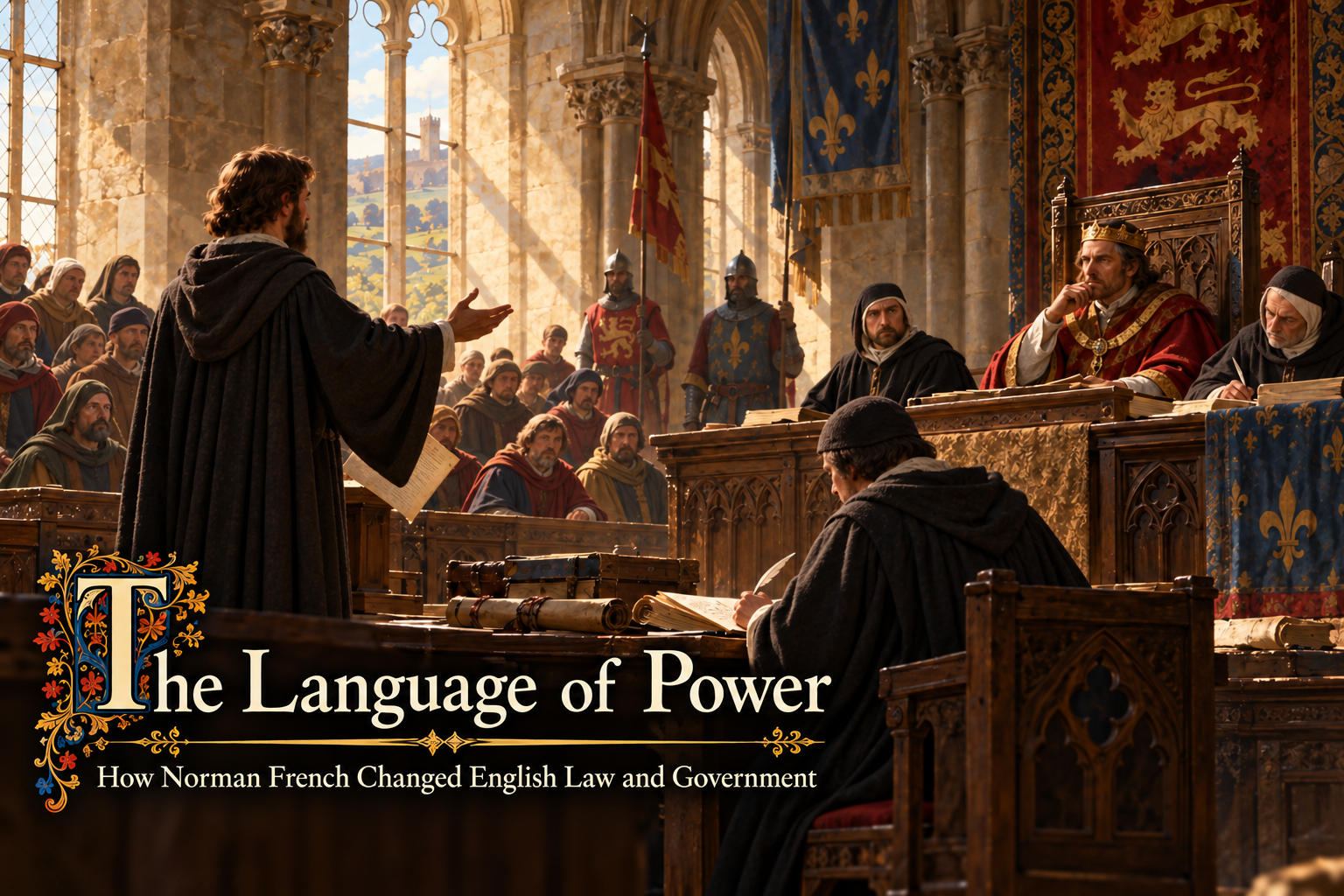

The Language of Power
How Norman French Changed English Law and Government
A judge hears a case in court. An attorney represents a client. A jury considers the evidence. Elsewhere, Parliament debates the work of government.
Much of this familiar vocabulary reached English through French. These words are so ordinary now that their history can disappear behind the institutions they name.
After the Norman Conquest, French became deeply involved in the exercise of authority in England. Over the following centuries, it helped provide the terms through which people discussed disputes, representation and government. Its influence endured because words became embedded in the work of institutions.
More Than the Speech of Rulers
French did not become the language of every legal activity on the day William took the throne. Its position developed over time, alongside the continuing use of English and Latin.
The variety used in England is explored in What Was Anglo-Norman? — The French Language of Medieval England. Within the legal profession, French acquired increasingly specialised uses, developing into the register generally called Law French.
That mattered because legal work depended on learned procedures and established terminology. Someone entering the profession needed to understand how a claim was framed, how it could be answered, and which distinctions affected its outcome.
French was therefore more than a marker of social prestige. It became a practical means of acquiring and applying legal knowledge.
Learning the Law in French
Medieval legal manuals make that professional role visible.
The late-thirteenth-century treatise Britton explained English law in French. Another manual, Fet Asaver, used French and Latin to explain legal procedure, particularly matters connected with land.
In his discussion of legal education, William Rothwell also draws on the historian Paul Brand’s research into French teaching materials and lectures. These were tools for training people who needed to handle complicated business accurately.
The language was being renewed through professional use. Each learner encountered terms already employed by teachers, practitioners and texts, then carried them into further work.
This helps explain why a specialist vocabulary could persist even as the wider linguistic balance in England changed.
Court, Judge and Jury
Some surviving words reveal the concepts beneath their modern meanings.
Court came through Anglo-French curt or court. Its history includes an enclosed place, a ruler’s entourage and an assembly administering justice. The modern word still connects royal and judicial settings: a royal court and a court of law.
Judge reached Middle English from French juge, ultimately from Latin iudex. The noun names the person entrusted with deciding a case; the related verb extends much further, into everyday acts of assessment.
Jury comes through Anglo-French juree, associated with jurer, “to swear.” Its history preserves the importance of an oath.
That does not mean a medieval jury performed exactly the same role as a modern one. A word can continue while the institution it names develops. Etymology explains part of that history, rather than supplying a complete description of medieval justice.
Representation and Confinement
Attorney entered English through Anglo-French aturné, connected with appointing someone to act on another’s behalf. Representation is central to its history.
The word therefore points beyond a general idea of someone knowledgeable about law. It identifies a relationship: one person authorised to conduct business for another.
Prison, also borrowed through Anglo-French, ultimately connects with Latin prehendere, “to seize.” Its ancestry links confinement with the act of taking someone into custody.
These words name consequential actions and positions. They concern who may act for whom, who has authority to decide, and what happens to a person placed under restraint.
Their continued usefulness helps explain their durability. They became familiar ways of describing matters that institutions repeatedly had to address.
From Discussion to Parliament
The French word parlement could mean speech, conversation or a meeting for discussion. It also acquired the more specific sense of a formal gathering of the king’s counsellors.
English parliament inherited that connection with speaking and deliberation. Its subsequent history followed the development of an institution whose powers and membership changed over centuries.
Government belongs to the word family of govern, which reached English through French and ultimately derives from Latin gubernare, “to steer” or “to govern.”
Here too, the vocabulary should not be mistaken for a ready-made modern system imported in 1066. Borrowed words gained their place through the continuing development of English institutions.
Why the Words Stayed
The Year Books, medieval England’s law reports, show how French became part of the profession’s accumulated knowledge. The earliest examples date from about 1268; reports collected in the printed series cover cases through 1535. Many preserve legal argument in Law French.
These reports should be distinguished from the royal courts’ formal plea rolls, which were compiled in Latin. French’s professional importance did not make every legal record French.
Such texts gave later practitioners earlier cases to study. Established terms travelled with the material used to explain and practise the law.
This offers a practical explanation for their survival: changing the language of an institution does not require replacing every useful term within it. English could become more prominent while retaining vocabulary already associated with particular roles and procedures.
Even today, UK Parliament retains French in certain formal exchanges between the Houses and at Royal Assent. These limited ceremonial uses are another kind of continuity, distinct from ordinary government business.
Why It Matters
French gave English a substantial part of its legal and governmental vocabulary, but it did not supply every word. Law itself was already present in Old English, borrowed from Scandinavian speech.
The resulting language carries several histories together.
When we say court, jury, attorney or parliament, we use words shaped by centuries of institutional practice. English regained the language of government. French remained in the words through which it governed.
Continue Exploring
Explore The History of English, from its Anglo-Saxon foundations through centuries of contact and change.