
English Was Never Alone
Every language carries company. English carries centuries of it.
This week, medieval England became unexpectedly crowded.
What Was Anglo-Norman? followed the French used in England after 1066—not merely through kings and courts, but through households, estates, teaching, stories, administration, and ordinary working vocabulary. Then Three Languages, One Kingdom placed English beside French and Latin and asked what each language was actually being used to do.
A land dispute might begin in spoken English, pass through French, and survive on parchment in Latin.
One matter.
Three languages.
And eventually, one English carrying traces of all of them.
The Portal has seen that kind of thing before.
🐦⬛ Fetched from the Archive
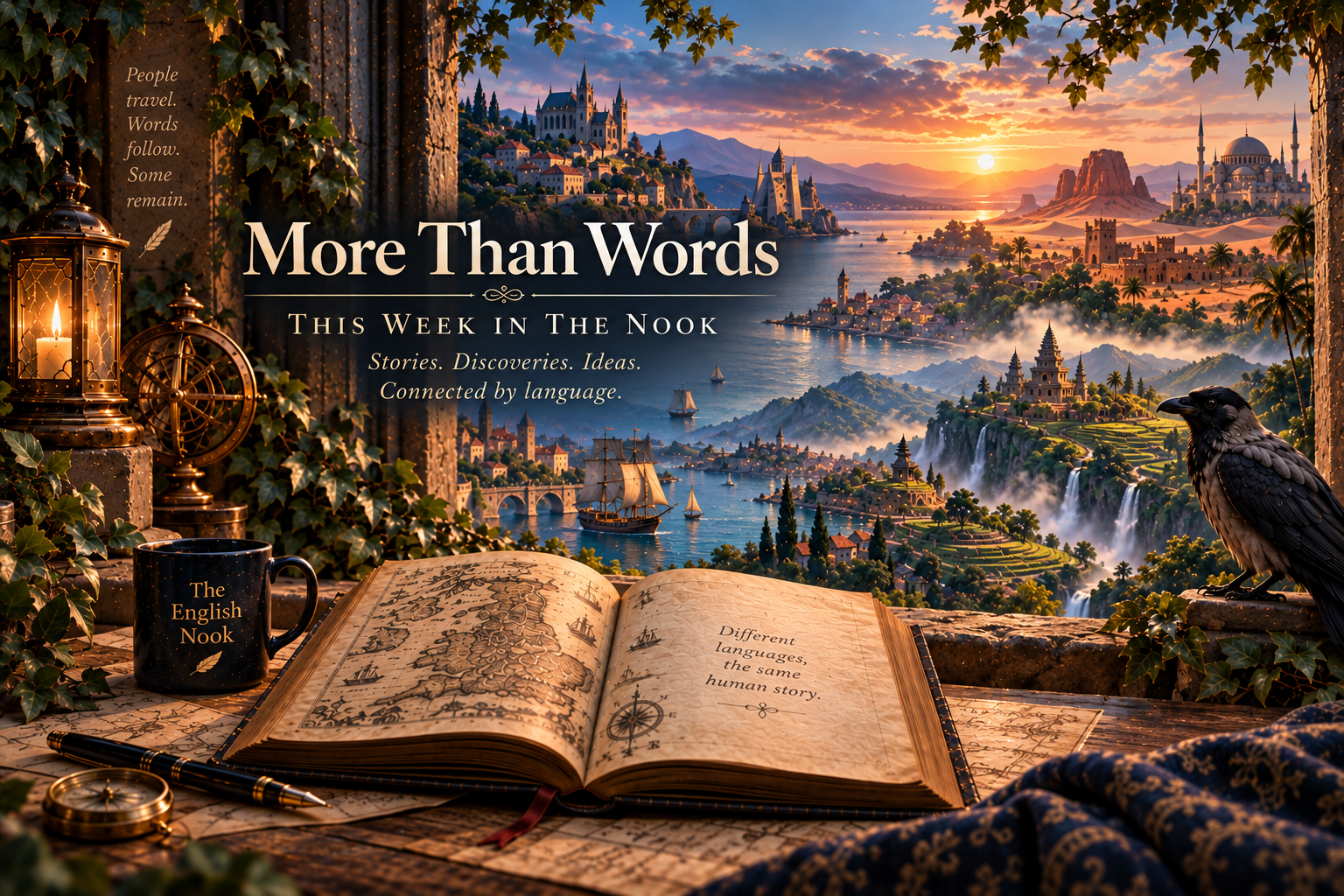
Languages rarely develop in splendid isolation.
People travel.
Armies cross borders.
Merchants negotiate.
Books are translated.
Religions spread.
Scholars revive older texts.
And somewhere amid all that movement, one language begins carrying pieces of another.
Sometimes the borrowed thing still looks foreign.
Sometimes we stop noticing it entirely.
When the Past Hides Inside an Ordinary Word
▸ The Roots of Language: A Journey Through Etymology
One of the older shelves approached words almost like archaeological objects.
Dig beneath the modern form and earlier lives appear: roots, borrowings, changed meanings, old affixes, pieces carried across languages and centuries.
A word may look perfectly settled in present-day English while its history still points somewhere else.
Familiarity is very good at hiding the journey.
▸ How Latin Has Influenced the English Language
Latin arrived by more than one road.
Religion carried it. Scholarship carried it. Science and law carried it. And after 1066, French carried large numbers of Latin-derived words into English by an indirect route.
That history helps explain why English can place short Germanic words beside more formal Romance ones and treat both as its own.
The layers did not replace one another neatly.
They accumulated.
When Movement Leaves Vocabulary Behind
▸ How Trade Routes Changed Everyday English
Conquest is only one kind of contact.
Trade carried words along roads and sea routes, through ports and marketplaces, until terms connected with food, clothing, navigation, mathematics, work, and everyday objects entered English from much farther away.
A conversation today can quietly contain evidence of journeys made centuries ago.
Vocabulary remembers movement long after the travellers are gone.
▸ English Loanwords in Spanish
And borrowing never belonged only to English.
Modern Spanish has taken in English words through technology, sport, business, popular culture, and everyday contact, adapting some while leaving others recognisably foreign.
The direction has changed.
The process has not.
Languages meet a new object, habit, institution, or idea—and sometimes the word travels with it.
When History Refuses to Disappear
▸ Why English Spelling Is So Inconsistent
English spelling can seem almost malicious until history enters the room.
Old pronunciations remain visible after sounds change. French scribal habits meet native English forms. Printing begins fixing spellings while pronunciation keeps moving. Scholars later reshape words to display classical ancestry.
The result can be untidy.
But the untidiness is evidence.
English spelling is sometimes history refusing to clean up after itself.
▸ War and the Evolution of the English Language
Conflict creates some of language contact’s darkest routes.
Invasion, occupation, empire, military technology, and the movements produced by war have repeatedly carried vocabulary across boundaries.
The words remain even after the circumstances that moved them have become history.
Language does not preserve those encounters innocently.
But it preserves them nonetheless.
🌾 Into Word Nook
Perhaps the nicest trick is that even the words we use to describe this process are carrying the process themselves.
Language came into Middle English through Old French langage. Trace also comes through Old French, carrying the image of a track or mark left by movement. And Memory travelled through Middle English memorie and Old French memoire back toward Latin memoria.
Language.
Trace.
Memory.
Three borrowed words describing what borrowing leaves behind.
English can barely tell the story of its own history without speaking some of that history aloud.
📚 Into History Nook
J. R. R. Tolkien understood languages as records of peoples, migrations, separations, sound changes, and lost histories. That is why his invented languages feel older than the stories containing them: each seems to have had a life before the reader arrived.
And the Fall of Constantinople opens another road: the movement of Greek texts and scholarship westward formed part of the larger Renaissance recovery of classical learning whose vocabulary would later enter English intellectual life.
One reminds us that language can preserve an imagined history.
The other that real histories of movement can reshape what a language becomes capable of saying.
The Company English Keeps
English survived 1066.
But survival did not mean remaining untouched.
English continued to be spoken. French acquired powerful roles beside it. Latin remained essential in other domains. Over generations, those languages met in documents, institutions, literature, work—and eventually inside vocabulary itself.
And the process did not stop in medieval England.
Latin.
French.
Norse.
Arabic.
Languages of India.
Languages encountered through commerce, migration, scholarship, empire, technology, and ordinary human contact.
Some arrived through exchanges we can celebrate.
Others through histories we should remember more carefully.
All left traces.
Perhaps that is what this week’s medieval doorway makes easiest to see:
English was never alone.
And perhaps no living language ever really is.
Until the next path opens,
listen for the company a word keeps.