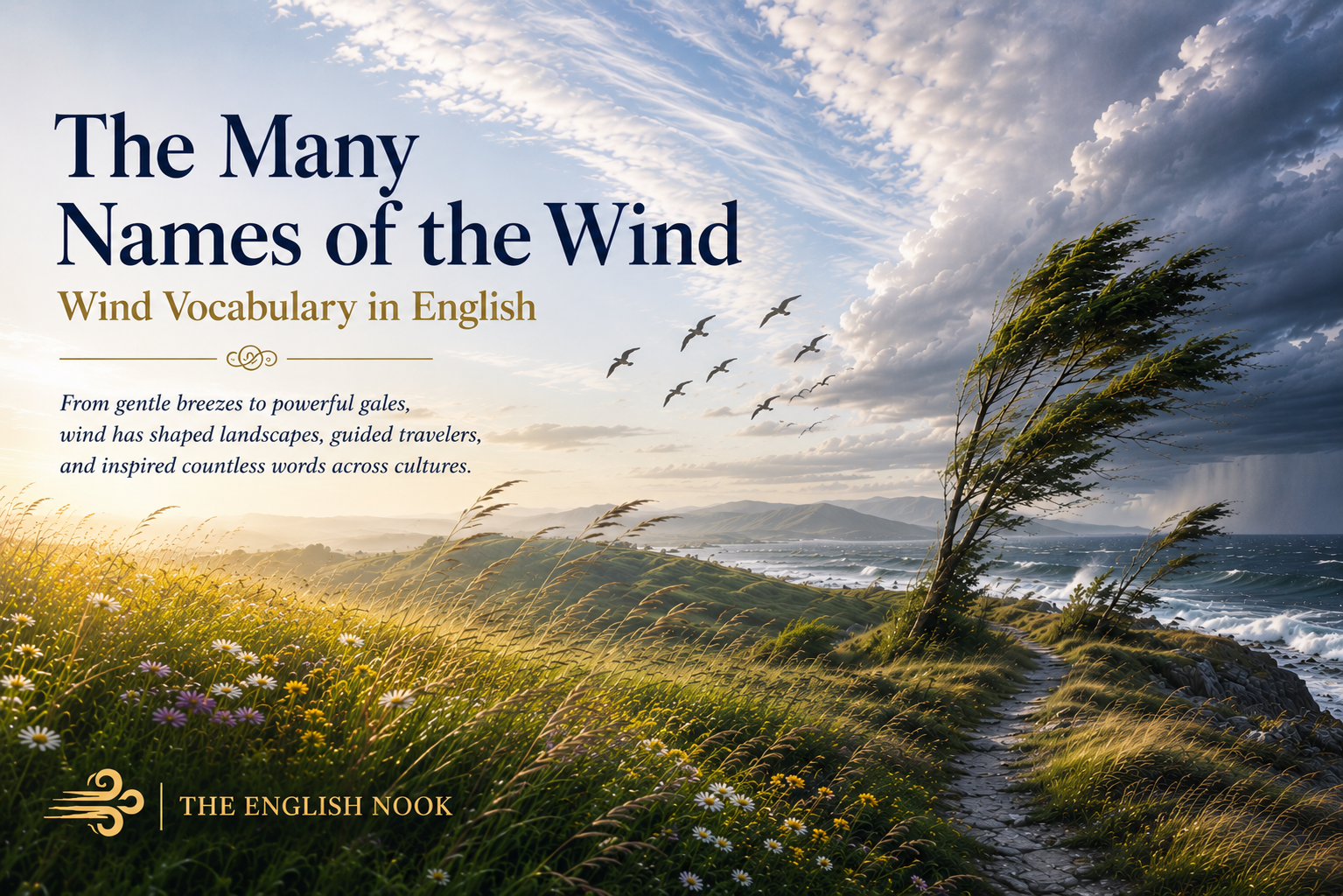

The Many Names of the Wind
How Languages Describe One of Nature’s Most Invisible Forces
We explored some wind-related vocabulary earlier this year in Carried by the Wind, where we looked at words connected to air, movement, and the atmosphere. A few familiar terms will appear again here, but today we will focus more specifically on the wind itself and the many forms it can take.
From a gentle breeze crossing a meadow to powerful winds that help shape deserts and guide ships across oceans, wind has influenced both nature and human history for thousands of years. It is therefore no surprise that languages have developed a rich vocabulary to describe it.
Today, we will explore some of the many names of the wind and discover how English and Spanish describe one of the world’s most invisible yet influential forces.
🌬️ Vocabulary
1. Breeze
IPA: /briːz/
Spanish: brisa
Definition: A light and pleasant wind.
Example: A cool breeze moved through the trees at sunset.
Translation: Una brisa fresca atravesó los árboles al atardecer.
2. Zephyr
IPA: /ˈzef.ər/
Spanish: céfiro
Definition: A gentle, mild wind, often associated with spring.
Example: A warm zephyr carried the scent of flowers across the meadow.
Translation: Un céfiro cálido llevó el aroma de las flores por el prado.
3. Gust
IPA: /ɡʌst/
Spanish: ráfaga
Definition: A sudden, brief increase in wind speed.
Example: A strong gust nearly took his hat away.
Translation: Una fuerte ráfaga casi se llevó su sombrero.
4. Draft
IPA: /drɑːft/
Spanish: corriente de aire
Definition: A current of air moving through an enclosed space.
Example: There was a cold draft coming from the window.
Translation: Había una corriente de aire fría que venía de la ventana.
5. Gale
IPA: /ɡeɪl/
Spanish: vendaval
Definition: A very strong wind.
Example: The fishing boats remained in port during the gale.
Translation: Los barcos pesqueros permanecieron en el puerto durante el vendaval.
6. Squall
IPA: /skwɔːl/
Spanish: turbonada
Definition: A sudden, violent wind often accompanied by rain.
Example: A squall crossed the bay shortly before sunset.
Translation: Una turbonada cruzó la bahía poco antes del atardecer.
7. Whirlwind
IPA: /ˈwɜːl.wɪnd/
Spanish: torbellino
Definition: A rapidly rotating column of air.
Example: Leaves danced inside the small whirlwind.
Translation: Las hojas giraban dentro del pequeño torbellino.
8. Dust Devil
IPA: /ˈdʌst ˌdev.əl/
Spanish: diablo de polvo
Definition: A small rotating column of air that lifts dust and sand.
Example: A dust devil crossed the dry field.
Translation: Un diablo de polvo cruzó el campo seco.
9. Monsoon
IPA: /mɒnˈsuːn/
Spanish: monzón
Definition: A seasonal wind system associated with major changes in rainfall.
Example: The monsoon brings heavy rains to the region every year.
Translation: El monzón trae fuertes lluvias a la región cada año.
10. Trade Wind
IPA: /ˈtreɪd ˌwɪnd/
Spanish: viento alisio
Definition: A steady wind that helped sailors cross oceans for centuries.
Example: Ancient ships relied on trade winds during long voyages.
Translation: Los antiguos barcos dependían de los vientos alisios durante largos viajes.
11. Tailwind
IPA: /ˈteɪl.wɪnd/
Spanish: viento de cola
Definition: A wind blowing in the same direction as movement.
Example: The aircraft reached its destination faster thanks to a tailwind.
Translation: El avión llegó más rápido gracias a un viento de cola.
12. Headwind
IPA: /ˈhed.wɪnd/
Spanish: viento en contra
Definition: A wind blowing against movement.
Example: Cyclists struggled against a strong headwind.
Translation: Los ciclistas luchaban contra un fuerte viento en contra.
✨ Useful Phrases
A gentle breeze drifted across the valley.
The wind picked up during the afternoon.
A strong gust shook the trees.
🌬️ Common Expressions
Gone with the wind — disappeared or no longer present.
Get wind of something — hear news or information about something.
Throw caution to the wind — act without worrying about the risks.
📖 Reading Practice
🇬🇧 One Wind, Many Paths
For thousands of years, humans have depended on the wind. Sailors crossed oceans by following trade winds, while farmers learned to recognize the signs of a coming monsoon or a powerful gale. On calmer days, a gentle breeze or a warm zephyr could make travel more pleasant, while a sudden gust might change conditions in an instant. Although the wind itself remains invisible, its effects can be seen almost everywhere, which may explain why languages have developed so many words to describe it.
🇪🇸 Leer en español — Haz clic para abrir
El Viento Que Moldea el Mundo
Durante miles de años, los seres humanos han dependido del viento. Los marineros cruzaban océanos siguiendo los vientos alisios, mientras que los agricultores aprendían a reconocer las señales de un monzón inminente o de un poderoso vendaval. En los días más tranquilos, una suave brisa o un cálido céfiro podían hacer los viajes más agradables, mientras que una repentina ráfaga podía cambiar las condiciones en un instante. Aunque el viento permanece invisible, sus efectos pueden observarse casi en todas partes, lo que quizás explique por qué los idiomas han desarrollado tantas palabras para describirlo.
🇵🇹 Ler em português — Clique para abrir
O Vento Que Molda o Mundo
Durante milhares de anos, os seres humanos dependeram do vento. Os marinheiros cruzavam oceanos seguindo os ventos alísios, enquanto os agricultores aprendiam a reconhecer os sinais de uma monção que se aproximava ou de um poderoso vendaval. Em dias mais tranquilos, uma brisa suave ou um zéfiro agradável podiam tornar as viagens mais confortáveis, enquanto uma rajada repentina podia mudar as condições em um instante. Embora o vento permaneça invisível, seus efeitos podem ser observados em quase todos os lugares, o que talvez explique por que as línguas desenvolveram tantas palavras para descrevê-lo.
🌬️ The Shape of the Wind
The wind is one of the few forces we experience every day without ever truly seeing.
Yet it shapes landscapes, influences weather, carries life across continents, and connects distant places through a movement we can only observe indirectly.
Perhaps that is why people have given it so many names.

The wind leaves no footprints, yet it shapes entire landscapes.
✍️ Writing Challenge
Describe a memorable windy day.
Where were you? What could you see, hear, and feel?
Try to use at least three of the vocabulary words from this article.
📚 Vocabulary Quick Reference
| English | Spanish | Portuguese |
|---|---|---|
| Breeze | Brisa | Brisa |
| Zephyr | Céfiro | Zéfiro |
| Gust | Ráfaga | Rajada |
| Draft | Corriente de aire | Corrente de ar |
| Gale | Vendaval | Vendaval |
| Squall | Turbonada | Rajada forte |
| Whirlwind | Torbellino | Redemoinho |
| Dust Devil | Diablo de polvo | Redemoinho de poeira |
| Monsoon | Monzón | Monção |
| Trade Wind | Viento alisio | Vento alísio |
| Tailwind | Viento de cola | Vento de cauda |
| Headwind | Viento en contra | Vento contrário |
If this article stayed with you, consider leaving a like, sharing it, commenting, or all three .