
World Day to Combat Desertification and Drought
The Words Written by Dry Lands
Most people rarely think about dry lands.
Deserts often appear in the imagination as distant places: vast stretches of sand, scorching heat, and seemingly endless horizons. Yet nearly half of the world’s land surface can be classified as dry land, and billions of people depend on these environments for their livelihoods.
Every year on June 17, the world observes World Day to Combat Desertification and Drought, a day dedicated to raising awareness about land degradation, water scarcity, and the importance of protecting fragile ecosystems. It is also an opportunity to look more closely at a surprising truth: some of the landscapes that seem most empty have quietly left a lasting mark on the English language.
How This Day Began
The observance was established by the United Nations in 1994 following the adoption of the United Nations Convention to Combat Desertification, an international agreement created to address the growing challenges posed by drought and land degradation.
The choice of June 17 is not accidental. It marks the anniversary of the convention’s adoption and serves as a reminder that healthy land is one of humanity’s most valuable resources.
When soil loses its fertility, communities face difficult choices. Agriculture becomes harder. Water becomes scarcer. Migration often increases. Entire ways of life may change.
Yet long before these modern concerns entered international discussions, dry lands had already been influencing human history, trade, and language for thousands of years.
The Vocabulary of Survival
People who live in demanding environments often develop rich vocabularies to describe them.
English has borrowed many words from regions where water is precious and the landscape demands careful observation.
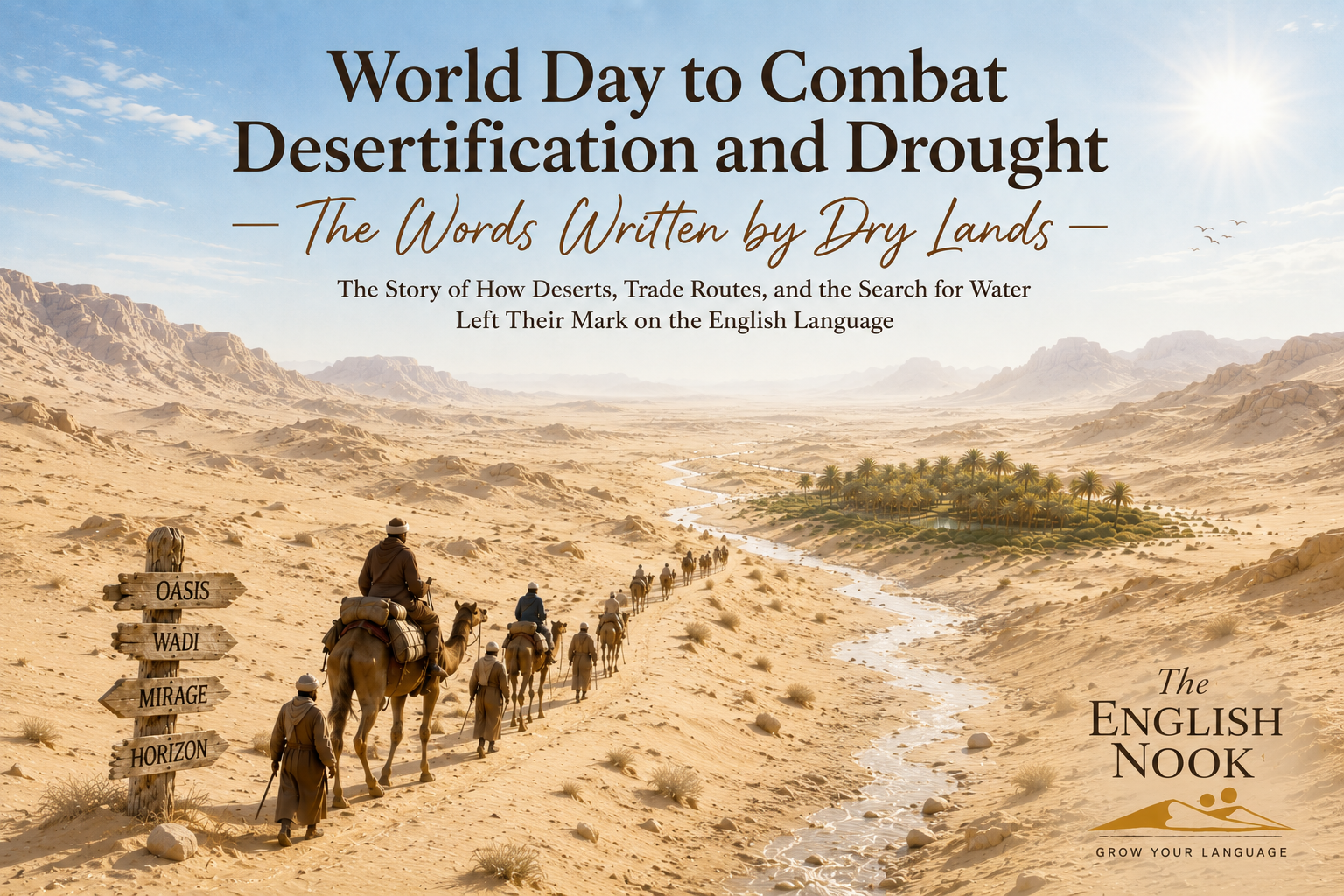
Consider oasis.
The word traveled through several languages before reaching English, carrying with it the idea of a fertile place surrounded by aridity. Today, it still refers to a physical refuge in a desert, but it has also become a metaphor for any place of relief, comfort, or renewal.
Another example is wadi, borrowed from Arabic. A wadi is a dry riverbed that may remain empty for months or years before sudden rains transform it into a flowing watercourse. The word entered English because existing vocabulary could not fully capture the unique nature of the feature.
Even the familiar word mirage emerged from observations common in hot, dry environments. What begins as a genuine optical phenomenon eventually became one of English’s most powerful metaphors for something that appears real but remains unattainable.
These words remind us that language grows not only from books and cities, but also from landscapes.
Roads Through the Desert
The influence of dry lands extends far beyond individual words.
For centuries, deserts were crossed by merchants, pilgrims, explorers, and scholars. The great caravan routes of North Africa, the Middle East, and Central Asia connected distant civilizations long before modern transportation existed.
Along these routes, people exchanged far more than goods.
They exchanged stories.
They exchanged ideas.
And they exchanged words.
Languages constantly absorb vocabulary from cultures they encounter. Through centuries of contact, English inherited terms related to trade, navigation, geography, mathematics, science, and daily life—many of which traveled through desert regions before eventually becoming part of the language we speak today.
In this sense, deserts have functioned not as barriers but as corridors of cultural exchange.
What Dry Lands Teach Us
There is another lesson hidden within these landscapes.
Dry lands demand attention.
A traveler crossing a forest may take water for granted. A traveler crossing a desert cannot.
Every cloud matters.
Every spring matters.
Every sign of life matters.
Perhaps this is why so many desert-related words carry meanings that extend beyond geography. They often become symbols of hope, endurance, resilience, and careful observation.
An oasis becomes a refuge.
A mirage becomes a false promise.
A wadi becomes a reminder that even places that appear empty can suddenly come alive.
Language remembers what people learn from the land.
The Echo of the Landscape
When we celebrate World Day to Combat Desertification and Drought, we are not only thinking about environmental challenges.
We are also recognizing the deep connections between people, places, and words.
The English language carries traces of deserts, droughts, caravan routes, and distant horizons. Some of those traces appear in obvious vocabulary. Others survive as metaphors woven so deeply into everyday speech that we rarely notice their origins.
Yet they remain there.
Quiet reminders that language does not emerge in isolation.
It grows from rivers and mountains.
From forests and oceans.
And from the world’s dry lands, where survival often depends on seeing clearly what others might overlook.
The desert appears silent, yet it has written its story into languages, landscapes, and lives for thousands of years.
→ Read more interesting articles
→ Read a story
If this stayed with you, consider leaving a like, sharing it, commenting,
or all three!