
Global Wind Day
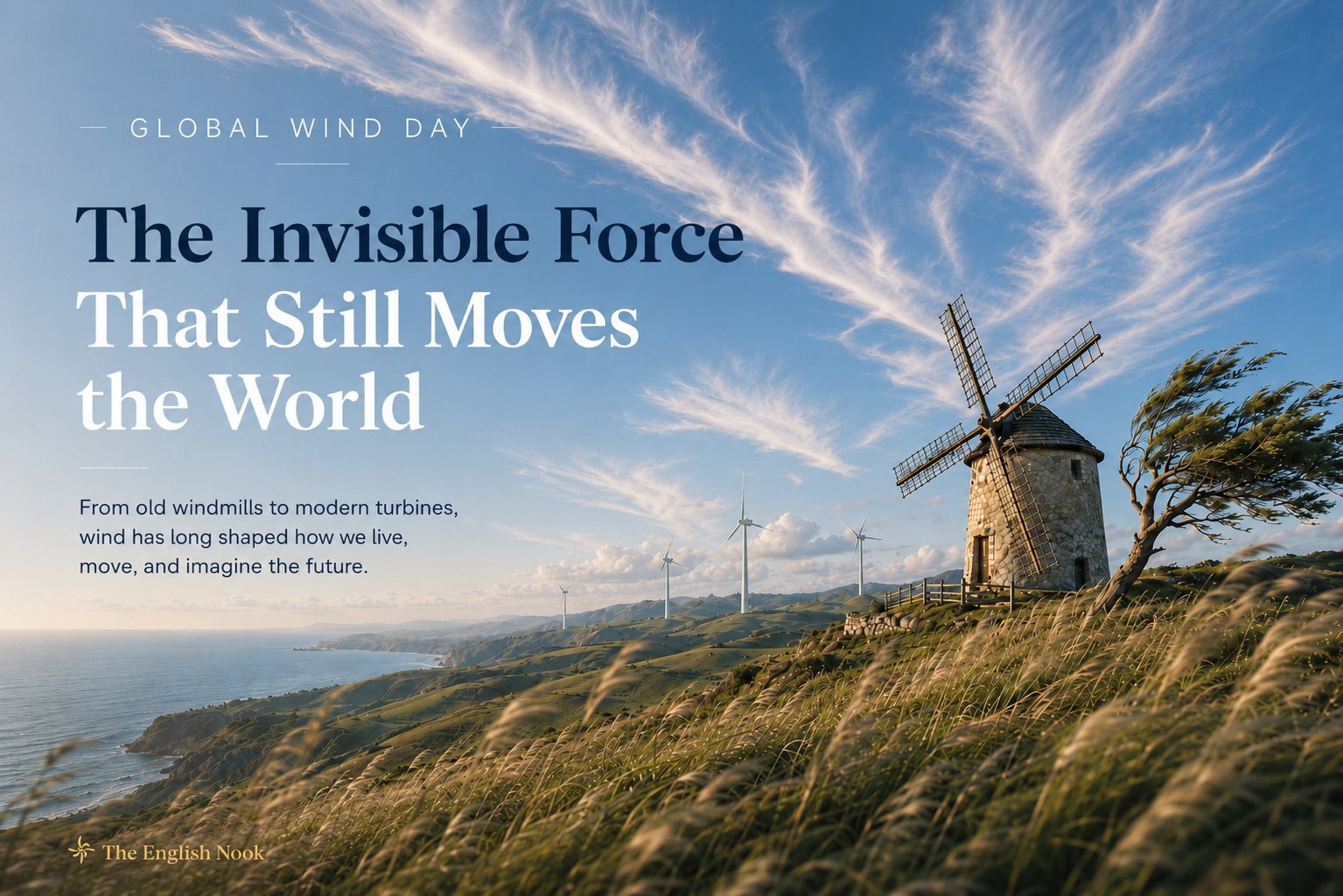
The Invisible Force That Still Moves the World
How Wind Connects Nature, Energy, Language, and Human History
Wind is one of the oldest forces human beings ever learned to notice.
Long before we built engines, power lines, weather stations, or turbines, we felt the wind on our skin. We watched it bend grass, move clouds, lift dust from dry roads, and push waves across open water. We heard it in trees, doors, sails, windows, storms, and quiet rooms.
Wind is invisible, but it never feels absent.
We do not see the wind itself. We see what it touches.
A field leaning in one direction.
A curtain moving beside an open window.
A ship crossing the sea.
A turbine turning slowly on a hill.
A storm gathering strength over the horizon.
This is part of what makes wind so powerful in both nature and language. It reminds us that not every force needs a visible body to change the world.
On Global Wind Day, we often think of wind as energy — and rightly so. Modern wind power has become one of the clearest examples of how a natural force can help shape a cleaner future. But wind is older than our technologies. Before it became electricity, it was movement, weather, travel, warning, work, and metaphor.
Wind has always been moving the world.
The Force We Learned to Follow
For most of human history, wind was not something people controlled. It was something they observed, respected, and learned to follow.
Sailors studied it because wind could carry them across oceans or leave them stranded at sea. Farmers watched it because wind could bring rain, dryness, cold, dust, or change. Travelers felt it because it could make a journey easier or harder. Communities learned the character of local winds because those winds shaped daily life.
A gentle breeze could bring relief.
A strong gale could bring danger.
A seasonal wind could decide when crops were planted, when ships departed, or when people prepared for storms.
Wind was never just weather.
It was part of survival.
This is why so many languages developed precise words for different kinds of wind. People named the winds that mattered to them. A wind from the desert was not the same as a wind from the sea. A cold wind in winter was not the same as a warm wind before rain. A sudden gust was not the same as a steady current of air.
To name the wind was to understand it a little better.
And to understand it was to live more carefully with the world.
From Sails to Windmills
Wind also became one of humanity’s first great partners in work.
Before engines, wind filled sails and helped connect distant places. It carried people, goods, ideas, stories, languages, and customs across seas. Trade routes, migrations, exploration, and cultural exchange were all shaped, in part, by the movement of air.
Wind did not simply move ships.
It moved history.
Later, windmills turned invisible movement into visible labor. They ground grain, pumped water, and supported communities. In those turning blades, people found a way to work with the air instead of only enduring it.
This was not yet modern wind energy, but the idea was already there: movement could become useful force.
A natural current could become human work.
The wind could be more than something passing by.
It could help build, feed, move, and sustain.
The Modern Wind
Today, wind turbines continue that older story in a new form.
A turbine does something simple and extraordinary: it turns moving air into electricity. The principle feels almost poetic. The same invisible force that once filled sails can now power homes, schools, hospitals, farms, and cities.
Of course, the technology behind it is complex. Modern wind energy depends on engineering, materials, planning, geography, maintenance, and careful connection to electrical systems. But at the heart of it, there is still the same old movement: air crossing the land or sea.
This is why wind energy feels different from some other modern technologies. It is futuristic, but it does not feel entirely new. It belongs to a much older relationship between human beings and the natural world.
We did not invent the wind.
We discovered another way to work with it.
Global Wind Day reminds us of this relationship. It is not only about machines on hills or offshore farms in the distance. It is about the possibility of working with natural systems instead of depending only on resources that damage the planet when we use them.
Wind energy is not perfect. No source of energy is without questions, limits, or consequences. Wind farms require space, planning, materials, infrastructure, and care for the landscapes and communities around them.
But wind remains one of the most important renewable energy sources because it begins with something the Earth already does.
The air moves.
And we have learned to turn that movement into power.
Wind and the Language of Change
Wind has always had a special place in language because it is both real and symbolic.
We speak of the “winds of change” when something begins to shift in society. We say a plan is “up in the air” when it is uncertain. We describe things as “scattered to the winds” when they are dispersed beyond control. And we speak of “catching a second wind” when strength returns after exhaustion.
Wind gives us vocabulary for movement, uncertainty, renewal, and transformation.
This makes sense. Wind is never still for long. It arrives, changes direction, gains strength, disappears, and returns. It can be soft enough to comfort us, or strong enough to frighten us. It can carry seeds, clouds, smoke, sand, sound, and scent. It can erase footprints or spread life across a field.
In language, wind often represents what cannot be held.
But that does not mean it is weak.
The opposite is true.
Wind teaches us that power does not always look heavy. Sometimes power is movement. Sometimes it is pressure. Sometimes it is persistence over time.
A cliff is shaped by stone, but also by air and weather.
A forest grows from seeds, but some seeds travel by wind.
A city runs on electricity, and some of that electricity may begin as air moving across open land.
The invisible becomes visible through its effects.
That is true in nature.
It is also true in language.
Why Wind Still Matters
Global Wind Day is a good moment to think about energy, but also about attention.
Modern life often hides the forces that support it. We turn on a light, charge a phone, open a refrigerator, or heat a room without thinking much about where that energy comes from. Electricity feels immediate, almost invisible.
Wind asks us to look again.
It reminds us that energy has a source. It comes from somewhere. It depends on choices, systems, landscapes, and relationships with the natural world.
When we see turbines turning in the distance, we are not only seeing technology. We are seeing a conversation between old forces and modern needs.
We are seeing air become work.
We are seeing movement become possibility.
And we are seeing one answer — not the only answer, but an important one — to the question of how human life can continue with more respect for the planet that sustains it.
Wind has crossed the Earth long before us.
It moved over oceans before there were ships.
It shaped deserts before there were maps.
It carried seeds before there were gardens.
It filled silence before there were words for weather.
And now, in a world searching for cleaner ways to live, wind continues to move us.
The wind remains invisible.
But its work is everywhere.
The wind has no shape of its own, yet it gives shape to everything it touches.
→ Read more interesting articles
→ Read a story
If this stayed with you, consider leaving a like, sharing it, commenting,
or all three!