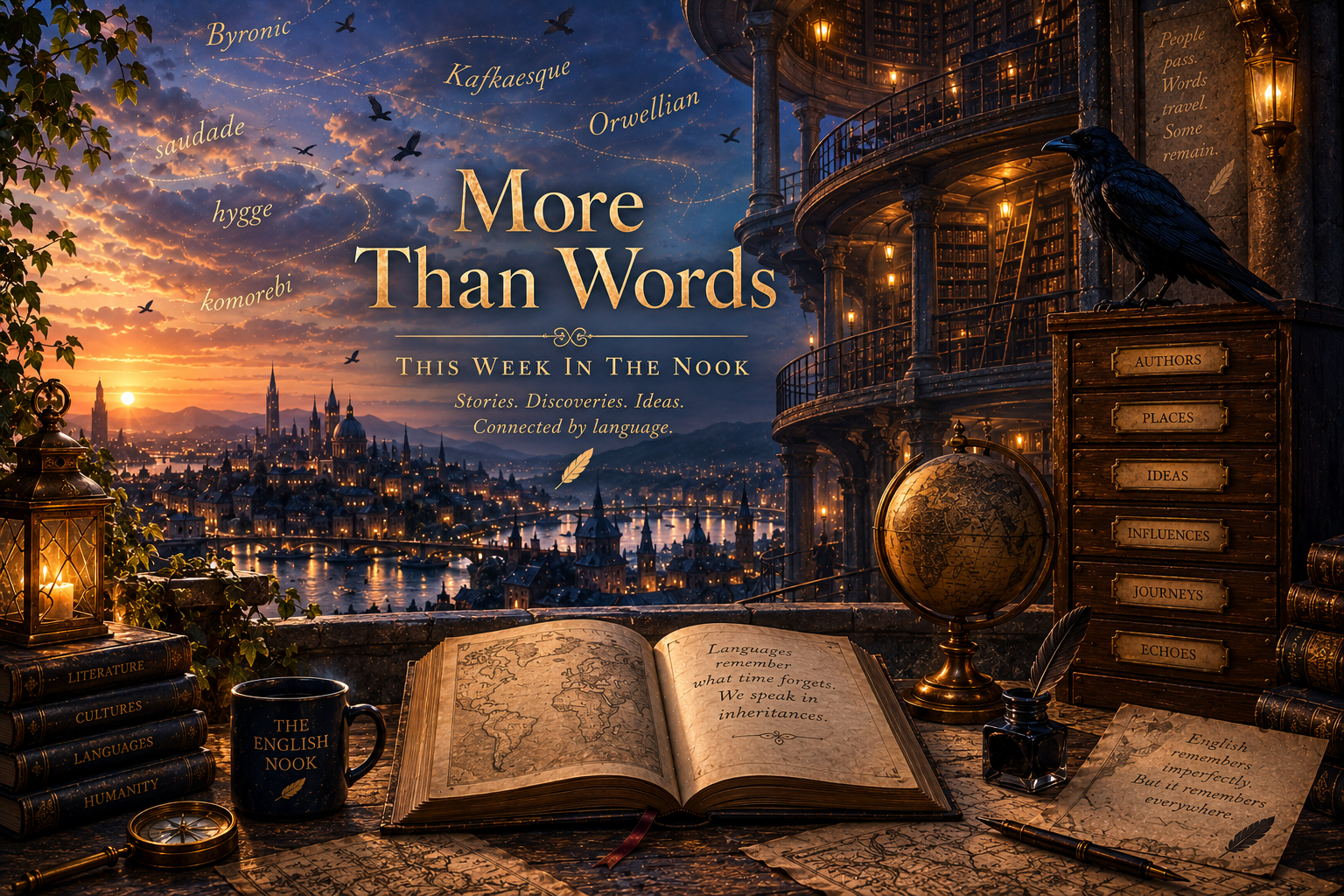

What English Remembers
Writers leave books. Cultures leave words. Language keeps more than either intended.
There is a strange moment when a name stops belonging only to a person.
Byron becomes Byronic. Kafka becomes Kafkaesque. Orwell becomes Orwellian.
This week’s doorway, When an Adjective Claims a Voice, begins there: with the moment a writer’s name escapes biography and starts describing moods, systems, characters—even whole ways of seeing.
But names are only the most visible traces.
Long before a writer becomes a word, something else has already happened.
🐦⬛ Fetched from the Chronicle
The Portal has crossed this ground before—not always through names, but through poetry, inheritance, borrowed vocabulary, and the strange way one culture leaves something behind inside another.
Taken together, those older paths ask a larger question:
What does English remember?
When a Voice Changes the Language
▸ How Poetry Shaped English
Poetry did not merely decorate English. It taught the language to compress experience, trust implication, bend toward emotion, and carry more than literal statement alone.
▸ Shakespeare — Why English Feels Different After Him
Shakespeare’s inheritance is larger than a collection of famous phrases. English itself became more flexible around him—more willing to stretch, hesitate, contradict itself, and follow the movement of thought.
The voice disappears into the language it helped change.
When a Name Begins to Carry More
▸ The Weight of a Name
Names begin as labels, then memory, reputation, affection, and history gather around them. Eventually a few syllables can carry far more than the person they once identified.
▸ The Quiet Lessons We Carry
Most linguistic inheritance is quieter: a parent’s phrase, a teacher’s expression, a regional pronunciation, a saying repeated until one day we hear somebody else’s voice coming out of our own mouth.
Not every trace keeps the name of the person who left it.
When Cultures Leave Words Behind
▸ The Words We Borrow, The Selves We Become
English grew through contact. Migration, trade, conquest, food, scholarship, and ordinary conversation brought words that eventually became so familiar we stopped noticing their journeys.
▸ Why Some Words Refuse to Translate
Others keep more of their original world attached. Saudade, hygge, komorebi: sometimes English does not merely borrow a word.
It makes room for another way of noticing the world.
🌾 Word Nook
Continue into the Word Nook with Memory, Language, and Resonance—the past carried forward, the system that preserves it, and the echo that remains after the original voice has gone.
Three words for three stages of the same journey: what is kept, what carries it, and what continues to sound.
📚 History Nook
Sometimes a writer’s words travel so far that authorship itself begins to disappear behind them.
Continue into History Nook with Laurence Binyon — The Words by Which Britain Remembers, where poetry leaves the page and becomes communal speech—words repeated across generations until they become part of cultural memory.
The Archive We Speak
Books preserve language deliberately.
Language preserves us almost accidentally.
Writers enter it. Families enter it. Migrations, landscapes, customs, jokes, fears, and memories enter it.
Some traces remain obvious: Byronic. Kafkaesque. Orwellian.
Others have been worn smooth by centuries of use.
Literature does not remain politely on the shelf.
Culture does not remain behind a border.
Human experience keeps escaping into words.
For now, listen closely.
English remembers imperfectly.
But it remembers everywhere.
Until the next path opens,
listen for what English remembers.