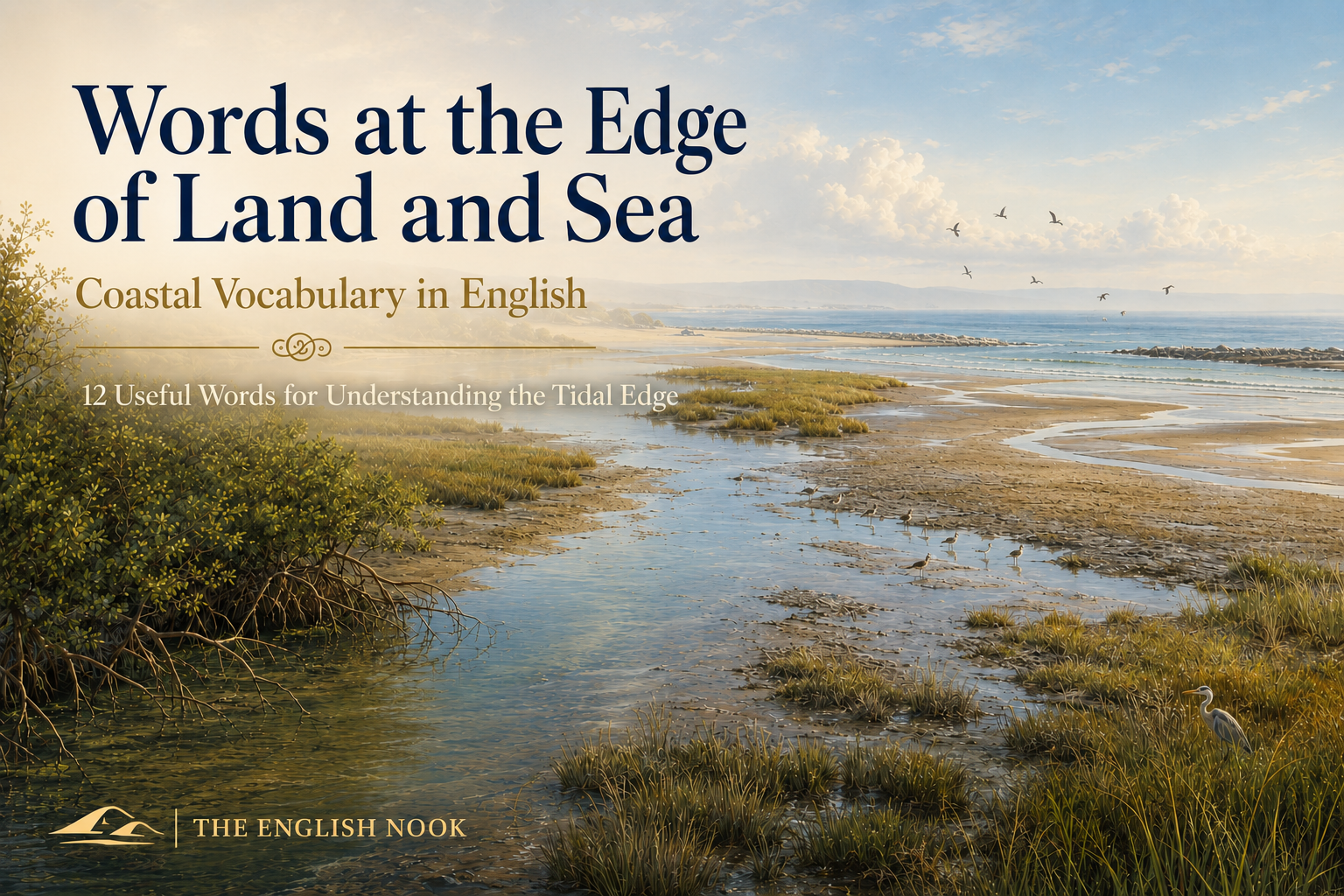

Words at the Edge of Land and Sea
Coastal Vocabulary in English
12 Useful Words for Understanding the Tidal Edge
Where rivers and the sea meet, the landscape is constantly changing.
Fresh water mixes with salt water, tides repeatedly cover and reveal the ground, and currents reshape estuaries, salt marshes, mangrove forests, lagoons, mudflats, seagrass meadows, wetlands, and shorelines.
The vocabulary of these places appears in geography, travel writing, nature documentaries, environmental reporting, and everyday descriptions of rivers and coasts. These words help us understand not only where land and water meet, but also how each continues to shape the other.
Let’s explore twelve useful words from this shifting world between land and sea.
🌊 Coastal Vocabulary
1. Estuary
IPA: /ˈes.tʃu.ə.ri/
Spanish: Estuario
Definition: A coastal area where freshwater from a river meets and mixes with seawater.
Example: The river widens into a large estuary before reaching the ocean.
Translation: El río se ensancha y forma un gran estuario antes de llegar al océano.
2. Brackish
IPA: /ˈbræk.ɪʃ/
Spanish: Salobre
Definition: Containing some salt, but less salt than seawater.
Example: Many coastal plants can survive in warm, brackish water.
Translation: Muchas plantas costeras pueden sobrevivir en aguas cálidas y salobres.
3. Inlet
IPA: /ˈɪn.let/
Spanish: Ensenada, entrada de mar
Definition: A narrow area of water that extends inland from a sea, lake, or another larger body of water.
Example: The small boat entered a quiet inlet surrounded by trees.
Translation: La pequeña embarcación entró en una tranquila ensenada rodeada de árboles.
4. Channel
IPA: /ˈtʃæn.əl/
Spanish: Canal, cauce
Definition: A passage through which water flows.
Example: The canoe followed a narrow channel through the wetland.
Translation: La canoa siguió un canal estrecho a través del humedal.
5. Tidal
IPA: /ˈtaɪ.dəl/
Spanish: Mareal, afectado por la marea
Definition: Related to or affected by the regular rise and fall of the sea.
Example: The area contains several tidal streams and pools.
Translation: La zona contiene varios arroyos y pozas afectados por la marea.
6. Current
IPA: /ˈkʌr.ənt/
Spanish: Corriente
Definition: A continuous movement of water in a particular direction.
Example: The current carried the floating leaves towards the sea.
Translation: La corriente llevó las hojas flotantes hacia el mar.
7. Shoreline
IPA: /ˈʃɔː.laɪn/ (UK), /ˈʃɔːr.laɪn/ (US)
Spanish: Línea de costa, orilla
Definition: The place or line where a body of water meets the land.
Example: Tall grasses grew along much of the shoreline.
Translation: Altos pastos crecían a lo largo de gran parte de la línea de costa.
8. Lagoon
IPA: /ləˈɡuːn/
Spanish: Laguna costera
Definition: A shallow body of water separated from a larger body of water by sand, islands, or another natural barrier.
Example: Birds gathered beside the calm coastal lagoon.
Translation: Las aves se reunieron junto a la tranquila laguna costera.
9. Mudflat
IPA: /ˈmʌd.flæt/
Spanish: Llanura fangosa, planicie de marea
Definition: A wide, flat area of coastal mud that is covered at high tide and exposed at low tide.
Example: Small crabs appeared across the mudflat when the tide went out.
Translation: Pequeños cangrejos aparecieron en la llanura fangosa cuando bajó la marea.
10. Wetland
IPA: /ˈwet.lænd/
Spanish: Humedal
Definition: An area of land that is permanently or seasonally covered or saturated with water.
Example: The protected wetland provides a home for many birds and fish.
Translation: El humedal protegido proporciona un hogar a muchas aves y peces.
11. Silt
IPA: /sɪlt/
Spanish: Limo
Definition: Fine earth carried and deposited by moving water.
Example: The river deposited a layer of dark silt along its banks.
Translation: El río depositó una capa de limo oscuro a lo largo de sus orillas.
12. Erosion
IPA: /ɪˈrəʊ.ʒən/ (UK), /ɪˈroʊ.ʒən/ (US)
Spanish: Erosión
Definition: The gradual wearing away of soil, rock, or land by water, wind, or other natural forces.
Example: Coastal vegetation can help protect the shoreline from erosion.
Translation: La vegetación costera puede ayudar a proteger la costa de la erosión.
✨ Useful Phrases
At low tide — When the sea is at its lowest level.
Along the shoreline — Following or beside the place where water meets the land.
Carried by the current — Moved through the water by its natural flow.
🌍 Common Expressions
Go with the flow — To accept a situation and adapt rather than trying to control everything.
Test the waters — To try something carefully before making a larger commitment.
Make waves — To attract attention or cause important change, discussion, or controversy.
📖 Reading Practice
🇬🇧 Where the River Meets the Sea
The river widened as it approached the estuary, where the water gradually became brackish. A narrow channel led towards the open sea, while a gentle current carried leaves past the mangrove trees growing along the shoreline. Their tangled roots held the soft ground together and helped reduce erosion during storms and high tides.
🇪🇸 Leer en español — Haz clic para abrir
Donde el río se encuentra con el mar
El río se ensanchaba al acercarse al estuario, donde el agua se volvía gradualmente salobre. Un estrecho canal conducía hacia el mar abierto, mientras una suave corriente llevaba hojas junto a los manglares que crecían a lo largo de la línea de costa. Sus raíces entrelazadas mantenían unido el terreno blando y ayudaban a reducir la erosión durante las tormentas y las mareas altas.
🇪🇸 Leer en español — Haz clic para abrir
Onde o rio encontra o mar
O rio se alargava ao se aproximar do estuário, onde a água se tornava gradualmente salobra. Um canal estreito conduzia ao mar aberto, enquanto uma corrente suave levava folhas junto aos manguezais que cresciam ao longo da linha costeira. Suas raízes entrelaçadas mantinham o solo macio unido e ajudavam a reduzir a erosão durante tempestades e marés altas.
Why These Words Matter
The coast is not a single, motionless boundary.
A river carries water and earth towards an estuary. The tide enters channels and inlets before withdrawing again. Currents transport leaves and silt, while erosion removes material from one place and deposits it somewhere else.
Some of these changes happen suddenly during storms. Others take place so slowly that they are difficult to notice from one day to the next.
These words help us see the coast not merely as the point where the land ends, but as a living landscape shaped by continual movement.

✍️ Writing Challenge
Write a description of between 100 and 150 words about a place where land and water meet.
Use at least six of today’s vocabulary words.
You may describe an estuary, lagoon, wetland, riverbank, mangrove forest, or imagined coastal landscape.
Before you finish, ask yourself:
How is the water shaping the place?
📚 Vocabulary Quick Reference
| English | Español | Português |
|---|---|---|
| Estuary | Estuario | Estuário |
| Brackish | Salobre | Salobro |
| Inlet | Ensenada, entrada de mar | Enseada |
| Channel | Canal, cauce | Canal |
| Tidal | Mareal, afectado por la marea | De maré |
| Current | Corriente | Corrente |
| Shoreline | Línea de costa, orilla | Linha costeira |
| Lagoon | Laguna costera | Lagoa costeira |
| Mudflat | Llanura fangosa, planicie de marea | Planície de lama |
| Wetland | Humedal | Zona úmida |
| Silt | Limo | Limo |
| Erosion | Erosión | Erosão |
If these words stayed with you, pass them on—or drop an acorn before you go.