
Spanish Across the Nook
Part II
Roots, Marks, and Many Voices
Spanish does not remain still once we begin learning it.
At first, it may appear as a handful of greetings, sounds, and useful phrases. But soon, more begins to emerge: patterns, connectors, letters, histories, regional voices, and literary echoes that have travelled far beyond Spain itself.
In this second journey across the Nook, we return to the Chronicle to look beneath the surface—not only at how Spanish begins, but at how it is built, remembered, marked, and carried forward.
🐦⬛ Fetched from the Chronicle
Some languages open through conversation. Others reveal themselves through structure.
Spanish does both.
It asks learners to speak and listen, but also to notice how ideas connect, how words change shape, how a single mark can alter sound, and how centuries of history still live inside everyday language.
From across the Chronicle, the crows have fetched another collection of paths into Spanish: practical, historical, and wonderfully precise.
Building Momentum
▸ Where to Go Next When Learning Spanish: Building Momentum After the Basics
Once the first greetings and simple phrases are in place, Spanish needs room to grow. This guide helps learners move beyond the basics by strengthening grammar, expanding vocabulary, practising listening and speaking, and turning study into a living routine.
▸ Sequencing & Process Language in Spanish
To explain clearly, we need order. Explore useful Spanish connectors such as primero, luego, después, a continuación, mientras tanto, and finalmente—the small words that help actions, stories, and instructions move step by step.
Seeing the Structure
▸ Overview of Parts of Speech in Spanish
Nouns, verbs, adjectives, adverbs, pronouns, prepositions, conjunctions, interjections, and articles all play their part in Spanish. This overview offers a broad look at the categories that help sentences take shape.
▸ The Power of Ñ: A Unique Letter in the Spanish Language
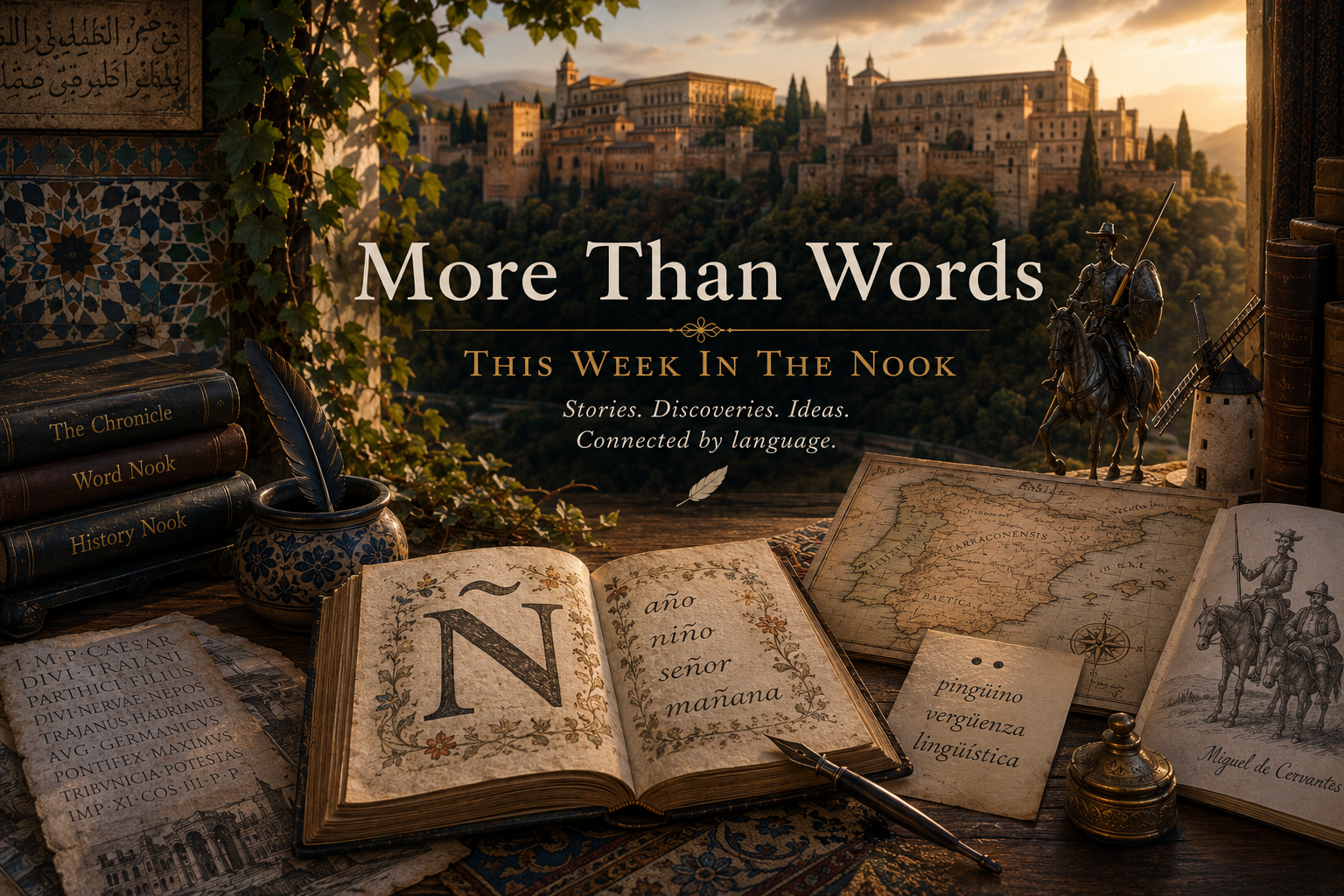
More than a decorated n, the letter ñ carries sound, history, and identity. From año and niño to señor and mañana, it reminds learners that pronunciation is also memory.
▸ The Diéresis (¨) in Spanish: What’s Up with the Ü?
A small mark can make a silent letter speak. This guide explains how the diéresis works in words such as pingüino, vergüenza, and lingüística, where the u must be heard.
Roots and Many Voices
▸ Latinization of the Iberian Peninsula
Before Spanish, there was Hispania: a peninsula of many peoples and languages transformed by Roman conquest and the spread of Latin. This article follows the foundations from which Spanish and other Iberian Romance languages would eventually emerge.
▸ The Visigothic and Arab Influences in Spain (5th–15th Centuries)
Spanish carries traces of later histories too: Germanic influence through the Visigoths, and a profound Arabic inheritance through centuries of contact, rule, science, trade, architecture, and daily life.
▸ The Present and Future of Spanish Dialects
Spanish is not one uniform voice. From Spain to Latin America and beyond, its dialects reveal history, migration, identity, media, technology, and the constant balance between unity and variation.
🌾 Word Nook
Spanish does not always enter English through direct borrowing. Sometimes it enters through image, story, and literary imagination.
Continue into the Word Nook with Quixotic, Errantry, and Chevalier—three words that lead toward knights, impossible quests, chivalric ideals, and the dream-haunted world that Cervantes transformed forever.
📚 History Nook
A language also travels through the works that cross borders and change how other languages imagine, describe, and tell stories.
Continue exploring through Cervantes and the long English afterlife of Don Quixote:
▸ Birth of Miguel de Cervantes (1547–1616) — The Father of the Modern Novel
▸ Don Quixote’s Journey — How Cervantes Shaped the English Language and Its Expressions
Spanish is not only a language to begin.
It is a language to keep following.
It moves from basic phrases into connected thought, from grammar into expression, from small marks into sound, from Latin roots into layered histories, from regional speech into global presence, and from Cervantes’s pages into the imagination of other languages.
The first step into Spanish may be simple.
But the path beyond it is wide.