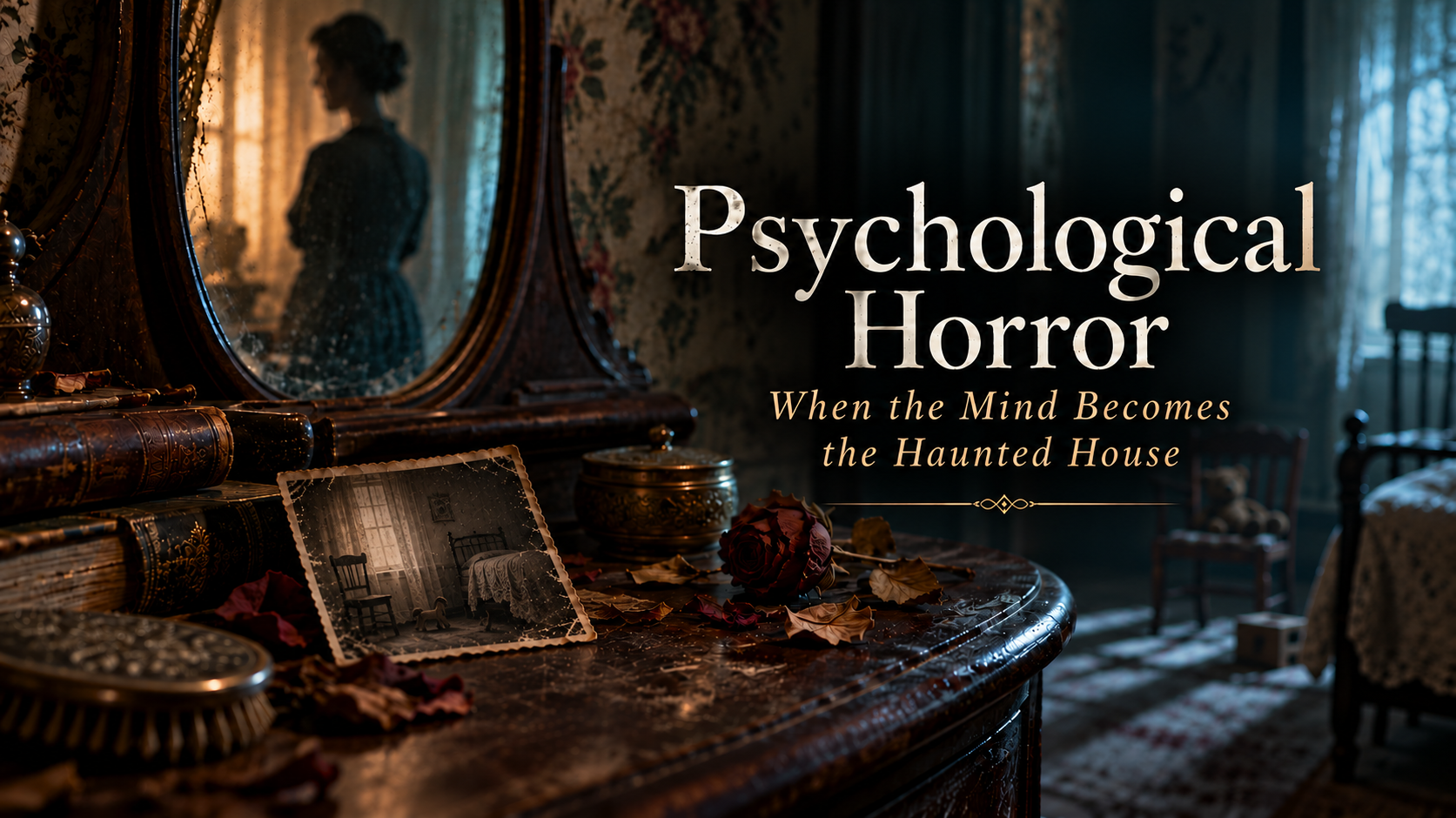

Psychological Horror — When the Mind Becomes the Haunted House
A woman wakes to find a photograph on her bedside table. It shows her standing in a room she has never visited, beside someone whose face has been carefully scratched away.
She asks her husband about it. He insists the photograph has always been there.
Later, she discovers another. The same room. The same faceless figure. But this time, she is looking directly at the camera.
Nothing has attacked her. No ghost has appeared. Yet something has begun to disturb her most basic certainty: her understanding of her own life.
This is the territory of psychological horror, where fear arises not simply from what happens, but from how a character experiences, remembers and interprets it.
The Fear Within
In supernatural horror, danger might take the form of a ghost or an impossible creature. Psychological horror often makes the threat harder to locate.
A familiar voice sounds strangely hostile. A childhood memory contradicts everyone else’s account. Someone suspects that a trusted companion is deliberately changing small details of their surroundings.
The danger may be real, misunderstood, imagined or hidden beneath an ordinary explanation. Psychological horror can include the supernatural, but does not require it. Its power lies in unsettling the relationship between perception and reality.
Because readers are frequently confined to a character’s limited viewpoint, we begin questioning our own interpretation alongside theirs.
When the Narrator Cannot Be Trusted
One of the genre’s most effective devices is the unreliable narrator.
Readers normally rely on narrators to guide them through a story. But a narrator might misunderstand events, conceal information or offer explanations that their own words quietly undermine.
In Edgar Allan Poe’s The Tell-Tale Heart (1843), a narrator repeatedly insists upon his rationality while recounting a murder. His precision and confidence only deepen our alarm. We hear not merely what he claims happened, but the troubling difference between his account and his understanding of it.
Unreliability does not necessarily imply deceit or mental illness. Grief, loyalty, fear, limited knowledge or a mistaken assumption can distort anyone’s account.
The voice meant to make events intelligible becomes another source of uncertainty.
When Memory Turns Against Us
We often treat memory as evidence of identity. It connects our present selves to the people and places we have known. Yet remembering is not the same as replaying a flawless recording.
Imagine a man returning to his childhood home. He remembers long summer evenings, a happy family and the bedroom where he slept.
His sister remembers a different house.
Then he discovers that the bedroom he describes never existed.
The mystery is no longer simply what happened there. It is why his memory offers a version of the past that cannot be reconciled with the evidence.
In psychological horror, contradictory recollections can expose guilt, grief, denial or deliberate manipulation. A character may discover not that the past has changed, but that the story they have always told about it cannot survive scrutiny.
The Ordinary Room as a Prison
Charlotte Perkins Gilman’s The Yellow Wall-Paper (1892) demonstrates how ordinary surroundings can become horrifying.
Its narrator is confined to a room under a restrictive treatment imposed by her physician husband. Discouraged from writing or engaging in meaningful activity, she secretly records her experiences and becomes increasingly absorbed by the room’s wallpaper.
The domestic setting gradually takes on the force of a Gothic prison. But the horror lies not simply in her distress: it also lies in the denial of her independence, the dismissal of her words and the authority exercised over her life.
A room need not contain a monster to become unbearable. Sometimes the person asking for the door to be opened is the one nobody believes.
Is the House Haunted?
Henry James’s The Turn of the Screw (1898) introduces another kind of uncertainty. A governess becomes convinced that sinister apparitions threaten two children in her care. Readers must weigh her testimony against the possibility that she has misunderstood what she sees.
The story never offers the comfortable certainty of an explanation beyond dispute.
Shirley Jackson’s The Haunting of Hill House (1959) likewise joins external mystery to inner vulnerability. Eleanor arrives at a supposedly haunted house longing for belonging and independence. As unsettling events unfold, her relationship with Hill House becomes increasingly difficult to separate from her hopes and fears.
Neither story can be reduced to the claim that its central character simply imagines everything. Their force comes from the unresolved interplay between setting, experience and interpretation.
A house might be haunted. The question is how we could know—and whom we would trust to tell us.
How Writers Create Unease
Psychological horror is often built from small, deliberate choices.
Repetition makes a harmless detail difficult to ignore: the same tapping each night, the same phrase in unrelated conversations.
Contradiction unsettles what we thought was established. Two apparently reliable witnesses describe an incident differently.
Restricted perspective traps readers inside incomplete information, whether through a diary, a letter or a closely limited narrator.
And ordinary settings deny us the comfort of distance. A kitchen, a photograph or a familiar hallway becomes frightening when one detail refuses to fit.
These techniques allow a writer to delay certainty without merely withholding information for a surprise ending. The uncertainty itself becomes the experience.
Beyond the Stereotype of the Dangerous Mind
Psychological horror must not be confused with the idea that mental illness makes people violent or monstrous. Psychological distress is not a shorthand for evil, and an unreliable perspective is not a diagnosis.
Some of the strongest works reveal the dangers of manipulation, isolation and having one’s experience dismissed. The person whose perceptions are questioned may be the person most in need of protection.
The genre becomes richer when it treats vulnerability as part of human experience rather than using it as a convenient source of villains.
The House We Carry Within
We often imagine horror as something waiting beyond a locked door.
Psychological horror offers another possibility: the door leads somewhere familiar, and nothing on the other side looks unusual.
The furniture is where it belongs. The windows are closed. The photographs are arranged exactly as we remember.
And yet we hesitate.
Perhaps a detail has changed. Perhaps someone has lied. Perhaps we are remembering something incorrectly.
Or perhaps the explanation we trusted most was never true.
A haunted house can be abandoned. A frightening place can be escaped. But what happens when the place we fear is the very mind through which we understand the world?
Reading the Dark
Reading 4 of 8
An eight-part journey through the darker imagination.
← Previous: What Is Dark Fantasy?
Continue Exploring
1. El Reemplazo
When Tomás discovers mysterious notes written in his own handwriting, the certainty of his identity begins to unravel. An unsettling story about memory, perception and the terrifying possibility that the person we believe ourselves to be may not be the original.
Don Cosme leaves behind a town he believes is watching him, only to discover that even the friendliest surroundings can become suspicious. A darkly humorous exploration of how fear can transform ordinary gestures into apparent threats.
An antique painting confronts Elías with an impossible vision of his own death. As dread gives way to obsession, the boundary between supernatural horror and psychological torment begins to disappear.