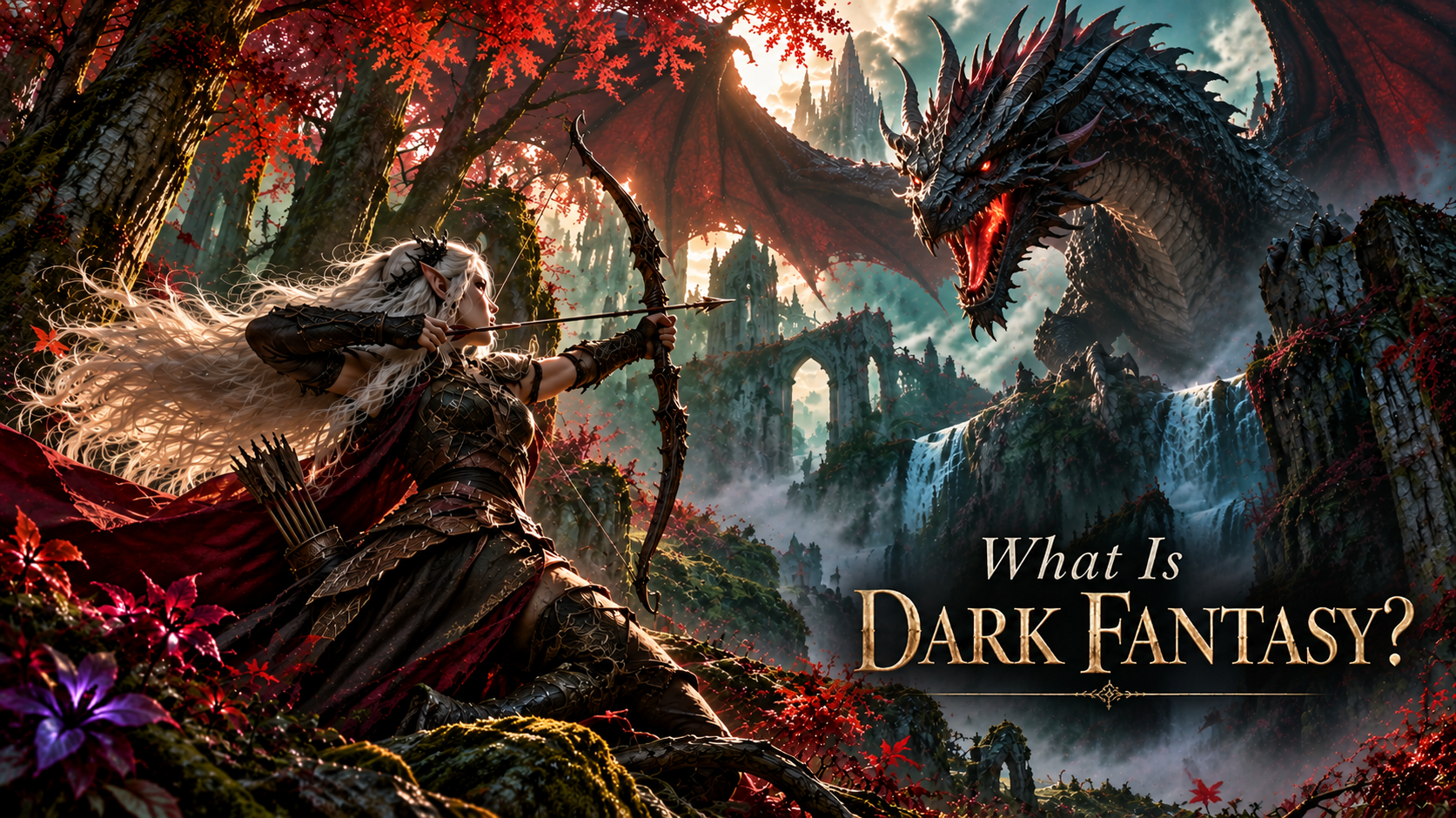

What Is Dark Fantasy?
In a forgotten kingdom, a river flows uphill towards a castle that no longer appears on any map. Its people know that the forest beyond the walls is enchanted. They also know that nobody who enters it returns unchanged.
Magic exists here. So do wonders, impossible creatures and ancient promises. But every gift seems to carry a warning, and even the most beautiful discoveries may demand something in return.
This is the territory of dark fantasy: fiction in which the possibilities of fantasy meet the unease, danger and disturbing questions often associated with horror.
Yet darkness alone does not define the genre. Its distinctive quality lies in what happens when imagination creates a world whose wonders cannot always be trusted.
Fantasy with a Darker Imagination
Fantasy allows writers to depart from the familiar rules of reality. A kingdom may be governed by sorcerers, a forest may remember its visitors, or the dead may continue speaking long after their names have been forgotten.
In many fantasy stories, such possibilities create adventure, excitement or astonishment. Dark fantasy uses the same freedom to explore more troubling experiences.
What if a healing spell transfers suffering to someone else? What if the guardian of an enchanted city is also its greatest danger? What if the creature everyone calls a monster understands compassion better than the people hunting it?
These questions need not produce horror in the strict sense. A dark fantasy story may be mysterious, melancholy, tragic or even occasionally humorous. What matters is that its imaginative world contains an unsettling dimension that cannot easily be dismissed.
Dark fantasy preserves the wonder of the impossible while questioning whether the impossible is necessarily a blessing.
Older Than Its Name
The expression dark fantasy belongs to relatively modern discussions of literary genres, and its meaning has never been completely fixed. Critics, publishers and readers have used it in different ways, sometimes placing it close to supernatural horror and sometimes treating it as a darker branch of fantasy.
Its imaginative roots, however, reach much further back.
Traditional fairy tales are not always gentle stories of wishes fulfilled. They contain abandoned children, dangerous bargains, enchanted punishments and forests where familiar rules cease to apply. Mythology also offers beings whose extraordinary powers bring both protection and destruction.
Gothic literature contributed another inheritance: threatening landscapes, concealed histories and the suspicion that something beautiful may hide a terrible secret.
Dark fantasy draws upon these traditions without being identical to any of them. It may borrow the atmosphere of a Gothic castle, the transformations of a fairy tale and the invented world of an epic adventure, creating something recognisably its own.
When Magic Has a Price
One of dark fantasy’s most compelling possibilities is that magic may solve a problem while creating another.
A character might acquire the power to defeat an enemy, only to discover that using it gradually destroys their memories. An enchanted object may offer protection but demand obedience. A prophecy may come true precisely because someone tries to prevent it.
Such devices change the meaning of supernatural power.
Instead of being merely a convenient instrument, magic becomes a source of conflict. Characters must decide not simply whether they can perform an extraordinary act, but whether they should.
This does not mean every dark fantasy must feature curses, sacrifices or corrupted spells. Some stories locate their darkness in an unjust kingdom, a dangerous journey or a world shaped by forces beyond human understanding.
The deeper principle is that extraordinary power does not remove uncertainty or responsibility.
Sometimes it makes both more difficult.
Heroes, Monsters and Uncertain Morality
Traditional heroic fantasy is often associated with recognisable champions and formidable enemies. Dark fantasy may disturb those expectations.
Its central figure might be a reluctant hero, a fallen ruler, a creature regarded as evil or an ordinary person forced into impossible decisions.
Similarly, its antagonists may possess understandable motives even when their actions remain frightening. A monster might be protecting its home. A seemingly benevolent ruler might preserve peace through cruelty.
These complications encourage readers to question appearances.
But moral complexity should not be confused with the idea that everyone must be selfish or wicked. Dark fantasy can contain courage, loyalty, kindness and genuine hope. Indeed, such qualities may become more meaningful because the surrounding world makes them difficult to preserve.
A compassionate decision can be especially powerful when cruelty would have been easier.
Dark Fantasy, Gothic Fiction and Horror
Because these genres share supernatural imagery and disturbing atmospheres, their boundaries often overlap.
Gothic fiction frequently explores confinement, secrecy, inherited guilt and the disturbing persistence of the past. Its settings and atmosphere often carry an emotional weight beyond their physical appearance.
Horror places particular emphasis on fear, dread, violation or confrontation with something disturbing. The supernatural may appear, but it is not essential.
Dark fantasy generally gives fantasy a central role. Its magical events, beings or alternative realities belong to the structure of the narrative rather than serving only as frightening intrusions.
Imagine a haunted castle.
In Gothic fiction, the castle might embody a family’s buried history. In horror, the story might concentrate on the terrifying presence within it. In dark fantasy, the castle might belong to a kingdom where every building is alive, every oath has magical consequences and the inhabitants must navigate these strange rules.
The same castle could, of course, belong to all three genres.
Another neighbouring term, grimdark, commonly describes fiction characterised by harsh moral conditions, brutality or cynicism. It overlaps with dark fantasy, but the two are not interchangeable: a darkly enchanted story need not be relentlessly bleak.
Literary categories help us notice patterns. They are not walls that imaginative writers must obey.
A Few Paths into the Genre
Michael Moorcock’s Elric of Melniboné (1972) offers an influential example of dark-edged fantasy. Its troubled protagonist inhabits a world of sorcery, dangerous alliances and powers whose assistance carries consequences. Heroism becomes entangled with dependence and destruction.
Tanith Lee’s The Birthgrave (1975) presents another approach. Its mysterious heroine awakens without a clear understanding of her identity and moves through an imagined world in which beauty, danger and self-discovery are closely connected.
In The Book of Lost Things (2006), John Connolly draws upon the language of fairy tales to explore bereavement, childhood and the darker possibilities of familiar stories. The enchanted world is frightening, but its significance extends beyond its monsters.
These works differ considerably in style and intention. Together, they demonstrate that dark fantasy is not a single formula: it is a collection of imaginative possibilities shaped by uncertainty, wonder and consequence.
Why Darkness Makes Wonder Matter
Fantasy invites readers to imagine that the world might be larger than experience suggests.
Dark fantasy accepts that invitation but refuses to guarantee that everything discovered beyond the familiar will be welcoming.
There is something powerful in this combination. Beauty becomes more fragile when danger surrounds it. Compassion becomes more deliberate when cruelty is possible. A journey into an enchanted country can become a journey into questions about identity, responsibility and loss.
And wonder does not disappear when a story grows darker.
Sometimes it becomes more intense.
Perhaps that is the essential fascination of dark fantasy. It allows us to enter impossible worlds without abandoning the difficult truths of our own.
Fantasy asks what might become possible if magic existed. Dark fantasy asks a more unsettling question: what would that possibility cost—and who would have to pay?
Reading the Dark
Reading 3 of 8
An eight-part journey through the darker imagination.
← Previous: Terror and Horror — Two Ways of Frightening the Reader
Next: Psychological Horror — When the Mind Becomes the Haunted House →
Continue Exploring
1. George MacDonald — The Storyteller Who Opened the Door to Modern Fantasy
Discover how George MacDonald helped transform fairy tales into a literary form capable of exploring wonder, danger, moral choices and mysterious worlds, laying important foundations for modern fantasy.
2. Alan Garner — The Writer Who Made the Land Remember
Explore how Alan Garner brought ancient myths into familiar landscapes, creating stories where forgotten powers, enchanted places and inherited dangers continue to shape the present.
3. The Djinn Beneath the Orchard
In a forgotten valley, a young girl discovers a forbidden tree whose fruit awakens something ancient. A dark fantasy of supernatural power, dangerous curiosity and the terrible consequences of disturbing what should have remained untouched.