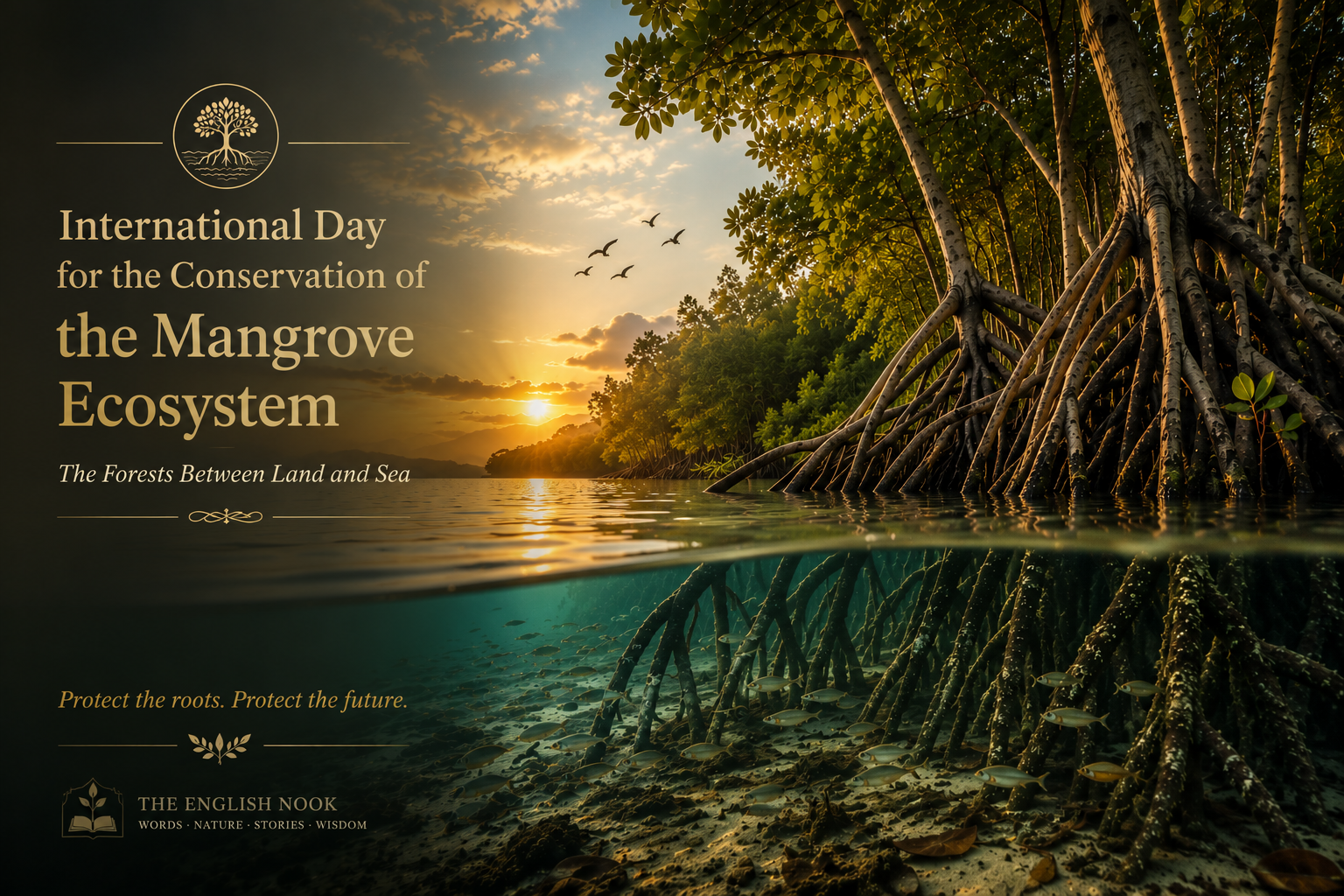

International Day for the Conservation of the Mangrove Ecosystem
The Forests Between Land and Sea
Every year on 26 July, Mangrove Day turns our attention towards the extraordinary forests growing where land and sea refuse to remain separate.
Some forests end where the water begins.
Mangroves do not.
They grow within the shifting territory where rivers meet salt water, tides repeatedly cover the soil, and ordinary trees would struggle to survive.
Their roots rise above the mud, twist through shallow water, and form a living boundary between two worlds. What may first appear tangled is one of the most carefully balanced ecosystems on Earth.
The roots slow the water.
The mud stores carbon.
Young fish shelter beneath the surface.
Birds rest above it.
And coastal communities find protection behind a forest that has learned how to stand within the movement of the sea.
Mangrove Day is also a day for words. To understand these forests, English had to travel, borrow, and expand.
A Word Carried Across the Sea
The word mangrove entered English in the early seventeenth century, probably through Portuguese mangue or Spanish mangle, with deeper roots in Taíno, one of the languages of the Caribbean.
English appears to have reshaped the ending under the influence of grove, making an unfamiliar tropical word sound partly familiar.
The history suits the forest.
Mangroves grow in places of meeting: river and ocean, fresh water and salt, land and tide. Their English name also emerged through contact between languages, carried across seas and altered along the way.
The word does not belong to one landscape alone.
Like the ecosystem it names, it was formed at a boundary.
Where Trees Learn to Live with Salt
Mangroves grow along tropical and subtropical shores, estuaries, lagoons, and tidal waterways.
Even the vocabulary of these places resists simple divisions.
Brackish water is neither fully fresh nor fully salty. An estuary is neither simply river nor sea. The intertidal zone belongs alternately to water and air.
Mangroves survive there through remarkable adaptations. Some develop arching prop roots above unstable mud. Others send specialised roots upwards through soil where oxygen is scarce.
Those roots slow water, trap sediment, and help stabilise the shore.
The mangrove does not merely tolerate the tidal world.
It helps create it.
The Language of Protection
Older descriptions often reduced wetlands to swamps, wastelands, or obstacles to development.
Modern environmental language asks us to see them differently.
Mangroves are now described as natural coastal defences, living shorelines, and green infrastructure.
These expressions are not decorative. They change what the forest appears to be.
Its trunks and roots interrupt waves, reduce erosion, and help soften the force of storms. A tangled wetland becomes a form of protection—not because the ecosystem has changed, but because our language has learned to recognise its work.
Concrete barriers resist movement.
Mangroves work with it.
They bend, filter, trap, and rebuild.
Nurseries and Blue Carbon
Below the branches, another important word appears: nursery.
The submerged roots give young fish, crustaceans, and other marine animals places to feed and hide. Many later move into rivers, reefs, seagrass meadows, or the open sea.
Calling the mangrove a nursery reveals that the forest’s influence travels beyond its outermost tree.
Much of its importance is also hidden underground. Carbon accumulates in mangrove vegetation and wet soils, where decomposition can be slow.
Today this storage is described as blue carbon—a modern expression that connects coastal ecosystems with the language of climate.
A visitor sees trees and water.
Beneath them lies an archive written in roots, mud, leaves, and time.
More Than Planting Trees
Mangroves face pressure from development, aquaculture, pollution, overharvesting, and a changing climate.
Protecting them requires more than planting seedlings.
A functioning mangrove depends upon tides, sediment, salinity, water flow, wildlife, and nearby communities. Restoration must recover those relationships rather than reproduce only the visible shape of a forest.
This is another place where words matter.
To restore is not merely to replace.
To conserve is not merely to leave untouched.
Both words ask us to understand how a living system works and what allows it to continue.
A tree can be planted in an afternoon.
A functioning ecosystem cannot.
Why It Matters
Mangroves challenge both our maps and our vocabulary.
We speak of land and sea as though a firm line separates them. Mangroves reveal a landscape formed through meeting, movement, and exchange.
Their name came into English from elsewhere. Their modern vocabulary—brackish, intertidal, nursery habitat, living shoreline, blue carbon—helps us notice forms of life and protection that older descriptions often ignored.
Language does not save an ecosystem by itself.
But before something can be understood, defended, or remembered, it must first be seen clearly enough to be named.
Some forests rise away from the water. Mangroves enter it, hold their ground, and teach language how to live between worlds.
The mangrove belongs wholly to neither land nor sea, yet it gives shelter and shape to both.
→ Read more interesting articles
→ Read a story
If this stayed with you, consider leaving a like, sharing it, commenting, or all three!