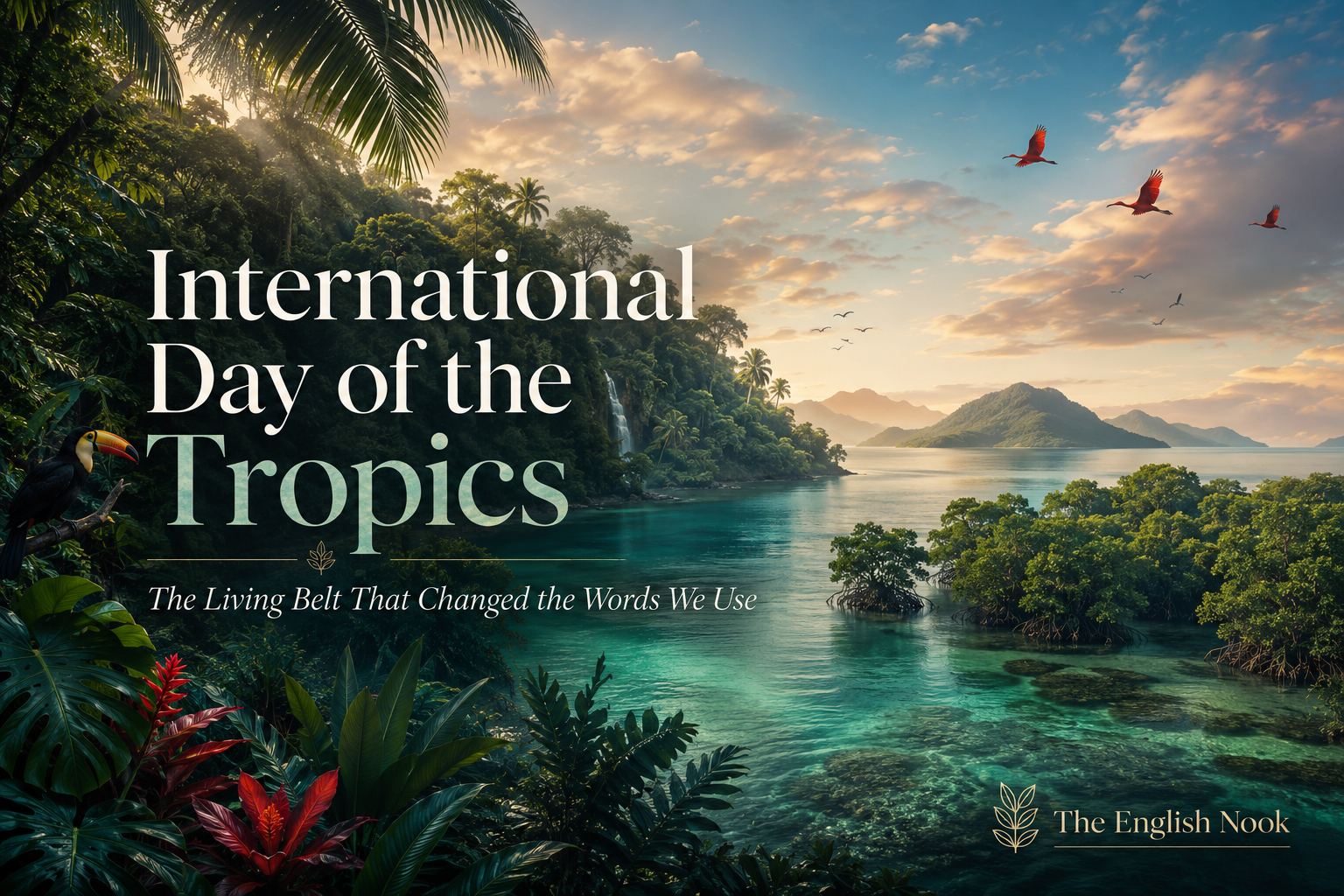

International Day of the Tropics
The Living Belt That Changed the Words We Use
How Tropical Regions Shaped English Through Climate, Culture, Nature, and Exchange
The tropics are often imagined through color.
Palm trees. Warm rain. Coral reefs. Dense forests. Bright fruit. Islands surrounded by blue water. Birds with impossible feathers. Flowers that seem almost unreal.
But the tropics are not only scenery.
They are home, history, climate, culture, biodiversity, trade, migration, food, medicine, music, stories, and language. They stretch across the Earth in a great living belt between the Tropic of Cancer and the Tropic of Capricorn, touching parts of the Americas, Africa, Asia, and Oceania.
On International Day of the Tropics, observed every year on June 29, we are invited to look beyond the postcard image. The day recognizes the importance, diversity, challenges, and potential of tropical regions.
It is a day about geography, yes.
But it is also a day about attention.
Because the tropics have shaped far more than maps. They have shaped the way human beings eat, travel, trade, imagine, survive, and speak.
More Than a Climate Zone
The tropics are commonly defined as the region of Earth between the Tropic of Cancer in the north and the Tropic of Capricorn in the south.
In many tropical areas, temperatures remain warm throughout the year. Seasonal changes are often less about cold and heat and more about rain and dryness. In some places, the rhythm of life is shaped by monsoons, river floods, humid forests, coral reefs, mangrove coasts, or long dry seasons.
This matters because climate teaches people what to notice.
In colder places, survival may depend on recognizing frost, thaw, ice, and snow.
In tropical places, survival may depend on reading rain, heat, winds, rivers, reefs, forests, soil, fruiting seasons, or the first signs of a storm.
Every environment creates its own vocabulary.
And when English encountered tropical regions, it found realities that earlier English words could not always describe.
So the language changed.
When the Tropics Entered English
English did not grow in isolation.
It grew through contact.
Ships, trade routes, colonization, scientific exploration, migration, agriculture, and cultural exchange all brought English into contact with tropical regions. The result was a language that absorbed words from many places and many peoples.
Some tropical words describe geography:
lagoon, atoll, archipelago, reef, mangrove.
Others describe plants, foods, and materials:
coconut, banana, cacao, canoe, hammock.
Some of these words entered English through Spanish, Portuguese, French, Dutch, or Italian. Others ultimately came from Indigenous languages, Arabic, Persian, Hindi, Malay, Tamil, or other languages spoken along tropical routes of trade and contact.
Each word carries a small history.
A coconut is not only a fruit.
A canoe is not only a boat.
A hammock is not only a place to rest.
These words remind us that English expanded by meeting the world. It borrowed from people who already knew those climates, those plants, those waters, and those ways of living.
Language often follows need.
When speakers meet unfamiliar environments, old vocabulary is not always enough.
The world becomes wider.
So the language must become wider too.
Food, Trade, and Everyday Words
Some of the most familiar tropical words entered English through food.
Coffee. Chocolate. Sugar. Banana. Coconut. Mango.
These words feel ordinary now. They appear on menus, shopping lists, recipes, advertisements, and breakfast tables.
But their histories are anything but ordinary.
They connect English to plantations, trade, colonization, labor, migration, botany, empire, and global commerce. Some of those histories are creative and rich. Others are painful.
That is why vocabulary deserves respect.
Words are not just labels.
They are routes.
A simple word can carry centuries of contact between continents. It can move from a local plant to a global commodity, from a regional language into international trade, from a tropical field into everyday English.
When we say chocolate or coffee, we are not only naming something we consume.
We are touching a long human story.
Language remembers more than we realize.
The Tropics in Imagination
The tropics have also shaped English through literature and imagination.
For centuries, tropical landscapes appeared in travel writing, adventure stories, scientific accounts, sea narratives, colonial literature, and later in postcolonial writing that challenged older ways of seeing.
Sometimes the tropics were described with wonder.
Sometimes with fear.
Sometimes with ignorance.
Sometimes with deep belonging.
In English, tropical places have often been made to symbolize intensity: heat, mystery, abundance, danger, paradise, escape, wildness, fertility, distance, freedom, or loss.
That symbolic language can be powerful, but it must also be handled carefully.
The tropics are not only symbols.
They are real places.
A rainforest is not just a metaphor for mystery.
A reef is not just a beautiful image.
An island is not just an escape.
A tropical city is not a backdrop.
The more carefully we use language, the more clearly we see the world behind it.
What the Tropics Leave Behind
International Day of the Tropics reminds us that tropical regions are central to the life of the planet.
Their forests, coasts, rivers, reefs, farms, cities, and communities are deeply connected to climate, biodiversity, food systems, culture, and human history.
But they are also central to language.
English carries traces of the tropics in ordinary words: in the foods people eat, the landscapes they describe, the weather they name, the journeys they remember, and the stories they tell.
Some of those words came through trade.
Some through exploration.
Some through colonization.
Some through migration, science, agriculture, travel, and cultural exchange.
Together, they remind us that language is never separate from the world. It moves with people. It crosses oceans. It changes when it meets new climates, new plants, new dangers, new customs, and new ways of seeing.
The tropics are not only warm regions on a map.
They are living systems of nature, culture, memory, and movement.
And long after a word leaves the place where it began, something of that place continues to travel with it.
The tropics are not only places of heat and color; they are living worlds whose words have travelled far beyond the sun that shaped them.
→ Read more interesting articles
→ Read a story
If this stayed with you, consider leaving a like, sharing it, commenting, or all three!