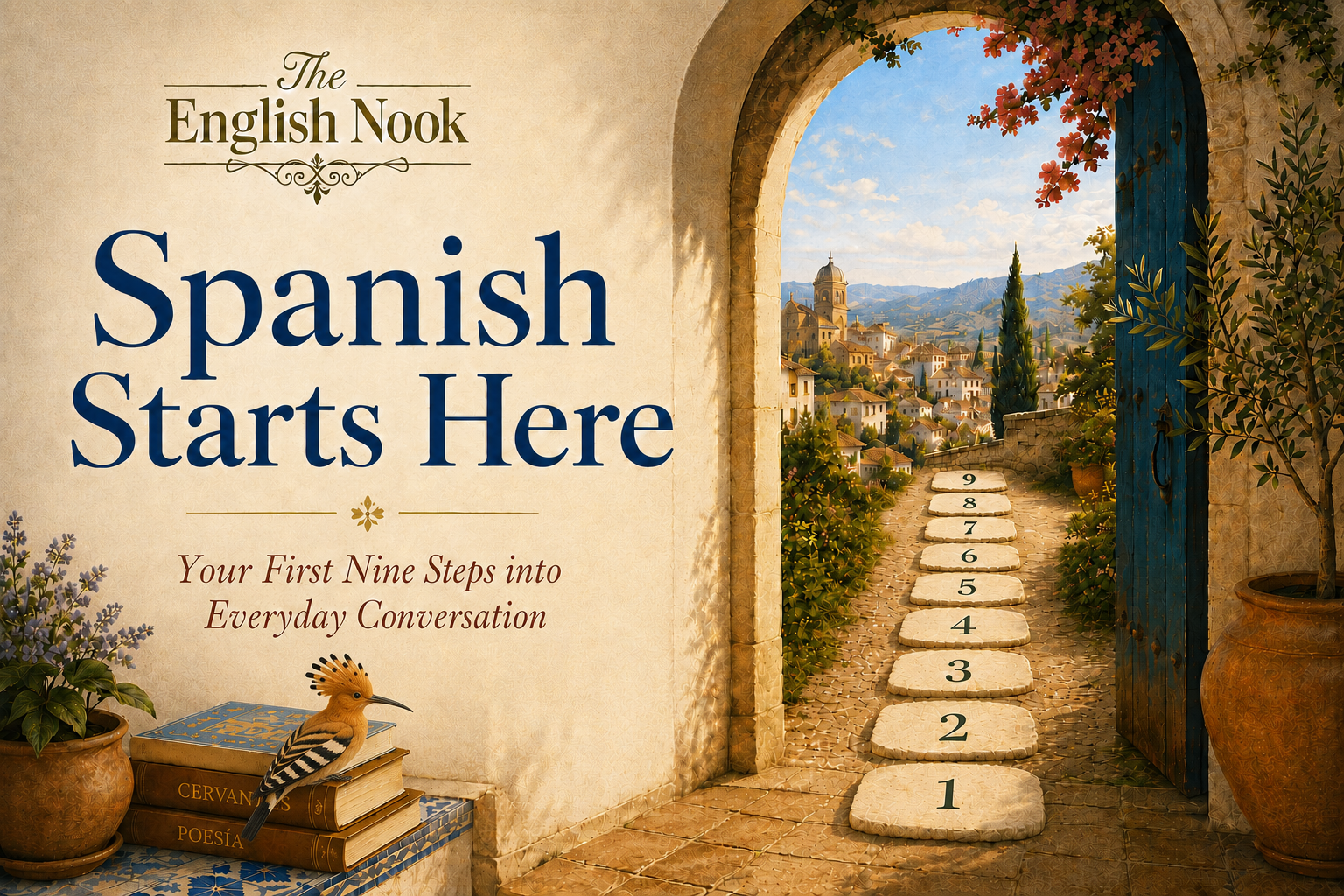

Spanish Starts Here:
Your First Nine Steps into Everyday Conversation
A guided beginner path from your first introduction to your first complete story
Learning a new language can feel like arriving somewhere with too many possible roads.
Should you begin with grammar? Memorise long vocabulary lists? Study every verb tense before attempting a conversation?
You do not need to do any of those things first.
You need a clear place to begin—and a path that allows each new step to grow naturally from the one before it.
This nine-part Español básico series was created to provide that path. It begins with the simplest and most useful act in any language: introducing yourself. From there, it gradually helps you speak about your daily life, the people and places around you, your experiences, your plans, your opinions, and finally, your own stories.
You do not need to complete everything at once. Begin with the first step, practise what you learn, and continue when you feel ready.
Your First Nine Steps
1. Cómo presentarte en español
→ Introducing Yourself in Spanish
Every conversation needs a beginning.
In the first step, you learn how to introduce yourself using your name, where you are from, where you live, what you do for work or study, why you are learning Spanish, and something you enjoy or find interesting.
These simple details allow you to give a clear, natural introduction and begin a real conversation in Spanish.
This is where your Spanish journey truly starts: with the ability to say, “This is who I am.”
2. Cómo hablar de tu rutina en español
→ Talking About Your Daily Routine in Spanish
Once you can introduce yourself, the next step is to describe the life you live each day.
This guide helps you organise your routine from morning to night using everyday actions, expressions of time, and words such as siempre, normalmente, a veces, and nunca.
You learn how to explain when you wake up, what you do during the day, and how you usually spend your evenings.
Your routine may seem ordinary, but it provides some of the most practical language you can learn.
3. Cómo hablar de tu trabajo y tus estudios en español
→ Talking About Your Job and Studies in Spanish
Work and education are among the most common subjects in everyday conversation.
In the third step, you learn how to explain your profession or area of study, where you work or study, what you do there, and what responsibilities you have.
The lesson also helps you speak about your professional or academic interests, ambitions, and future goals.
You are no longer only introducing yourself. You are beginning to describe an important part of how you spend your time and what you hope to achieve.
4. Cómo hablar de tu familia y describir personas en español
→ Talking About Your Family and Describing People in Spanish
The people around us are an important part of almost every personal conversation.
This step teaches you how to introduce a relative, friend, partner, or another important person in your life.
You learn how to explain who the person is, what they do, where they live, what they look like, and what their personality is like.
With these expressions, your Spanish begins to include not only your own life, but also the people who share it.
5. Cómo hablar de dónde vives en español
→ Talking About Where You Live in Spanish
Our homes, neighbourhoods, towns, and cities help shape our daily lives.
In the fifth step, you learn how to say where you live, describe what kind of place it is, and explain what your home or neighbourhood is like.
You also practise talking about nearby shops, parks, services, landmarks, and natural surroundings, as well as what you like—or do not like—about living there.
This allows you to give someone a clearer picture of your world and the place you call home.
6. Cómo hablar del pasado en español
→ Talking About the Past in Spanish
Until this point, most of the path has focused on who you are and what your life is like now. The sixth step opens the door to things that happened before.
You learn how to describe simple completed actions using common past-tense verbs and expressions such as ayer, la semana pasada, and hace unos días.
The lesson shows you how to say when something happened, explain where you went or where you were, place the main actions in a clear order, and finish with a detail or opinion.
The past allows you to move beyond description and begin sharing experiences.
7. Cómo hablar del futuro en español
→ Talking About the Future in Spanish
After learning to speak about the past, you can begin looking forward.
This guide introduces the useful beginner structure ir a + infinitive, allowing you to talk about what you are going to do tomorrow, next weekend, or later in life.
You also learn how to express plans, intentions, hopes, goals, expectations, and simple predictions.
Spanish now becomes a language not only for describing your life, but also for imagining and shaping what comes next.
8. Cómo dar tu opinión en español
→ Giving Your Opinion in Spanish
Conversation becomes more meaningful when you can express what you think.
In the eighth step, you learn how to introduce an opinion, give a reason, add an example, and make your ideas clearer with simple connectors.
You also practise expressing preferences, agreeing or disagreeing politely, softening a different point of view, and asking another person what they think.
You no longer need to limit yourself to facts. You can begin contributing your own perspective to a conversation.
9. Cómo contar una historia en español
The ninth and final step brings everything together.
Talking about the past allows you to describe events. Telling a story goes further: you connect those events and show why they were interesting, funny, surprising, difficult, or important.
You learn how to establish when and where something happened, introduce the people involved, organise the actions, present a main event or problem, and explain how everything ended.
Your first story does not need to be long or complicated. A clear beginning, a few connected events, and a simple ending are enough.
When you can tell a story, however simple, you are doing something important: you are using Spanish to turn experience into meaning.
How to Follow the Path
The nine steps are arranged in order, and beginners will benefit from starting with the first one. However, this is not a rigid course or a race.
Move at a pace that allows the language to stay with you.
Read each guide carefully. Say the examples aloud. Replace the information in the model sentences with details from your own life. Return to earlier steps whenever you need them.
Most importantly, use what you learn.
After reading the first article, introduce yourself. After the second, describe your real routine. When you reach the final step, tell a story that genuinely happened to you.
Personal language is easier to remember because it already belongs to your world.
A Beginning, Not an Ending
Completing these nine steps will not teach you everything about Spanish—and it is not supposed to.
They provide something more immediately valuable: a foundation.
By the end of the path, you will have practised speaking about:
- who you are
- what you do each day
- your work or studies
- your family and other important people
- where you live
- past actions and experiences
- future plans, hopes, and expectations
- your opinions and preferences
- complete events and stories
From here, you can continue exploring Spanish grammar, vocabulary, readings, fables, cultural notes, and more advanced conversations throughout The English Nook.
These nine steps are not the whole journey.
They are the doorway.
You do not need to know everything before you begin. You only need your first sentence.
Spanish starts here.
Your Spanish Path
Return to any step whenever you need it:
- → Introducing Yourself in Spanish
- → Talking About Your Daily Routine in Spanish
- → Talking About Your Job and Studies in Spanish
- → Talking About Your Family and Describing People in Spanish
- → Talking About Where You Live in Spanish
- → Talking About the Past in Spanish
- → Talking About the Future in Spanish
- → Giving Your Opinion in Spanish
- → Telling a Story in Spanish
Continue Exploring
→ Return to The English Nook
Step back into the wider world of words, stories, history, and language.
→ Read Stories in Spanish
Practise through short stories and language that lives beyond the lesson.
→ Explore Spanish Fables
Meet memorable characters, simple narratives, and lasting truths in Spanish.