Retrieved Field Log No. 4
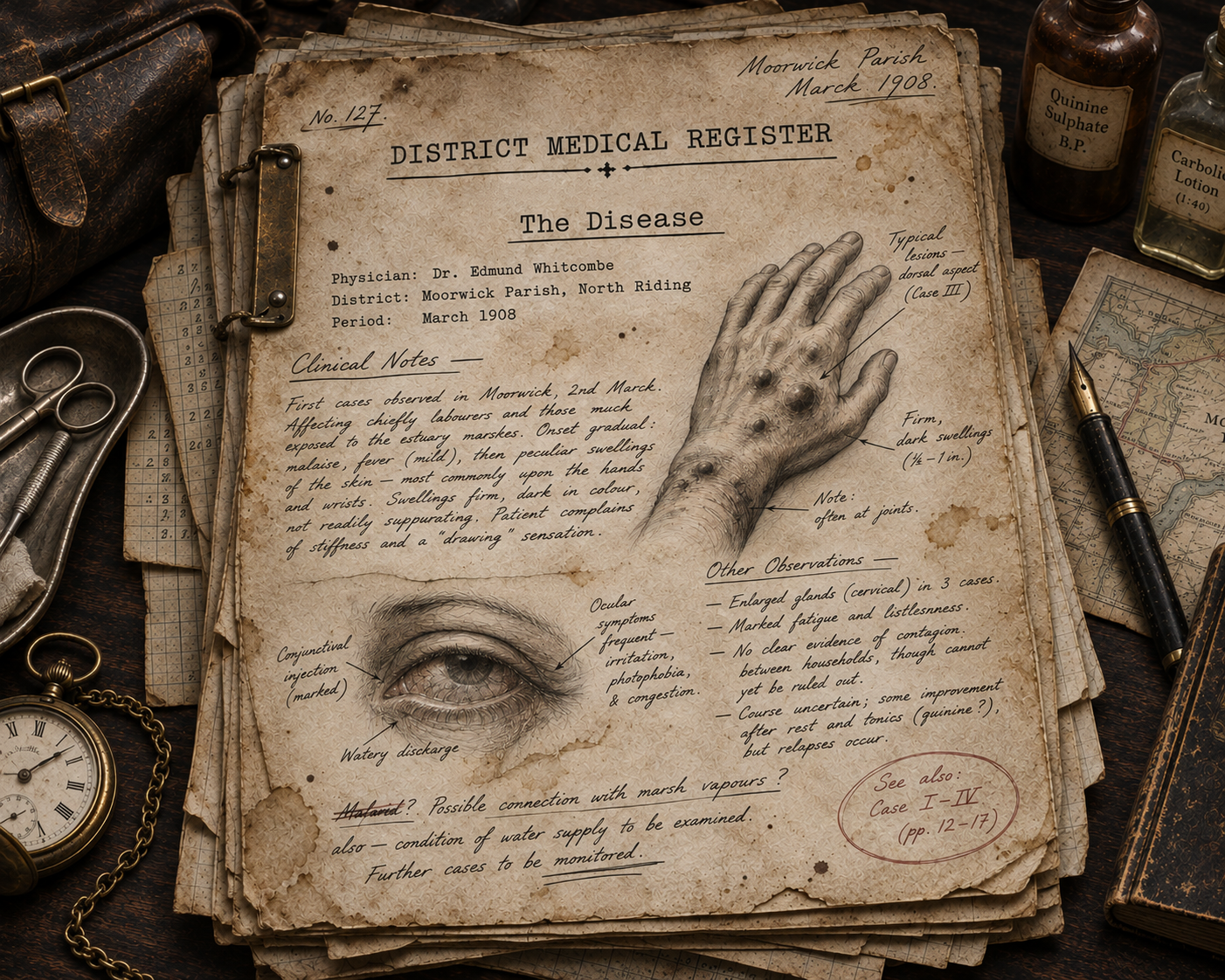
The Disease
DISTRICT MEDICAL REGISTER
Attending Physician: Dr. Edmund Whitcombe
District: Moorwick Parish, North Riding
Period: March 1908
Purpose: Record of unexplained neurological and cutaneous complaints
4 March
Called to the mill cottages shortly after sunrise. Jonah Rusk, twenty-six, complains of fever, restlessness and painful contractions in the throat. Temperature 38.6°C; pulse 104. He remains lucid and answers questions without hesitation.
When offered water, he reached for it eagerly, but his first attempt to swallow produced a severe spasm. He drank several mouthfuls after it passed.
No injury apparent. His mother reports that the condition began with headache two days ago. I have advised bed rest and observation. There is no reason presently to disturb the rest of the household.
5 March
Rusk’s fever increased overnight. The spasms persist, although he still requests water. There is no aversion to its sight or sound, and a draught from the window caused no reaction.
I questioned him regarding bites and scratches from animals. He remembers none. His mother knows of no recent exposure. This weakens the explanation suggested by the nervous symptoms, though it does not wholly exclude an older injury.
He asked whether the illness was contagious. I told him that I had not established its cause. He found this reassuring. I did not intend it as reassurance.
6 March
Miss Ada Pell, district nurse, reports that Rusk slept little but remains entirely rational.
A second patient attended this afternoon: Miss Beatrice Sorrell, thirty-eight, schoolmistress. Fever, headache and sudden tightening of the muscles beneath the jaw. She has not visited the mill cottages, and their water supplies are separate.
I have advised temporary isolation. It is possible that the two illnesses are unrelated, although the similarity warrants caution.
Miss Sorrell asked if the school must close. I said there was insufficient evidence to justify that measure. She accepted this and returned home with instructions to report any change.
7 March
Rusk’s temperature has fallen to 38.0°C. He asked for bread and walked to the window without assistance. His mother reports no difficulty speaking and less agitation.
During examination I noticed a small black swelling beneath the skin of his left wrist, approximately the size of a pea. No tenderness, heat or redness. The surface is intact. He says it appeared overnight.
I have recorded it separately from the throat symptoms. A connection is not yet established.
I asked him not to press or scratch it. He replied that he had hardly noticed its presence.
8 March
Two additional swellings on Rusk, one below the collarbone and one on the forearm. Both are small, dark and painless. The first has not enlarged.
Miss Sorrell now bears an identical swelling near the base of her neck. She reports that her throat is improving.
I considered plague. These marks are neither the painful enlarged glands nor the inflamed lesions I would expect. Their positions also argue against that diagnosis. There are no reports of unusual sickness among the parish animals.
I have requested advice from the county medical officer and enclosed a drawing of the marks.
9 March
Miss Sorrell swallowed tea without difficulty this morning, then experienced a severe contraction upon attempting a second cup. She apologised for the inconsistency, as though it were voluntary.
Rusk has four swellings. None measures more than eight millimetres across. The older marks remain unchanged. They are not gathering together or breaking down.
Miss Pell asked whether we should tell the parish that plague was suspected. I said there was insufficient evidence.
This is correct. I could provide no alternative diagnosis, and for that reason I have omitted any name for the illness from the public notices.
11 March
Samuel Brice, a cooper, presented with two painless black swellings. He has no fever, difficulty swallowing or nervous disturbance. He lives at the far end of the parish and knows neither patient.
Rusk’s fever has resolved. His appetite is normal. Miss Sorrell is similarly improved, though another mark has appeared beneath her shoulder.
I should regard their recovery as encouraging. Instead, I have spent much of the day counting swellings.
There may be two conditions, one mild and cutaneous, the other febrile and neurological. That would be preferable to assuming a common cause without sufficient grounds.
12 March
While examining Rusk’s wrist, I noticed a slight movement beneath the first mark. I assumed an artery lay near its base.
His radial pulse was 76. The movement appeared much slower. I placed a fingertip over the swelling and felt a faint pressure, then another after several seconds.
No corresponding arterial movement could be detected in the surrounding skin. I have encountered muscular twitches beneath apparently normal skin, though not of precisely this character.
I have made no interpretation of this observation. It is a movement, not necessarily a pulsation.
14 March
At 16:12 I placed Rusk and Miss Sorrell in adjoining rooms. Their visible swellings rose and subsided at the same moments. Their wrist pulses did not coincide.
I repeated the observations after allowing the patients to rest. The correspondence persisted for eleven minutes, interrupted by irregular pauses.
I requested that Miss Pell check the surgery clock against the church clock. An error of timing is a more reasonable explanation than the alternative presently suggested by our notes.
Neither patient was informed of what we were comparing. Both spoke freely during the examination, without apparent discomfort.
15 March
Both clocks are accurate to within a few seconds. I borrowed a third watch.
During morning examinations the marks on Rusk, Miss Sorrell and Brice moved at intervals averaging five seconds. There were occasional longer pauses. These pauses occurred in all three patients simultaneously.
They were examined separately. The patients could not see one another. I checked each time against the watch without informing Miss Pell of my results.
I have written the measurements exactly as observed. This should not be confused with endorsing any explanation of them.
Miss Pell has asked that we repeat the experiment with a greater number of patients.
17 March
Rusk now has eight swellings. Miss Sorrell has four. Brice has four. The earlier marks remain the same size.
None has a temperature above normal. All eat and converse without difficulty. In each patient the number of marks has doubled between examinations, although our intervals may account for the apparent pattern.
If the fever, throat contractions and swellings belong to one illness, its course is unlike either disease first considered.
The county officer requests a specimen. The patients have declined an incision. I cannot justify one without clinical necessity.
I have instructed Miss Pell to keep the records of each patient separate.
18 March
Miss Pell examined twelve people from the mill cottages. Three have small black marks. None has been ill; two were unaware of their presence.
One girl, aged eleven, has a swelling beside her ankle. She ran to fetch her father without discomfort. I examined her breathing, eyes and throat. Nothing abnormal.
I instructed the affected households to remain indoors pending further advice. They objected, reasonably, that no one could explain why.
I have avoided the word quarantine when speaking to them. In this register I see no reason to avoid it.
I do not know how long such a restriction can be maintained.
19 March
Rusk collapsed while rising from bed. He was conscious when I reached him, but the throat spasms had returned. Temperature normal. Breathing rapid and shallow.
He died at 09:06. I found no pulse or respiration after repeated examination. Miss Pell witnessed this.
While closing his sleeve I saw the swelling upon his wrist move. I uncovered it. It moved again.
Muscular contractions sometimes persist after death. I have seen them before. I am aware that the other movements are not satisfactorily explained by this fact.
I did not remain to observe a third movement.
His mother was informed shortly afterwards.
21 March
Twenty-three persons examined. Nine bear swellings. Only two of those nine have experienced fever or difficulty swallowing.
Several say the marks appeared more than a week ago. The first case may therefore not have been Rusk. I cannot determine whether the nervous symptoms precede the marks, follow them, or never occur.
The councillors have closed the north and east roads. I did not request this measure. They have stationed watchmen at the parish boundaries and speak of stopping the illness from escaping.
They have asked how long the restriction must remain in force. I have not been able to answer.
22 March
The watchman employed on the east road requested an examination. Two swellings: one below the ear, another near the wrist. He reports no illness.
He worked beyond the parish boundary throughout the previous fortnight and returned yesterday to take his post. One mark had troubled him while shaving three mornings ago.
The road was closed last evening.
I have not included this detail in the notice posted at the church. I do not know how to phrase it.
The councillors regard the watchmen as a safeguard against persons carrying the condition into the parish. I did not discuss the assumption with them.
23 March
Miss Pell compared her timed observations from the infirmary with mine from the surgery across the courtyard. Neither of us had been able to see the other’s watch.
At 14:17 both records show a pause of eleven seconds followed by three movements at shorter intervals. Other irregularities also coincide.
The watches differ by less than two seconds. The movements cannot be explained by the patients’ heart rates.
Miss Pell asked what this means. I said that further observations were required.
She did not ask again. She copied the figures into the main register and left the final column unfilled.
25 March
Miss Pell showed me a black point beneath the skin of her forearm. It is small enough to conceal beneath her cuff. She has had no fever or throat symptoms.
She asked whether she ought to leave the infirmary.
I told her there was no reason to anticipate danger from a single mark. The evidence does not support that assurance. I knew this when I gave it.
She wore her sleeves down for the remainder of the day.
She has continued to attend patients without complaint. I cannot decide whether this is courage, professional habit, or simple disbelief.
26 March
A letter from the apothecary at Lower Brae, twelve miles beyond the east road, describes several customers with painless black swellings. One has suffered spasms of the throat.
He suspects contaminated food and asks whether I have seen anything similar. He has not visited Moorwick. I know of no contact between his patients and ours.
I drafted a reply recommending observation and examination of the water supply.
It is insufficient. I cannot improve it without writing something I am not prepared to put into a letter.
The road has been closed for five days. The first marks in Lower Brae were noticed before that.
27 March
The councillors asked whether the road restrictions should continue. The watchmen require relief; families need coal, flour and medicines. I have re-examined every known journey between the parish and Lower Brae.
No sequence of travel adequately explains the dates. A chain of exposure may exist without our knowing it, but the available evidence does not establish one.
I told the councillors that the restrictions were unlikely to offer the protection expected. They took this to mean the danger had passed.
I did not correct them.
It has become difficult to make a statement without considering what my listeners will prefer to understand.
28 March
At breakfast I found a dark swelling beneath the strap of my watch. I removed the watch, thinking it had caused a bruise. The mark remained.
Temperature normal. Pulse 68. No difficulty swallowing.
At 11:02 I placed my finger upon the swelling while Miss Pell recorded a patient’s movements in another room. I made no signal to her.
Our times correspond.
I have entered my findings among the general observations without a patient’s name. This is an irregularity in the record. I shall correct it when the county officer arrives.
I have worn my watch upon the other wrist today.
29 March
The councillors have reopened the roads on my advice. They took this to mean that the danger had passed. I did not correct them.
The county officer has telegraphed that he cannot visit. Similar reports have reached him from three other districts. He asks for a diagnosis that may be circulated to practitioners.
Rabies does not account for the skin changes or recovery of the initial symptoms. Plague does not account for the position of the swellings or the course of illness. Two unrelated conditions cannot account for their movements.
I have sent no diagnosis.
The telegram remains beneath the blotter on my desk.
31 March
The county office has sent a printed return. It asks for the number examined, the number exhibiting symptoms, the number of deaths, the suspected source and the probable extent of the outbreak.
I have filled the first three spaces. The fourth remains blank. In the fifth I have written “not established”.
Miss Pell examined my wrist while I completed it. The first mark has not enlarged. There are now two more above the elbow. She did not mention them.
At 16:17 their movement paused. I looked at her. She was watching the clock.
A narrow copper-coloured crescent caught the light at the edge of her iris. I took it for a reflection from the brass clock case. When she turned towards me, it remained.
I cannot recall having noticed it before.
I did not examine her other eye.
I shall send the return in the morning.
Retrieved for the Shelves.