
When the Shape of a Poem Becomes Meaning
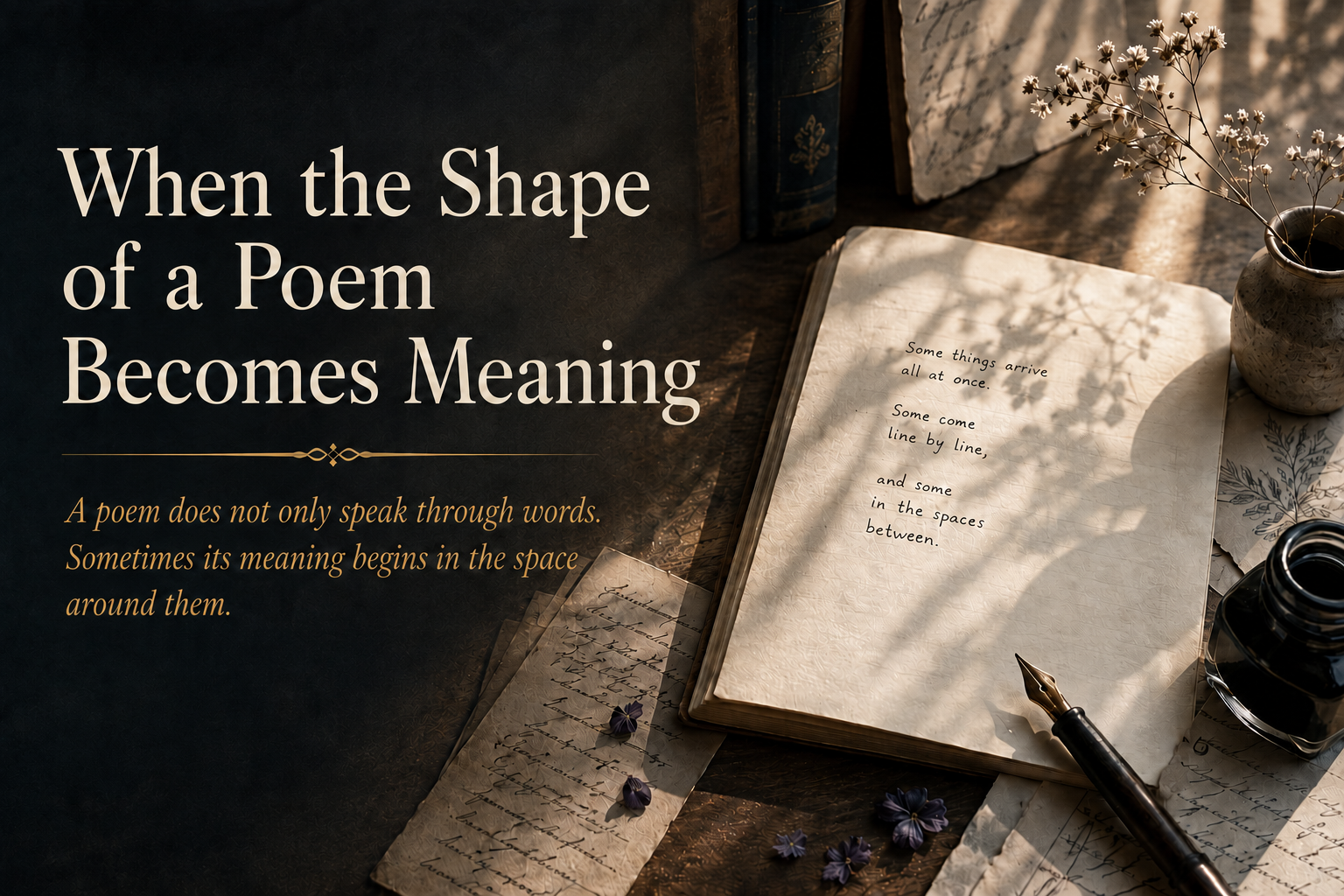
A poem does not only speak through words. Sometimes its meaning begins in the space around them.
A poem is rarely just a paragraph broken into shorter lines. Its shape matters.
Before we understand a metaphor or trace a theme, we have already seen something: a narrow column of words, balanced stanzas, a sudden isolated line, a broken fragment, perhaps even a page interrupted by silence. The poem has already begun to communicate.
In prose, the sentence usually governs movement. In poetry, the line can become a second kind of grammar. It can delay completion, isolate an image, create expectation, or force the reader to move differently through a thought.
The shape of the poem is therefore not merely the container of meaning. Sometimes it becomes part of the meaning itself.
The Line as Pressure
A poetic line creates emphasis simply by ending.
Compare:
She waited beside the door because she knew he would not return.
with:
She waited beside the door
because she knew
he would not return.
The vocabulary is almost , but the experience is not. The second version delays the final thought and gives he would not return greater weight.
This is one of poetry’s simplest powers: placement can change emphasis without changing language.
A sentence may finish neatly at the end of a line, or it may continue beyond it through enjambment. When that happens, the eye reaches a boundary while the thought remains unfinished. The reader is pulled forward.
The line therefore does more than organise words. It influences how those words arrive.
The Stanza as a Room
If the line controls movement moment by moment, the stanza can organise larger movements of thought.
A stanza may contain an image, a memory, an argument, or a particular emotional position. Moving into the next stanza can feel like entering another room.
A poem may leave childhood in one stanza and return decades later in the next. It may move from observation to confession, from certainty to doubt, or from one voice to another.
The blank space between those stanzas then becomes meaningful. Time may pass there. Perspective may change. A thought may be abandoned.
White space is not always emptiness.
It can be distance made visible.
Repetition Changes What Returns
Some poems build their shape through recurrence. A phrase returns, a line repeats, or an image appears again several stanzas later.
Yet repeated language rarely remains identical in meaning because its surroundings have changed.
Imagine the line:
I will remember.
Near the beginning of a poem, it might sound like a promise. After a loss, it might become an act of resistance. At the end, it might sound uncertain.
The words remain the same.
The poem around them does not.
Repetition can therefore show how we return to the same language carrying different experiences with us.
When Structure Breaks
Once a poem establishes a visible pattern, the reader begins to expect it.
Stanzas may remain the same length. A repeated phrase may appear at regular intervals. The page may feel balanced and controlled.
Then something changes.
One stanza becomes shorter. A recurring line disappears. A final phrase stands alone.
The shift matters because the poem first taught us what to expect.
Structure therefore creates meaning not only through repetition, but through departure. A break may suggest instability, hesitation, revelation, grief, resistance, or release.
The important question is not whether the poem follows a traditional form. It is whether the arrangement creates an expectation—and what happens when that expectation changes.
Free Verse Still Has Shape
Free verse is sometimes mistaken for poetry without form.
It is not.
It simply does not begin with a predetermined structure.
Where does the line end? How long is the stanza? Why does one phrase stand alone? Why is there a gap here?
These decisions still shape the reading.
A line may lengthen because a thought expands. Another may collapse into a single word. A stanza may fragment because the speaker’s certainty has fragmented.
Form is still present. It has simply been created from inside the poem rather than inherited beforehand.
White Space Can Speak
Poetry is one of the few literary forms in which absence can be physically placed on the page. A gap can interrupt speech, an isolated line can feel exposed, and a single word surrounded by white space can acquire unusual weight.
Fragments may suggest thought breaking apart. Indentation can create hesitation or echo. Silence can be designed.
The poet may leave room where explanation could have been, and the reader must then inhabit that space. This is partly why poetry can feel more demanding than prose: it asks us to notice not only what has been written, but sometimes what the poem has chosen not to fill.
We See the Poem Before We Finish It
There is another unusual quality to poetic form: we read a poem word by word, yet we can often see much of its structure before we have finished.
The eye may notice that the final stanza is shorter than the others, glimpse a repeated phrase waiting further down the page, or see that the poem narrows toward its ending.
Poetry therefore exists in time and space at once. We experience it as progression, but we also perceive it as visual structure.
That visual awareness can begin shaping expectation before we consciously interpret anything.
The Shape Is Not Decoration
Not every line break hides a secret, and not every gap requires elaborate interpretation.
The more useful question is not:
What does this shape symbolise?
It is:
What does this arrangement make me do?
Does it slow the reading down? Push it forward? Make us wait? Separate two ideas that would normally sit together? Leave a thought suspended? Make the final line feel unusually exposed?
Questions like these keep form connected to experience rather than turning poetry into a puzzle.
A poem’s shape does not need to contain a hidden message. It only needs to alter the way its words are encountered.
The words may tell us what happened.
The voice may tell us who is speaking.
But sometimes the page itself helps tell us how it felt.
Continue Exploring
→ The Measure of a Line
How stress, rhythm, and variation give movement and pressure to a poetic line.
→ The Space Between Words
Meaning can live not only in language, but in pauses, placement, and what is deliberately left open.
→ Why Metaphor Is Not Decoration
A look at how poetic devices become structures of thought rather than mere ornament.
Related Words
From History Nook
Birth of John Hollander (1929–2013) — The Architect of Form and Sound in Modern English Poetry
Hollander explored how poetic structure, pattern, and sound can become active parts of meaning.