
Poetry Does Not Stay Put
It begins in breath, crosses languages, changes shape—and sometimes leaves the poem entirely.
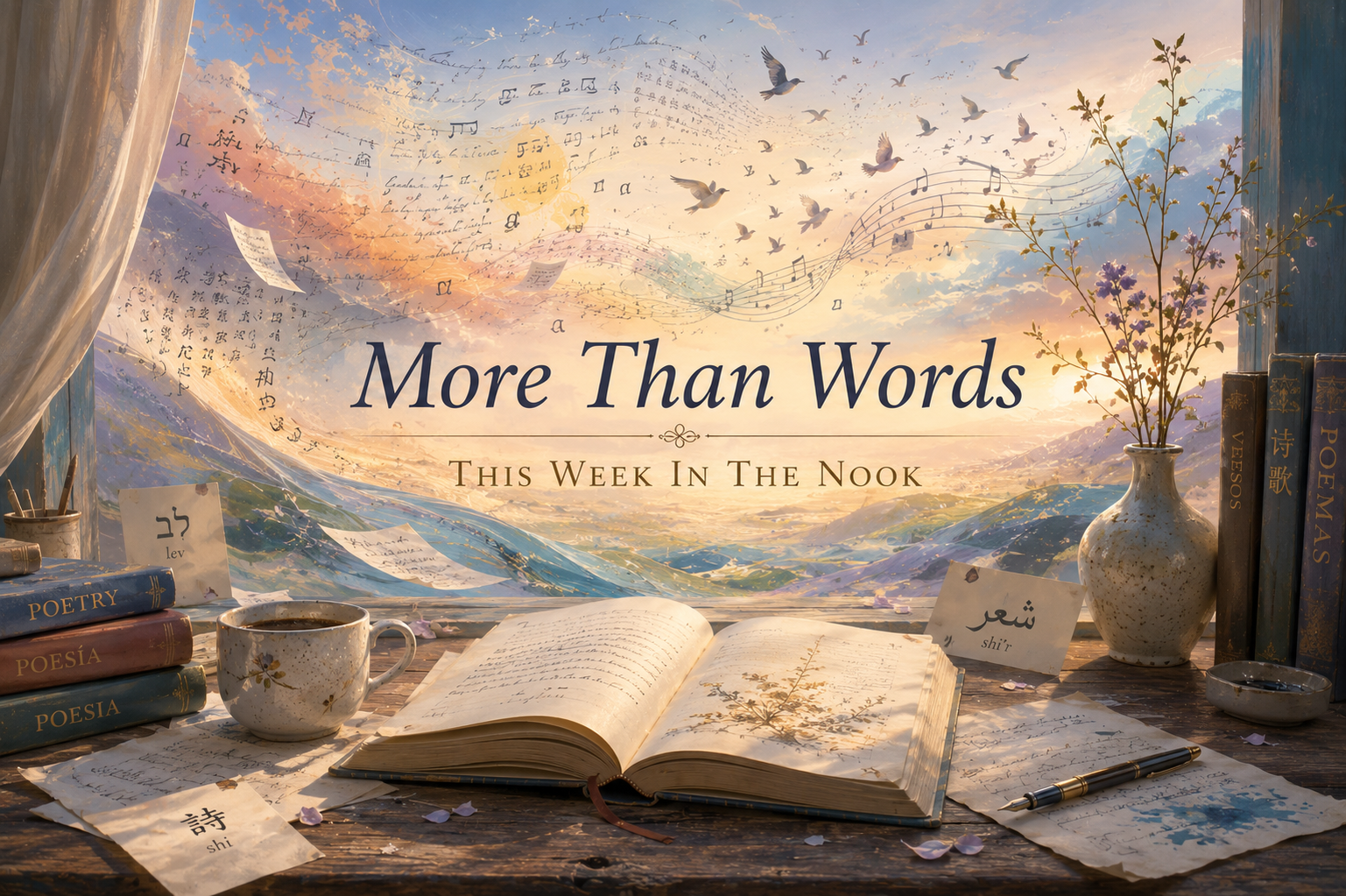
This week, poetry has been returning to something older than the page.
Before Poetry Was Read, It Was Heard followed it back to voice, memory, rhythm, and repetition. When Sound Carries Meaning moved closer still, toward the moment when stress, cadence, silence, and breath begin carrying meaning before explanation does.
Poetry may live beautifully on the page.
But it did not begin there.
And the archive suggests that it has never been particularly interested in staying there either.
🐦⬛ Fetched from the Chronicle
The Portal has followed poetry through many forms before—not only through English verse, but through Spanish, translation, vocabulary, story, and the spaces where languages begin speaking to one another.
Taken together, those older paths suggest something simple:
Poetry survives because it moves.
When Poetry Changes Shape
▸ The Main Types of Poetry in the English Literary Tradition
Published exactly one year ago today, this path moves from epic and ballad through sonnet, Romantic ode, modernist fragmentation, and contemporary verse.
The forms change because the worlds around them change.
Poetry remains recognisable partly because it never insists on remaining the same thing.
▸ El Lugar Donde Aún Te Esperaba
This is not a poem at all.
Yet waiting, repetition, silence, memory, and seasonal movement give the story a distinctly poetic architecture.
Sometimes poetry changes form so completely that it stops announcing itself.
When Poetry Crosses Languages
▸ Spanish Poetry: A Journey Through Emotion and Artistry
From medieval jarchas and romances to Bécquer, Darío, Machado, Lorca, and beyond, Spanish poetry carries different histories and rhythms while returning to recognisable human pressures: love, grief, memory, identity, rebellion.
Different language.
The same old need to make words carry more.
▸ Untranslatable Words: Concepts That Defy Translation
Some words cross easily. Others carry so much of their original culture that another language can explain them without ever quite replacing them.
Poetry faces the same difficulty. Meaning may travel while rhythm shifts; an image may survive while an association disappears.
Crossing a language is not copying a poem. It is deciding what must survive the journey.
When Languages Meet Inside the Poem
▸ Vocabulario de Poesía en Inglés
Stanza / estrofa. Rhyme / rima. Line break / corte de verso.
What first appears to be a vocabulary lesson becomes something more interesting from the Portal: two languages standing beside the same poem, finding their own ways to name what happens there.
▸ Poetry Vocabulary — Where Tension Begins to Speak
Here English, Spanish, and Portuguese move around tension, restraint, rupture, cadence, silence, and compression.
The vocabulary changes.
The pressure beneath it remains remarkably familiar.
🌾 Word Nook
Continue into Word Nook with Cadence, Resonance, and Hush—movement in the voice, what continues after the sound, and the silence that can carry as much as speech.
Three words for three places poetry has always lived:
in sound, in echo, and in what is withheld.
📚 History Nook
▸ Federico García Lorca — Enriching English Poetry Through Translation and Literary Innovation
Lorca’s imagery, folklore, musicality, and symbolism crossed into English through translation, inevitably changing in transit while opening new possibilities in the receiving language.
Translation did not merely carry the poetry. It gave the poetry another life.
▸ Rabindranath Tagore — When a Bengali Voice Entered English Literature
Tagore carried his Bengali poetic world into English, revealing both what translation could preserve and what it could transform.
One reached English from Spanish through translation.
The other carried Bengali into English himself.
Both remind us that poetry can acquire another life without surrendering the one it came from.
Where Poetry Goes
The page gave poetry somewhere extraordinary to stay.
But it was never a cage.
Poetry has lived in voices and books, in English and Spanish and countless languages beyond them. It has crossed through translation, performance, memory, vocabulary—and sometimes into stories that never call themselves poems at all.
Perhaps that is why we keep finding it.
Poetry does not stay put.
It moves whenever language discovers that saying something plainly is no longer enough.
Until the next path opens,
listen for where poetry goes next.