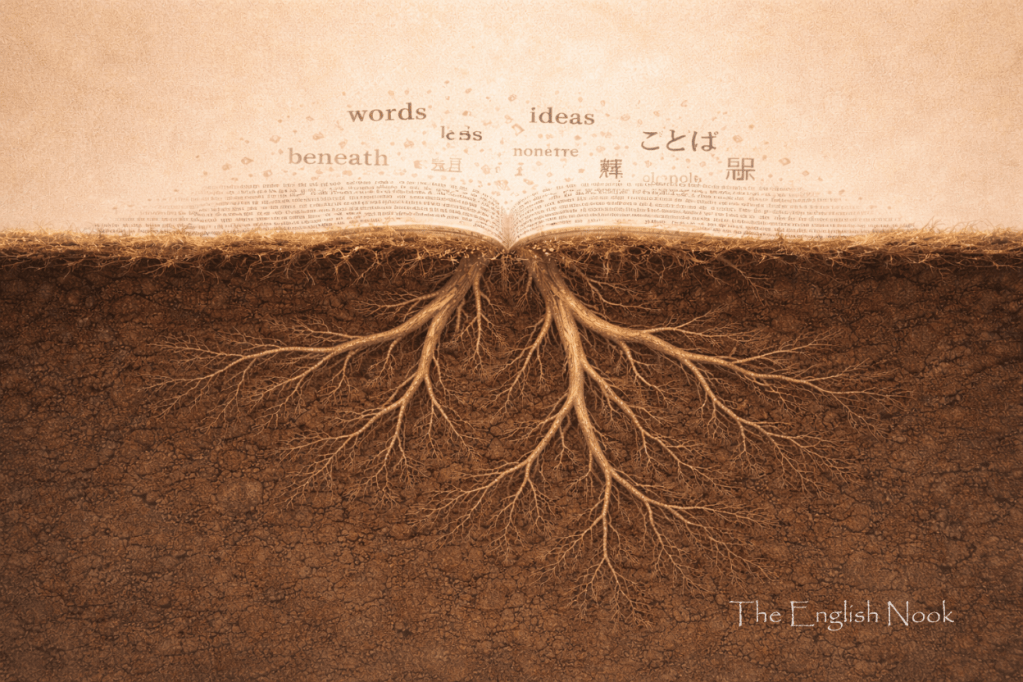
The Language Beneath Language
We often think of metaphor as a literary trick.
Something poets use to make language more colorful. A flourish added to otherwise ordinary speech — like decoration on a plain surface.
But metaphor is not decoration.
It is structure.
Long before we study literature, we already rely on metaphors to think. They help us grasp ideas that would otherwise remain abstract. Without them, much of our everyday language would collapse into vague explanation.
Consider how often we talk about time.
We spend time.
We save time.
We waste time.
We say a deadline is approaching, or that a difficult week lies ahead.
None of this is literal. Time is not money, nor is it a road. Yet these metaphors allow us to understand something invisible by comparing it to something familiar.
They give shape to what cannot be touched.
Metaphor does not merely embellish thought; it organizes it.
When we describe an argument as something we defend, attack, or win, we are thinking of disagreement as if it were a kind of battle. When we speak of ideas as things that grow, take root, or bear fruit, we are quietly borrowing the language of nature.
These patterns are not accidents.
They reveal how the mind builds bridges between the known and the unknown.
Poets are simply more aware of these bridges. They stretch them further, sometimes to surprising places. But the basic impulse — to understand one thing through another — belongs to everyone who uses language.
Even the simplest expressions carry hidden metaphors.
We say someone has a bright idea.
We say a memory fades.
We say a story falls flat.
Light, color, movement, weight — physical experiences become tools for describing mental ones.
Over time, these metaphors become so familiar that we stop noticing them. They blend into the language the way old paths disappear into a landscape that people walk every day.
But they are still there, quietly shaping how we interpret the world.
Without metaphor, language would struggle to move beyond what can be directly observed. Abstract ideas — love, freedom, identity, memory — would become difficult to describe without constantly retreating into explanation.
Metaphor offers another way.
It lets us say something indirectly, yet with precision.
A well-chosen metaphor does not merely decorate a sentence. It reveals a relationship between things that might otherwise remain distant. It allows meaning to arrive all at once, rather than step by step.
Perhaps that is why metaphors feel so natural. They mirror the way thought itself often moves — not in straight lines, but in associations.
One idea reaches toward another.
And in that moment of connection, language becomes more than description.
It becomes understanding.
Language explains.
Metaphor reveals.
What has language helped you see differently?
→ Continue wandering
→ Read a story
→ Explore English/Spanish sessions





 The English Nook
Leave a comment