The Apocalypse Subscription Service
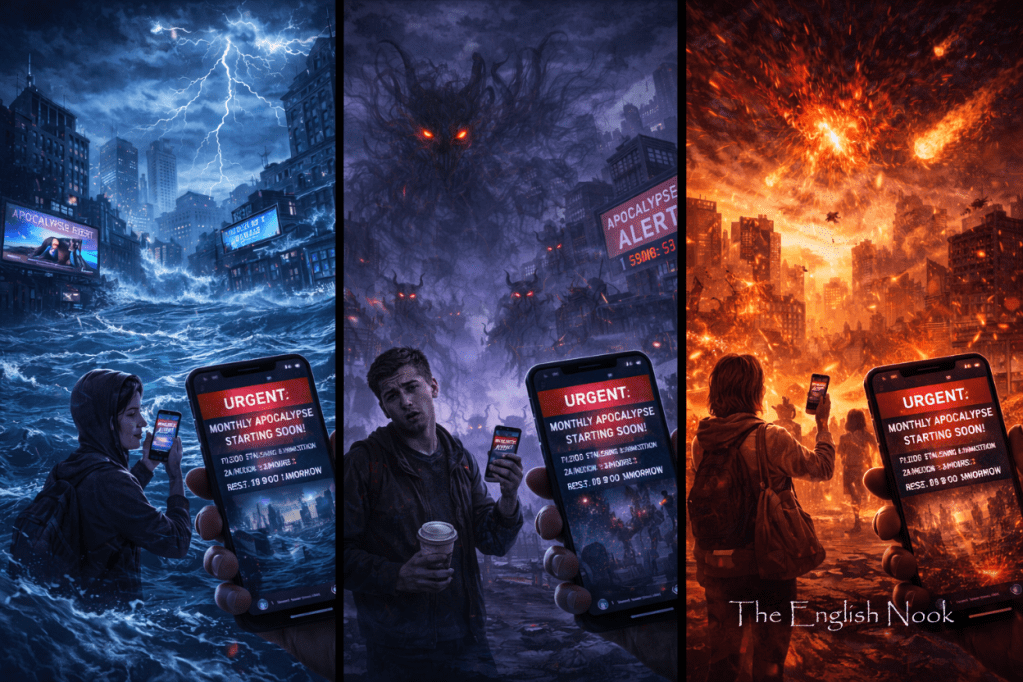
The first apocalypse arrived on a Tuesday.
At 9:03 a.m., a government alert chimed on every device in the country.
THIS IS YOUR SCHEDULED MONTHLY APOCALYPSE.
Category: Moderate Flood Event
Duration: 24 hours
Reset: 09:03 tomorrow
Thank you for participating in National Resilience.
People sighed.
Traffic adjusted.
Meetings were rescheduled.
The sky turned the color of old bruises, and water began rising from sewer grates like something exhaling.
By noon, downtown was a canal.
By evening, people were kayaking past Starbucks.
At 9:03 the next morning, the water snapped back into pipes. Streets dried in seconds. Buildings un-cracked. Casualties—if any—were statistically insignificant and ethically reimbursed.
Everything restored.
Except memory.
Memory remained.
The program had been introduced five years earlier.
The official explanation was simple:
“Exposure to controlled catastrophe builds collective strength.”
Psychologists testified.
Influencers endorsed it.
News panels debated it for six weeks and then moved on.
The subscription tiers were progressive:
Tier 1 – Environmental disasters.
Tier 2 – Supernatural incursions.
Tier 3 – Existential anomalies.
Premium neighborhoods occasionally received cosmetic upgrades: cinematic meteor showers, designer demon hordes, limited-edition sky fracturing.
The resets were flawless.
The economy adjusted.
Insurance policies evolved.
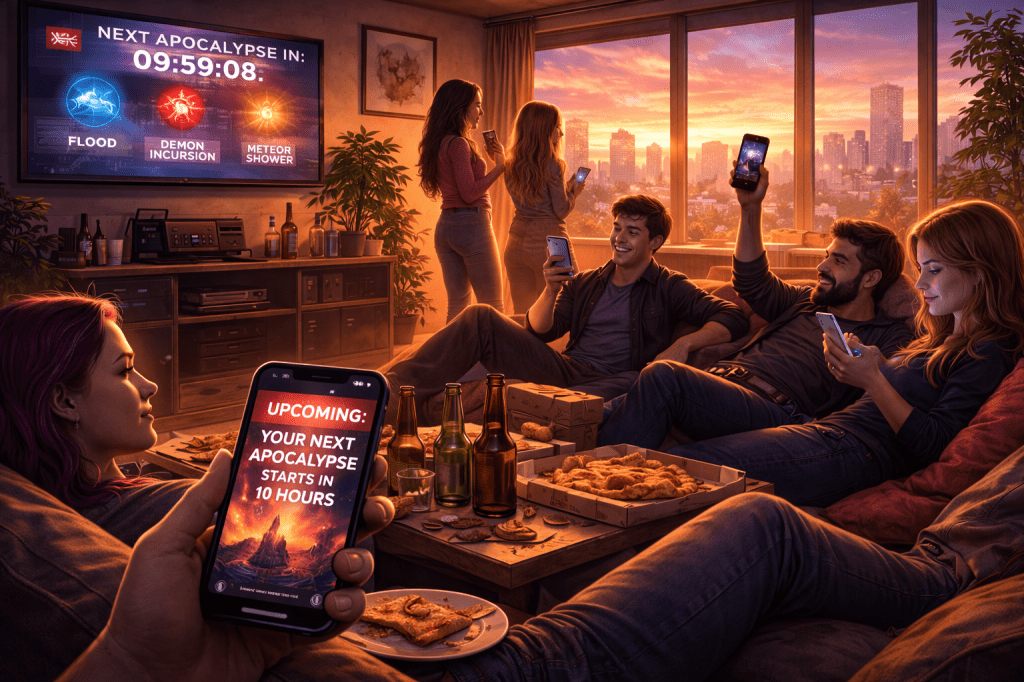
Apocalypse days became informal holidays.
“Apoc-a-latte?” cafés joked during volcanic ash events.
Children ranked disasters the way previous generations ranked theme parks.
“Sinkhole was mid.”
“Demon Swarm 4.2 was iconic.”
The government dashboard showed rising resilience metrics.
Heart rate recovery times improved.
Panic duration shortened.
Social media engagement spiked 340% during each event.
It was called “productive fear.”
Lena worked in Content Calibration for the Ministry of Stability.
Her job was to monitor public emotional saturation.
After each apocalypse, she analyzed footage.
Were screams trending?
Were jokes outpacing despair?
Was existential dread converting into brand partnerships?
Her screen displayed heat maps of hysteria.
“Desensitization is success,” her supervisor liked to say.
On her first day, Lena had asked:
“What if we succeed too much?”
He’d smiled like someone humoring a child.
“Humanity always panics. It’s renewable.”
The third-year meteor shower was particularly elegant.
Golden streaks across a violet sky.
Buildings split neatly, symmetrically.
The death toll peaked at 8.2 million before reset.
Trending hashtag: #SkyfallSelfie.
At 9:03 the next morning, skyscrapers inhaled themselves upright.
Lena reviewed the metrics.
Panic duration: 11 minutes.
Average livestream count during impact: 22 million concurrent viewers.
Tears per capita: declining.
She flagged it.
“Emotional decay threshold approaching.”
Her supervisor dismissed it.
“People adapt. That’s the point.”
Then came Time Fracture Month.
Clocks liquefied.
Days repeated irregularly.
Conversations looped with slight variation.
By hour twelve, most citizens were mildly annoyed rather than terrified.
Memes appeared:
“Time glitch but make it aesthetic.”
Lena noticed something new.
Not panic.
Not humor.
Fatigue.
A flatness in the data.
Apocalypse no longer pierced the emotional surface.
It skimmed it.
When demons breached Parliament during Month 52, viewership was lower than during a celebrity divorce scandal.
The government convened an emergency optics meeting.
“If catastrophe fails to command attention,” the Minister said, “it fails to build resilience.”
“What’s left?” someone asked.
Silence.
Then:
“Existential Erasure.”
Month 60.
The alert arrived.
THIS IS YOUR SCHEDULED MONTHLY APOCALYPSE.
Category: Total Ontological Collapse
Duration: 24 hours
Reset: 09:03 tomorrow
Participation mandatory.
The sky did not darken.
The earth did not shake.
Instead, things began… un-meaning.
Words detached from objects.
“Door” stopped referring to doors.
Faces blurred at the edges.
People forgot why they were in rooms.
Lena watched the feeds.
Confusion spread like slow ink.
There was no spectacle.
No fire.
No blood.
Just erosion.
Metrics flatlined.
No trending hashtags.
No mass hysteria.
Just quiet.
At hour eighteen, Lena felt it too.
Her name loosened.
The concept of government thinned.
Even apocalypse felt abstract.
At 8:59 a.m., the Ministry server room flickered.
Technicians prepared for reset.
They always prepared.
9:02.
9:03.
Nothing.
No snap.
No restoration.
The city remained hollow.
Buildings stayed slightly translucent.
People continued speaking sentences that no longer connected to meaning.
Technicians rebooted systems.
Error messages cascaded.
RESET FUNCTION: NOT FOUND
CAUSALITY LOOP: BROKEN
MEMORY BUFFER: OVERFLOW
The Minister demanded explanation.
Lena stared at her screen.
There was no spike in panic.
No surge in despair.
Just baseline emptiness.
After five years of curated catastrophe, the population had adapted beyond fear.
They had metabolized apocalypse.
When reality fractured permanently, it did not register as worse than before.
It felt… scheduled.
People waited for the fix.
It didn’t come.
Hours passed.
Then days.
The sky remained slightly misaligned.
Gravity inconsistent.
Language unreliable.
Still, citizens went to work.
Ordered coffee.
Scrolled feeds that no longer loaded.
Lena walked outside the Ministry building.
Half the skyline was missing.
No one screamed.
She checked her phone.
No alert.
No countdown.
No apology.
She understood then.
The reset had not failed.
Resilience had succeeded.
Humanity had been trained so thoroughly in temporary collapse that permanent collapse felt normal.
The apocalypse subscription had expired.
And no one noticed.
📅 When the end came for real, it felt right on schedule. ⏳
Note:
Thank you for reading “The Apocalypse Subscription Service”! This is a story in a series created for avid readers and English learners who want to enjoy captivating tales while practicing their language skills. Stay tuned for more stories and language tips to enhance your journey!
Explore more short stories in English and Spanish by visiting the section:
Short Stories / Cuentos Cortos
When the world feels dull, your mind restless, or your heart heavy, let a story be your escape. Just one page, one sentence, one word—and suddenly, you’re somewhere new, where imagination breathes life into the ordinary and turns the simplest moments into magic.
“Liked it? Smash that like button! 📱🔥”
 The English Nook
Leave a comment