How Love Learns to Speak
Love has never been silent. Across centuries, it has found expression in poetry, letters, sonnets, whispered vows, printed cards, and now glowing screens. What changes is not the feeling itself, but the language that carries it. Each era reshapes romantic expression according to its values, technology, and social norms.
From the formal elegance of medieval courtly love to the immediacy of heart emojis, the vocabulary of romance reveals something profound about how societies understand intimacy, devotion, and desire. Tracing this evolution allows us to see not only how language changes—but how emotional intensity is framed, stylized, restrained, or amplified across time.
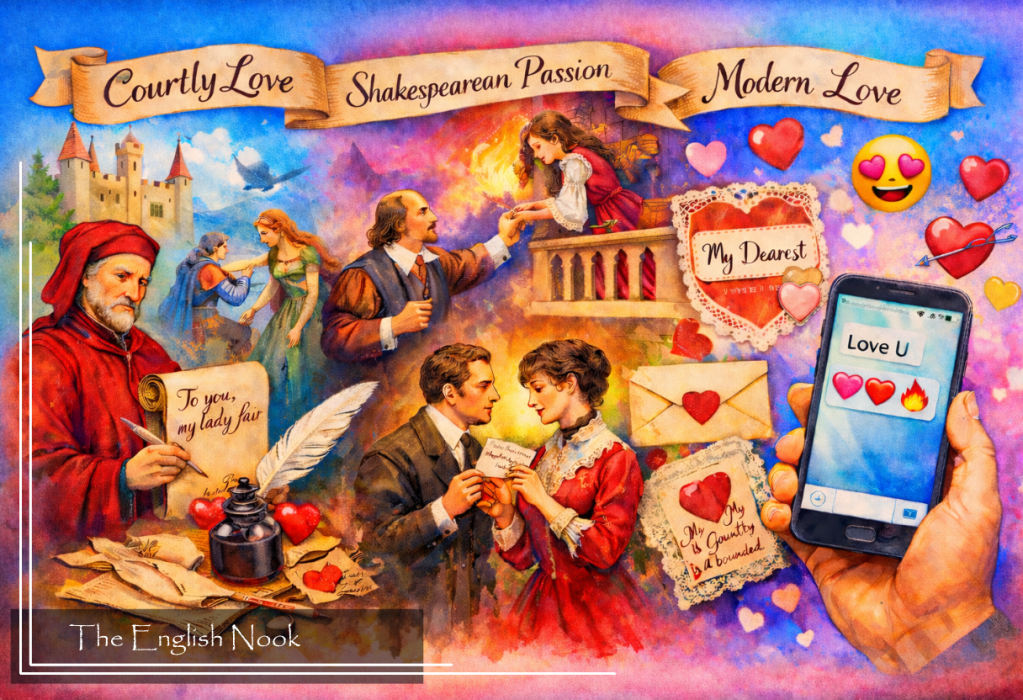
Medieval Courtly Love: Idealized and Distant
Romantic language in medieval Europe was deeply influenced by the tradition of courtly love, a highly stylized and often unattainable form of devotion. One of the earliest literary figures to connect romantic expression with what would later become associated with Valentine’s traditions was Geoffrey Chaucer.
In works like Parlement of Foules, love was presented as noble, elevated, and governed by ritual. A lover did not simply “like” someone; he served her. Devotion was expressed through elaborate metaphors, references to nature, and formal declarations of loyalty.
Language during this period was:
- Elevated and poetic
- Indirect and symbolic
- Focused on admiration rather than physical passion
- Often centered on longing rather than fulfillment
Intensity was expressed through restraint. Love was powerful precisely because it was controlled, distant, and sometimes impossible.
Shakespearean Passion: Dramatic and Doomed
By the late 16th century, romantic language became more theatrical and emotionally explosive. No figure embodies this shift more than William Shakespeare.
In Romeo and Juliet, lovers are no longer distant admirers—they are overwhelmed by emotion. Phrases like “star-crossed lovers” and declarations of eternal devotion introduced a new dramatic intensity. Love could now be urgent, impulsive, and tragic.
Shakespeare’s language amplified emotion through:
- Hyperbole (“My bounty is as boundless as the sea.”)
- Vivid imagery
- Direct declarations
- Emotional volatility
Where medieval love was disciplined and ritualistic, Shakespearean love was consuming and dangerous. The vocabulary shifted from reverent admiration to passionate urgency.
Victorian Love Letters: Structured Sentiment
The 19th century introduced yet another transformation. With increased literacy and the rise of postal services, love became something that could be physically mailed, preserved, and reread. The Victorian era valued propriety, structure, and emotional depth within moral boundaries.
Romantic language in letters often included:
- Formal salutations (“My dearest…”)
- Flowery descriptions
- Moral devotion
- Emphasis on loyalty and virtue
Intensity during this period was sincere but carefully framed. Emotion was present, but never reckless. Writers crafted their feelings deliberately, aware that their words might be kept for a lifetime.
The invention and commercialization of Valentine’s cards during this era also standardized certain romantic clichés—roses, hearts, poetic couplets—embedding them permanently into English romantic vocabulary.
The 20th Century: Simplicity and Pop Culture
As the 20th century progressed, romantic expression became more direct and conversational. Film, popular music, and advertising reshaped how love was described. Instead of ornate metaphors, people increasingly used simple but powerful statements:
- “I love you.”
- “Be mine.”
- “You complete me.”
The vocabulary of love became accessible. Emotional expression no longer required poetic training. Love moved from elite literary circles into everyday speech.
Intensity was no longer about linguistic complexity—but about authenticity and immediacy.
The Digital Age: Emojis and Instant Intimacy
Today, romantic language has undergone perhaps its most radical compression. Text messages, social media, and instant communication have transformed how affection is expressed.
A single ❤️ can replace a paragraph.
A 💘 can suggest sudden infatuation.
A 🔥 can communicate attraction instantly.
Modern romantic vocabulary is:
- Visual
- Rapid
- Minimalist
- Globally understood
The shift is not necessarily toward less emotion—but toward efficiency. Digital language prioritizes speed and shared symbolism. Emojis function as emotional shorthand, transcending linguistic barriers.
Interestingly, intensity has not disappeared—it has simply condensed. Where medieval lovers used pages of metaphor, modern lovers may send a single symbol carrying layered meaning.
Changing Forms of Intensity
Across these eras, we observe a fascinating pattern:
- Medieval love expressed intensity through restraint and devotion.
- Shakespearean love dramatized intensity through passion and tragedy.
- Victorian love structured intensity through eloquence and moral framing.
- Modern love condenses intensity into clarity and immediacy.
The emotional core remains constant. What changes is the form.
Language adapts to the tools and values of each age. As literacy expanded, love became written. As media evolved, love became performed. As technology accelerated, love became instant.
Love Endures, Language Evolves
From courtly sonnets to digital hearts, the evolution of romantic language reflects humanity’s ongoing attempt to articulate something fundamentally difficult to define. Each era reshapes love in its own image, embedding it within cultural norms, technologies, and aesthetic preferences.
Yet despite these transformations, one truth remains: love demands expression. Whether through Chaucer’s allegories, Shakespeare’s soaring metaphors, Victorian ink on parchment, or a glowing emoji on a screen, people continue to seek words—or symbols—that can hold the weight of feeling.
The evolution of romantic language is not a story of decline from poetry to pixels. It is a story of adaptation. Love does not weaken as language simplifies; it learns new forms.
From courtly vows to emojis, the heart still speaks. It just changes its vocabulary.
If you’ve read everything, please consider leaving a like, sharing, commenting, or all three!
YOU WILL ALSO LIKE READING:



 The English Nook
Leave a comment